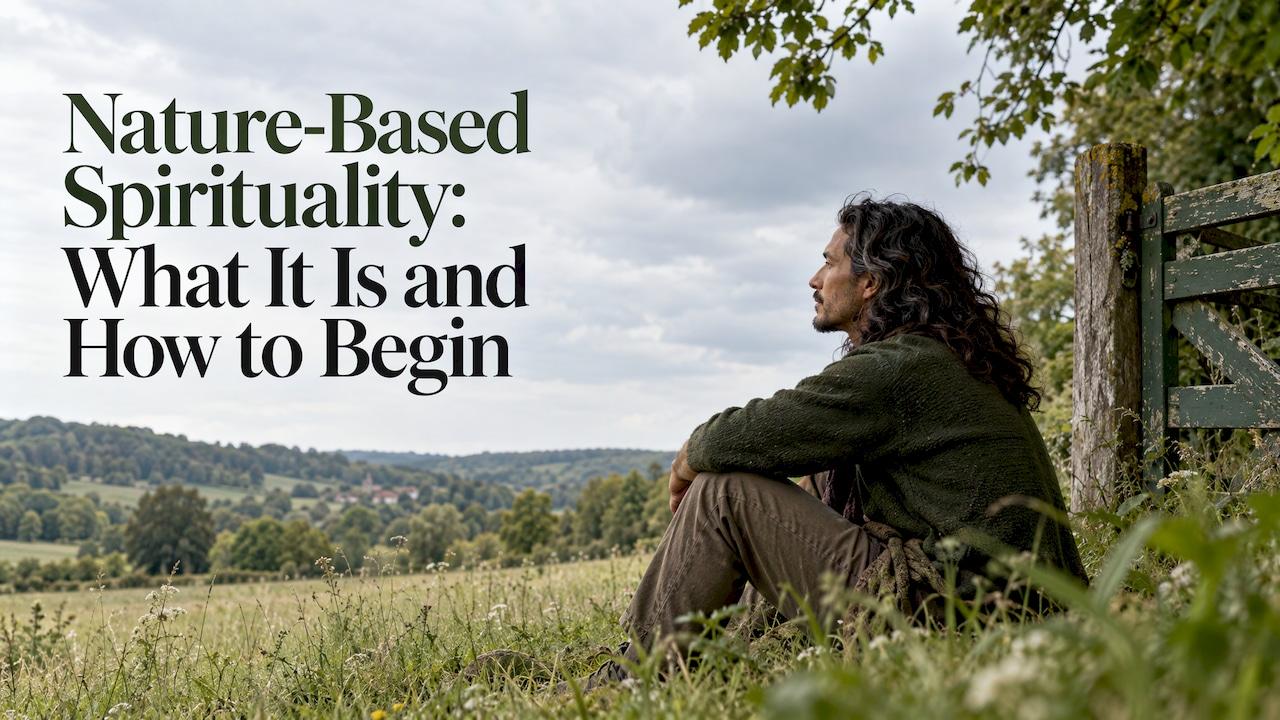
Nature-based spirituality is a way of finding meaning by treating the natural world as sacred, not as scenery. You do not need a holy book or a building. The forest, the river, the seasons and your own body are the teachers, and the practice is to show up, pay attention and let what you meet change you. At Sacred Paths, we teach this through lived experience on a rewilded farm in Burgundy, and this guide gives you the map first: the ideas, the range of traditions, the practices and a simple way to start.
TL;DR
- Nature-based spirituality is an umbrella for paths that hold nature sacred. "Earth-based spirituality" and "spirituality in nature" describe the same ground from slightly different angles.
- Paths differ on where the sacred lives: in places, in living beings, or in the cosmos. Most share a feeling of kinship and responsibility toward the more-than-human world.
- Common practices include time outdoors, ritual with the seasons, sacred space, journaling and ceremony in a circle.
- Begin small and regular, and learn where a practice comes from before you borrow it.
- If you feel disconnected or in transition, guided, in-person experience goes deeper than reading alone.
Table of Contents
- What nature-based spirituality means
- Earth-based, nature-based, spirituality in nature
- Where people find the sacred
- Is there a religion that worships nature?
- Practices you will meet
- What research says about nature and well-being
- How to begin, step by step
- Respecting where practices come from
- Take the next step with Sacred Paths
- FAQ
- Sources
What nature-based spirituality means
Scholars use the term "nature religion" as an umbrella for beliefs and practices marked by reverence for nature and the view that nature is sacred. The Encyclopedia of Religion entry on nature religions lists related terms such as nature worship, nature mysticism and earth religion.
The word "spirituality" matters here. Many people who walk these paths do not call themselves religious. Religion scholar Bron Taylor, in his study of earth and nature-based spirituality, observes that people in these movements often avoid the label "religion" while still finding ultimate meaning and transformative power in nature. Their experiences arise from very different activities, from mountaineering to ritual to altered states of consciousness.
In plain terms: you are practicing nature-based spirituality when the outdoors stops being a backdrop to your life and becomes the place where you ask the big questions, grieve, give thanks and listen for direction.

Earth-based, nature-based, spirituality in nature
These phrases overlap, and people use them loosely. A few useful distinctions:
- Nature-based spirituality is the widest phrase. It covers any path that centers the natural world.
- Earth-based spirituality leans toward the planet as a living, honored presence. One reference definition describes followers who see the Earth as divine, relate to it as a goddess such as Mother Earth, or simply regard it as deserving respect, often showing up as ecological awareness (Llewellyn's encyclopedia).
- Spirituality in nature usually describes an experience, such as the stillness on a ridge at dawn, rather than a defined tradition.
- Ecospirituality joins spiritual life with ecological concern. It does not mean one set of beliefs, and it has evolved since the 1960s, taking in Goddess, Wiccan, deep ecology and ecofeminist currents, mixtures of Eastern and indigenous ideas, and people with no religious affiliation (Encyclopedia.com).
Taylor's second study adds that these spiritualities grow from personal experiences that bond people with nature and are assembled from older traditions, especially Eastern and indigenous religions, and newer inventions such as neo-paganism. What unites them, he argues, is a sense of connection and belonging to nature.
This is not only a fringe interest. Mark Shibley's analysis of the Pacific Northwest argues that the region's earth-based spirituality collectively amounts to a popular nature religion, visible in local literature, leisure rituals and the environmental movement.
Where people find the sacred
The traditions disagree on where the sacred shows up. According to the same Encyclopedia of Religion entry, it may be earthly (caves, mountains, bodies of water), biotic (plants and animals) or cosmic (beyond the biosphere). Participants increasingly describe their paths as spiritualities of connection, with kinship and ethical duties toward nonhuman life.
That gives you three ways to orient yourself:
- Place. A mountain, spring or grove is held as sacred. Land spirits belong here, and our guide to land spirits and how to honor them shows what relationship with a place looks like.
- Living beings. Trees, animals and plants are persons, not resources. This is the heart of animism, which we explain in what animism means.
- Cosmos and cycles. The sun, moon and seasons set the rhythm of ritual, as in solstice rituals.
You do not have to pick one. Most people discover that one doorway feels natural and the others open later.
Is there a religion that worships nature?
Yes, many. Nature worship appears in animism, pantheism, polytheism, shamanism, Taoism, Hinduism and paganism including Wicca, according to Wikipedia's overview of nature worship. A living example is Sarnaism, a faith of indigenous communities in the Chota Nagpur Plateau of India, centered on water, forest and land, with prayers to trees and hills and offerings in sacred groves (Sarnaism).
Paganism shows how varied this can be. A university religion textbook chapter explains that Pagans may be pantheists, polytheists, animists or even atheists, but they share the finding of the divine within nature rather than beyond it. Their "sacred text" is nature itself.
Not every nature-loving path is the same, though. A Harvard Divinity Bulletin article, Is Neo-Paganism a Nature Religion?, sorts modern paganism into earth-centered, magic-centered (self-development) and deity-centered forms. It also cites a distinction between "Cosmic Nature," valued for symbolic truths, and "Gaian Nature," embodied and valued in itself. Knowing which you are drawn to saves years of searching.
Practices you will meet
Beliefs differ, but the practices rhyme. Here are the ones you will meet most often.

Time outdoors with intention. Not exercise, not a photo walk: slow, quiet presence. Sit in one place long enough that the birds forget you.
Seasonal ritual. Wiccan and related traditions follow an eight-festival cycle shared with Druidry and Goddess spirituality, and rituals often take place among trees, on hilltops, near stone circles or by streams (World Religions textbook).
Circle and ceremony. Gathering in a circle, calling the directions and elements, marking life passages. Taylor describes the Council of All Beings, a ritual facilitated widely since 1988 in Australia, Europe and the United States, where participants identify with non-human nature through experiential exercises and meditation. Some report shamanic trance states (Taylor, Part II).
Shamanic work. Shamanic traditions treat the natural world as alive and communicative, and work with journeying, ceremony and relationship with spirits. Two lineages we teach are Andean and Norse: see our explainers on Andean shamanism, the Andean medicine wheel and Norse shamanism.
Sacred space and journaling. A small altar, a corner of the garden, a notebook. Our guides to creating sacred space at home and spiritual journal prompts are practical places to start.
What research says about nature and well-being
People turn to these paths for meaning, but the wider research on nature contact is worth knowing, because it matches what many practitioners report.
- A 2023 scoping review of twelve studies with 2,786 cancer survivors found improvements in anxiety, depression, sleep, connectedness, stress and fatigue. Participants named nature as their most important resource for coping.
- A 2024 study of 293 secondary-school students in Malaysia found that spirituality and nature connectedness linked time in nature to psychological well-being, with spirituality having the greater influence.
- Oh and colleagues described a six-step process in nature-based therapy: stimulation, acceptance, purification, insight, recharging and change. Emotional shifts came first, followed by shifts in thinking and behavior.
- A 2013 review noted that the spiritual and social benefits of nature have received less research attention than the physical and psychological ones.
Two things follow. The order matters: feeling first, insight later, change after that, so do not rush the early stages. And the spiritual side is where much of the meaning sits, which is why a practice with a spiritual frame often holds longer than a walk alone. These studies describe general nature contact and are not medical advice. If you are managing an illness, depression or anxiety, keep your doctor or therapist involved and treat nature practice as a companion to that care.
How to begin, step by step
Most beginners fail by doing too much or by doing nothing in particular. A steadier approach:
- Choose one place. A park bench, a tree on your street, a stretch of shoreline. Returning to the same place lets you see change, and relationship grows from repetition.
- Commit to a small, fixed rhythm. Twenty minutes, twice a week, for four weeks. If you want a model for starting any spiritual discipline without pressure, the four week rule to start is a sensible frame to borrow.
- Arrive before you act. Spend the first five minutes only noticing: sound, temperature, smell, what moves. Then, if it feels right, offer thanks in words or silence.
- Write down what happened. One or two lines. Patterns appear after a few weeks that you would never catch in memory.
- Mark the turning of the year. Pick one seasonal moment, such as a solstice, and do something simple like lighting a candle outdoors.
- Find a circle. Practices that stay private often stall. Shared ceremony gives feedback, accountability and the experience of being witnessed.
Where it goes wrong: treating the practice as a performance, chasing dramatic visions, or collecting techniques from many traditions without learning any of them. Depth comes from staying with a few things.
Respecting where practices come from
Many nature practices, such as smudging, vision quests, spirit animals and medicine wheels, belong to living indigenous cultures, and some are protected within those communities. Respect starts with simple habits:
- Learn the name of the people and the land the practice comes from, and what it means to them.
- Prefer practices rooted in your own ancestry or place, or learn from teachers who are in real relationship with the tradition they teach, with its lineage openly stated.
- Do not use sacred items or sacred names as decoration or branding.
- Be willing to start with the humble basics: listening, gratitude, caring for the place you live.
If spirit animals are what drew you in, our guide on meeting your spirit animal and respecting indigenous traditions walks through this with care.
Our perspective
We have watched many people arrive disconnected: from their bodies, their purpose, the land. They do not usually need more information. They need an experience that reorders them. Nature-based spirituality works because the land does not argue, flatter or hurry. It simply asks you to be present and to be in relationship.
That is why Sacred Paths is built around lived practice. At La Ferme du Cerf Bleu, a rewilded 18th-century farm in Burgundy, we work in circle, outdoors, with the seasons and with the Andean and Norse traditions I was trained in. I came to this as a veterinarian and as a medicine man, and I hold both: respect for what can be observed and respect for what has been handed down.
Reading can open the door. Walking through it, with a community and a mentor who has walked the path, is what turns an interest into a way of life. That is the difference we aim for in everything we offer: practice over theory, relationship over technique.
Angell
Take the next step with Sacred Paths
If you are ready to move from reading to practice, we offer several doorways. Becoming the Medicine: 21-Day Practice is $67 and gives you a structured, daily way into the work. Becoming the Mystic is $197. For personal guidance, a Shamanic Healing Session is $245, and Shamanic & Spiritual Coaching is $395 one-off. For a long-term commitment, our two-year school path in Andean and Norse shamanism runs through the EarthWalker and FireKeeper programs, alongside retreats at La Ferme du Cerf Bleu.

You can see everything, and choose the format that suits your season of life, on the Sacred Paths home page.
FAQ
What is nature-based spirituality in simple terms?
It is a spiritual path that treats the natural world as sacred and as a source of guidance. Practice happens mostly outdoors, through attention, ritual and relationship with land, plants, animals and the seasons. It can be part of an organized tradition or a personal path.
Is earth-based spirituality the same thing?
They overlap a great deal. Earth-based spirituality tends to emphasize the planet itself as alive or divine, while nature-based is the broader umbrella. In everyday use, most people treat them as the same ground.
Do I have to join a religion to practice it?
No. Many people practice without any religious label, and scholars note that participants often avoid the word "religion" entirely. Others work within a tradition such as paganism, animism or shamanism. Either way, a regular practice and a respectful attitude matter more than membership.
How long before I notice a difference?
It varies by person. Research on nature-based therapy describes emotional shifts coming first, with deeper insight and change following over time. A four-week rhythm of regular visits is a realistic first stretch to judge how it feels for you.
Is it appropriate to use indigenous practices?
Only with care. Learn the origin of any practice, honor the people it belongs to, and favor teachers who are in genuine relationship with the lineage they share. Starting with gratitude, silence and caring for your local land is always appropriate.
Sources
- Ecology and Nature Religions, Encyclopedia of Religion
- Earth and Nature-Based Spirituality (Part I), Bron Taylor
- Earth and Nature-Based Spirituality (Part II), Bron Taylor
- Sacred Nature: Earth-based Spirituality as Popular Religion, Mark Shibley
- Earth-Based Spirituality, Llewellyn encyclopedia
- Ecospirituality, Encyclopedia.com
- Nature worship, Wikipedia
- Sarnaism, Wikipedia
- Nature as the Sacred Text, World Religions
- Is Neo-Paganism a Nature Religion? Harvard Divinity Bulletin
- Nature-Based Interventions and Exposure among Cancer Survivors, PMC
- Spirituality and nature connectedness as mediators, 2024 study
- Six-Step Model of Nature-Based Therapy Process, PMC
- What are the Benefits of Interacting with Nature? PMC
- Four week rule to start spiritual disciplines