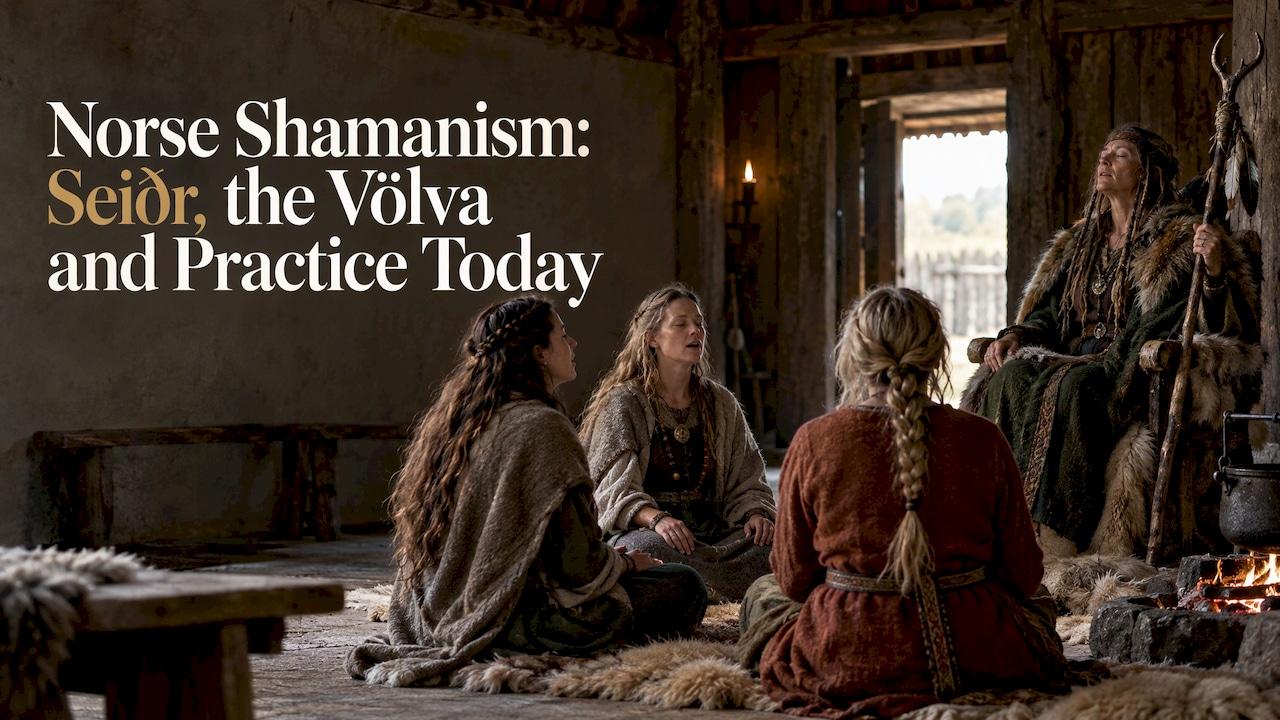
Norse shamanism is the modern name for a cluster of Viking Age practices: trance, spirit work, divination and healing, centered on the Old Norse tradition of seiðr (pronounced roughly "SAY-thur"). The name is a modern label, because no Old Norse text uses a word for "shaman". The practices behind it are well documented in sagas, poems and graves. If you want to work with this path rather than only read about it, the surest route is to learn the sources first, then practice in a lived, guided way. That is how we teach it at Sacred Paths, where Norse shamanism is one of the two traditions in our two-year initiatory path.
TL;DR
- Norse shamanism means the seiðr tradition and related practices: trance, spirit helpers, divination, chanting and healing, mostly led by women known as völvur.
- Scholars debate the word "shamanism" for the Norse world, but agree the practices were real and had a social function.
- Sources are fragmentary, so modern practice always involves interpretation. Knowing which parts are attested and which are rebuilt keeps your practice honest.
- Odin and Freyja are the central figures: Freyja is the teacher of seiðr, and Odin is the god who practiced it despite its stigma.
- Reading gives you the map. Experience, community and a teacher give you the territory.
Table of Contents
- What Norse shamanism actually means
- Seiðr: the core practice
- The völva and her tools
- Odin, Freyja and the question of the god of magic
- Is it really shamanism? What the scholars argue
- How modern Norse shamanism differs from the sources
- Starting a practice: what you can do now
- Our perspective
- Go deeper with Sacred Paths
- FAQ
- Sources
What Norse shamanism actually means
Shamanism, in the classic sense, comes from the circumpolar north: a specialist enters an altered state to meet spirits, travel, heal or find answers for the community. Norse shamanism refers to the features of Old Norse literature and practice that echo this pattern.
The fit is not perfect, and the best scholars say so. Clive Tolley's study of shamanism in Norse myth and magic points out that the Norse were a hierarchical farming society, unlike the nomadic hunting peoples of classic Siberian shamanism. He also notes that the Norse lived near the edge of the classic shamanic world. Neil Price, an archaeologist who has studied the subject for decades, places seiðr among practices found across the circumpolar zone that are sometimes reluctantly called shamanism.
For you as a seeker, the useful way to hold this is simple. "Norse shamanism" is a bridge word. It tells you the territory: ecstatic trance, spirit relationships, fate and the land. It does not claim that Vikings called themselves shamans.

Seiðr: the core practice
Seiðr is the Old Norse word for a kind of magic performed with song, ritual and trance. The Cleasby-Vigfússon Old Norse dictionary describes it as a spell or enchantment performed solemnly at night, with the practitioner seated on a raised platform called a seiðhjallr, chanting spells and songs. It could be used for good or ill, or as an oracle.
Price's paper The Archaeology of Seiðr gathers what the written sources describe:
- Initiation: rites involving fasting, exposure and hanging.
- Spirit journeys and shape-shifting: Odin's body lies as if asleep while his spirit travels in animal form.
- Animal helpers: ravens and wolves appear as helping spirits, and Odin's eight-legged horse Sleipnir belongs to the same world.
- Equipment: an elaborate costume, singers who attract spirits with chanting, a high seat or platform, and a special staff.
Most uses of seiðr were divinatory, according to a study of helping spirits in Norse magic, with some spells aimed at changing something physical. The same study reads the saga detail of yawning as a preliminary to the work as possibly the breathing in of spirits. It argues there is no evidence of free-soul wandering in seiðr itself, which is one of the places where Norse practice differs from the classic Siberian picture.
The völva scene in Erik the Red's Saga
The most vivid description comes from the Saga of Erik the Red, where a traveling seeress is invited to a Greenland farm during a famine. Accounts of the scene describe a woman with a pouch of charms, a ceremonial staff and a high seat cushioned with feathers, and a woman who sings the songs that call the spirits while others form a circle around the platform. You can read it as a snapshot of what we would now call ceremony: a prepared space, a specialist, a singing community and a question brought to the unseen.
The community's role matters. The seeress did not work alone, and the songs came from the group. This is one reason we work in circles at Sacred Paths rather than treating shamanic work as a solitary hobby.
The völva and her tools
A female ritual specialist in the Norse world is called a völva (plural völur). She is translated variously as seeress, prophetess or sorceress. The volume The Norse Sorceress describes völur as liminal figures in Old Norse texts, whose ritual acts let them see into the past, predict the future and affect the world around them. The authors argue they were real Viking Age ritual specialists, and they point to unusual burials containing iron staffs and amuletic objects.
The archaeology backs the texts. Price notes that Viking Age graves in Sweden, including several at Birka, contain staffs of this kind, and that all the dated examples belong to the 10th century. The Norse Sorceress emerged from a research project at the National Museum of Denmark that looked at the völva across religion, gender and the relationship between mind and material objects.
Who practiced, and the matter of ergi
Traditionally the practitioners were women. Men who practiced seiðr risked ergi, a word tied to dishonor and unmanliness. In the poem Lokasenna, Loki accuses Odin of unmanly behavior for practicing seiðr, a point discussed in Goodwin's chapter Manning the High Seat. Price describes the völur as embodying a network of social and sexual taboos, with proper performance limited to women and a small group of men seen as standing outside the norm.
That history is worth knowing if you are a man drawn to this work. It does not close the door. Goodwin documents that contemporary practitioners increasingly negotiate this inheritance in their own ways.
Odin, Freyja and the question of the god of magic
People often ask who the Norse god of magic is. The honest answer is two figures with different roles.
Freyja is the teacher. The Swedish History Museum's page on Freyja says she often carries a staff as a sign of her mastery of seiðr, a form of magic for seeing into the future, and that she taught Odin how to practice it and how to divine.
Odin is the seeker. He is the god of wisdom and of the runes, and he sacrificed himself to win them. He also practiced seiðr, which the saga tradition treats as remarkable precisely because of the stigma attached to it.
The pairing says something useful about the path. Wisdom in this tradition is something you receive from a teacher and pay for with commitment, not something you collect from a book. If the runes draw you, our guide to drawing a rune and keeping a reading journal is a gentle entry point.
Is it really shamanism? What the scholars argue
This is the question that fills the top search results, so here is the short version.
Tolley's 1995 position was that seiðr may be counted a form of shamanism because it summoned spirits during trance. His 2009 two-volume study found little ground for classic Siberian-style shamanism in the Norse world, while allowing for some ritual and belief of a broadly shamanic nature. He also observes that many magical practices live mainly in the imaginative tradition of the poets, which means some of what we read may be literary invention.
On the other side, the scholar Strömbäck (1935) saw a strong resemblance between seiðr and Sámi shamanism, and Price argues that any serious study must look to the Sámi homelands and to Siberia, Alaska, Canada and Greenland. Price's point goes deeper than labels: shamanism is fundamentally a view of the world, a particular conception of the nature of reality. Taking Viking Age shamanism seriously means taking that worldview seriously, not just stamping "shamanic" on objects.
What does this mean for you?
- The practices are attested: trance, chanting, spirit helpers, divination, staffs, high seats.
- The fit with Siberian shamanism is partial, and the debate is genuine.
- The worldview is the heart of it: a living world, fate woven like cloth, and spirits you can relate to.
You do not need to resolve the scholarly argument to practice well. You do need to know it exists, so that you never say "the Vikings did X" when you mean "I am doing X, inspired by sources that suggest Y."
The Sámi connection
The Norse did not live in isolation. The seeress in Vatnsdæla saga is a Sámi woman, and the 12th-century Historia Norwegie describes a Sámi séance. Price's book The Viking Way includes chapters on the Sámi, with whom the Norse partly shared a mental landscape. Whether seiðr borrowed from Sámi practice, shared a background with it or was simply described in Sámi colors by Icelandic authors is still argued. For a modern practitioner the lesson is respect: the northern shamanic world was a web of peoples, and some of its living descendants are still here.
How modern Norse shamanism differs from the sources
Medieval descriptions are sparse, so every modern practice fills gaps. Goodwin notes that since 1990 seiðr has become an increasingly common practice among Heathens, that Diana Paxson and her group Hrafnar are widely credited with popularizing it in the United States, and that a Swedish group has practiced since 1982. Many modern practitioners draw on scholarship about comparable circumpolar traditions to fill what the sagas leave out.
Trude Fonneland's article Shamanism in Contemporary Norway traces a shift. From the 1980s, Norwegian practice was dominated by Michael Harner's core shamanism, which is based on Native American material. Since the late 1990s, practitioners have worked to recover indigenous northern sources: Sámi traditions and Norse seiðr as the basis for ritual.

The direction of travel is clear: toward rooted practice that belongs to a place and a lineage. That is a good compass for anyone starting out.
A simple way to keep your practice honest
When you learn a Norse practice, ask three things:
- What does the source say? A saga scene, a poem, a grave find.
- What is the scholarly reading? Is it a direct description, a literary image or a comparison with neighboring cultures?
- What is my own experience adding? Journeying, song, ceremony and the relationships you build with land and spirits.
This habit keeps the history and the experience in their proper places, and it is the difference between a costume and a practice.
Starting a practice: what you can do now
If Norse shamanism calls to you, these steps work for most beginners.
- Learn the cosmos. Yggdrasil, the Nine Worlds and the Norns are the frame for everything else. Our primer on Norse cosmology and the Nine Worlds covers it.
- Meet the land. Norse and Andean traditions agree on one thing: the place where you live is alive. Our guide to land spirits and how to honor them shows where to begin.
- Try a first journey. A guided inner journey is the simplest way to feel what the sources describe. The beginner's guide to shamanic journeying walks you through one.
- Choose a teacher with care. Our practical guide on choosing a shamanic teacher lists what to look for.
If you are in a season of change, or feel cut off from your purpose, a practice rooted in nature and ancestral story can give you a structure to stand on. Those are the people who most often come to this work, and the reason it is built around experience rather than information.
Our perspective
We teach Norse shamanism the way the sources suggest it was lived: with the body, with song, with the land and with other people. A saga scene is a map. It is not the journey.
The scholars are right that the word "shamanism" is a modern one, and we respect the care they bring to it. What the sources show us is a living world, spirit helpers, trance, fate and a community that sang the work into being. Those elements can be met in practice, and meeting them is what changes people.
That is why our school is built around immersion at a rewilded 18th-century farm in Burgundy, in circles, over two years. I trained as a veterinarian before I became a medicine man, and I learned that real healing comes from relationship and attention, not from information alone. Norse and Andean traditions meet in our path because both teach the same thing in different voices: you are woven into a living web, and your purpose emerges when you take your place in it.
If you feel the pull, begin with the practices above and let your own experience become the teacher.
Angell
Go deeper with Sacred Paths
We offer several ways in, depending on where you are. The two-year Sacred Paths Shamanic School, with its EarthWalker and FireKeeper paths, combines Andean and Norse shamanism in a community of practice, with retreats at La Ferme du Cerf Bleu in Burgundy, France. For a lighter start, Becoming the Medicine: 21-Day Practice is $67, and Becoming the Mystic is $197. One-on-one shamanic and spiritual coaching is $395 as a single session, and a Shamanic Healing Session is $245.

You can see everything we offer, and the current details of each program, on the Sacred Paths site.
FAQ
What is Norse shamanism?
It is the modern name for Old Norse practices such as seiðr: trance, chanting, spirit helpers, divination and healing. The term is a scholarly and popular label, because no Old Norse text uses an equivalent of "shaman". Practitioners today combine what the sources describe with experiential work.
What is a female shaman called in Norse tradition?
She is called a völva (plural völur), often translated as seeress or sorceress. Old Norse texts portray her as a figure who can see the past, foretell the future and affect the world through ritual. Archaeologists have found Viking Age graves with staffs that support the picture of a real ritual specialist.
Who is the Norse god of magic?
Odin is the god of wisdom, runes and magic, but the Swedish History Museum notes that Freyja is the one who taught him seiðr and divination. Freyja is seen as the divine model of the völva. Both figures matter, with Freyja as the teacher and Odin as the seeker.
Is Norse shamanism the same as Norse paganism?
No. Norse paganism is the wider pre-Christian religion, with its gods, festivals and customs. Shamanic practice is one part of it, centered on trance and spirit work. Modern Heathens may practice both, while others come to the shamanic side without following a religion.
Can men practice seiðr?
Historically seiðr carried a stigma of unmanliness for men, called ergi, and Odin himself is mocked for it in Lokasenna. Today, as Goodwin documents, many men practice it, and different communities treat it differently. A teacher who understands this history can help you approach it with care.
Sources
- Shamanism in Norse Myth and Magic, Clive Tolley
- The Archaeology of Seiðr, Neil Price
- Várðr and Gandr: Helping Spirits in Norse Magic
- The Norse Sorceress, Oxbow Books, 2023
- The Norse Sorceress, National Museum of Denmark project
- Manning the High Seat, Goodwin
- Freyja, Swedish History Museum
- The Viking Way, Oxbow Books
- Shamanism in Contemporary Norway, Fonneland, MDPI Religions