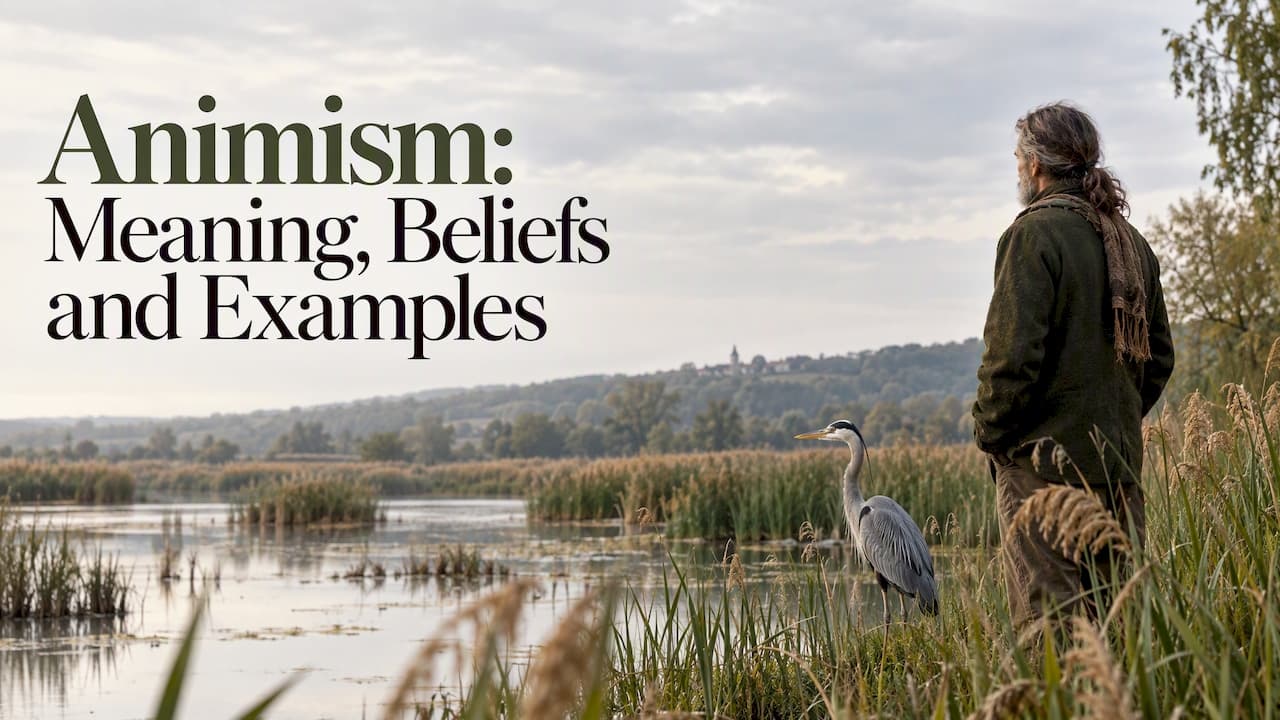
Animism is the worldview that the living world is full of spirit: animals, plants, rivers, stones and people each have their own spiritual essence and can be related to as persons, not just used as things. The word comes from the Latin anima, meaning breath, spirit or life. Below you will find where the term came from, what animists actually do, how animism differs from pantheism and from belief in a God, and how scholars read it today.
TL;DR
- Animism is a way of seeing the world in which many beings, not only humans, have spirit, sentience or a soul, and deserve respectful relationship.
- The word comes from Latin anima (breath, spirit, life). Edward Tylor made it a famous term in anthropology in 1871.
- Animism is a category of many traditions, not one religion, and it can sit alongside belief in a God.
- Pantheism says everything shares one unified essence. Animism says beings have distinct spirits. The two can be combined but neither requires the other.
- Modern scholars treat animism as a way of relating to the world, not as a primitive mistake.
Table of Contents
- What animism means
- Where the word animism comes from
- What animists believe and do
- Do animists believe in a God?
- Animism vs pantheism
- Animism and nature-based traditions
- How scholars read animism today
- Our perspective on animism
- Take the next step with us
- FAQ
- Sources
What animism means
At its simplest, animism is the understanding that natural phenomena, including animals, plants, objects and spirits, have distinct spiritual essences. A heron, an old oak and a mountain are not scenery. Each is someone, or something with its own life, to be met on its own terms.
Anthropologists often prefer to describe it less as a doctrine and more as a sensibility and a way of relating that attributes sentience to persons, animals, plants, spirits, the environment and even technology. That wording matters. Animism is not mainly a list of beliefs you sign up to. It is a stance toward everything you meet: with attention, courtesy and the expectation that the other party matters.
The Latin root is worth sitting with. Anima means breath, and breath is the most ordinary proof of life. When a children's encyclopedia explains the idea, it puts it this way: animists hold that animals, trees, rocks, rivers, plants and people all share the breath of life. Breath moves between bodies, wind, weather and air. The word carries the intuition that life is shared, not owned.
Animism in one sentence you can use
Animism is the practice of treating the more-than-human world as a community of living, communicating beings. If you need a definition for a class or a conversation, that sentence holds up, and the sections below explain each part of it.
Where the word animism comes from
People have held animist views for far longer than the word has existed. One scholarly overview describes animism as a dominant religious tradition across human societies since our ancestors first left Africa. That is a claim about the very long human past, and it is why you will see animism called the oldest form of spirituality. The label is a broad generalization, since the traditions it covers are many and varied, but the long reach is real.
The term itself is much younger. Edward B. Tylor borrowed it from Stahl and developed its study in anthropology through Primitive Culture in 1871. Tylor defined animism as the animation of all nature and treated it as the earliest stage of religion, within a social-evolutionary scheme that placed Victorian Europe at the top.
That framework has not aged well. Later anthropologists moved beyond his initial definition, and one scholar notes that today's interest in animism is an effort to move away from the discredited evolutionary paradigms of Victorian-era scholars. So if you meet the older claim that animists simply confuse objects with living things, you are meeting a nineteenth-century opinion, not a current finding.

What animists believe and do
Because animism is a family of traditions, there is no single creed. Still, a few patterns recur.
Many beings count as persons. Trees, lakes, mountains, thunderstorms and animals may all be non-human persons with whom humans maintain social relationships. Some groups extend this further. According to anthropologists, some animistic people attribute sentience to stones, metals and minerals, and even to cars, robots or computers.
Relationship comes with obligations. Animistic beliefs often involve respectful social relationships with non-human entities, sometimes treating them as relatives or ancestors. If a river is kin, you do not foul it. If an animal is a person, taking its life becomes a moral event that calls for thanks.
Prayer and offerings keep the relationship healthy. Prayers and offerings are given to assure the goodwill of spiritual beings. A well-known example is the Ashanti practice of asking a tree's spirit for permission before carving it.
Animals have their own social lives. One researcher's example, a Mi'kmaq powwow in 1996, is cited in a general reference entry to show non-human animals understood as persons who take part in their own kinship systems and ceremonies.
Everyday forms of animist practice
You do not need a specific tradition to see the pattern. Offering tobacco, cornmeal or water before taking something from the land, greeting a place when you arrive, or marking a transition with a ritual act all rest on the same logic: you are addressing someone, not operating a resource. Ritual acts of this kind range widely, from a cord cutting ritual script with aftercare for releasing an attachment to a moon ritual using crystals and stones. Not all of these are animist in the strict sense, but they share the habit of treating the material world as responsive and meaningful.
If you want a hands-on starting point that fits the idea, a slow solitary walk with the intention of paying attention is the simplest. We describe one in our guide to the medicine walk. Seasonal observances work in a similar way, and our piece on solstice rituals shows how a single candle at home can mark the sun's turning.
Do animists believe in a God?
Some do and some do not. Animists may or may not also be theists, and animism and theism are not mutually exclusive. Animism is not a single religious tradition but a category covering varied traditions, so one community may speak of a creator alongside countless local spirits, while another has no high god at all.
This is why the question "do animists believe in God?" has no single answer. It is a bit like asking whether people who love gardens believe in a particular political party. The category tells you how someone relates to the living world, not what they say about ultimate origins.
Animism vs pantheism
The two ideas are often confused because both say that the sacred is present in the world. The difference is in how the sacred is arranged.
| Animism | Pantheism | |
|---|---|---|
| Core idea | Beings have distinct spirits or souls | All existence shares one unified essence |
| Relationship to the world | Meeting many others, each with its own nature | Recognizing one Unity in everything |
| Typical practice | Offerings, permission, reciprocity with particular beings | Contemplation of the whole, reverence for the universe |
| Individual spirits | Yes, and they matter | Not distinct from the whole |
Pantheism posits that all existence shares a single, unified spiritual essence, whereas animism attributes unique, distinct spirits to individual entities. Another textbook source says animism stresses the uniqueness of individual souls or spirits, while pantheism holds that everything shares one essence and so has no distinct spirits.
The Stanford Encyclopedia of Philosophy describes pantheism as fundamentally a doctrine of an all-inclusive Unity. It adds that pantheism may be combined with animism, but the two remain conceptually distinct and neither entails the other. Where they overlap is in a shared sense that spirit is immanent, present within the world rather than only above it.
A practical way to tell them apart: ask whether the speaker is addressing a particular being (this spring, that wolf) or the whole of reality. The first leans animist, the second pantheist. Many people hold both, and nothing forces you to choose.
Animism and nature-based traditions
Animism shows up across Indigenous cultures worldwide, which is why it is often the first answer to "what are examples of nature-based religions?" Scholars describe it as a broad category for differing traditions. One widely read academic study of animism, published by Columbia University Press, covers Native American, Māori, Aboriginal Australian and eco-pagan forms, and points to their shared interest in respectful life within larger natural communities.
Two cautions help here. First, these traditions are not interchangeable. A Māori understanding of ancestors and land differs from an Ashanti one, and neither is a flavor of a generic "nature religion." Second, if you borrow practices from living Indigenous cultures, learn whose they are and what they ask of outsiders. Our article on the spirit animal deals with exactly that question of respect.
How scholars read animism today
The most useful shift in recent decades is from asking "what do these people wrongly believe?" to asking "how do these people relate to the world?" Contemporary anthropology studies animism as an ontology and as a way of relating to non-human beings, not only as a form of religion. This is often called the new animism, and it focuses on social relations between humans and non-human beings.
Some researchers go further. Anthropologist Nurit Bird-David has speculated that animism may be better understood as a network of relationships in which non-human entities are treated as relatives, rather than merely as persons. Under this reading, the question is less "does this stone have a soul?" and more "what kind of relationship do we have with this stone?"
Popular reference works have followed. Modern scholarship has moved past the view that animistic rituals are childish or primitive, recognizing them instead as complex systems of symbols and myths.
What about Piaget?
People searching "animism" often arrive from child psychology. Jean Piaget used the word for a stage in which young children treat objects as alive. That is a separate, developmental usage and should not be read as a verdict on religious animism. This article covers the religious and anthropological meaning.
Our perspective on animism
We teach shamanism at La Ferme du Cerf Bleu, a rewilded 18th-century farm in Burgundy, and animism is not an idea we study from a distance. It is the ground we stand on.
Here is how we see it. Animism is less a belief than a practice of attention. You can agree with every definition above and still walk past a tree without a word. The shift happens when you start to treat the tree as someone, and then notice that the relationship changes you. That is why our school stresses experiential learning over information. Reading about breath is not breathing.

We also come to this from two directions. Before becoming a medicine man, I trained as a veterinarian, and I spent years in relationship with animals as patients and as teachers. That made it hard to accept that other beings are simply mechanisms. Our path draws on Andean and Norse cosmologies, two traditions that treat land, ancestors and other-than-human beings as part of the community. We hold these traditions with respect and never claim to speak for any one people.
For those new to this, we suggest going slowly. Try a shamanic journey to meet your own inner landscape, or begin your day with the four directions prayer. Practice with others when you can. Animism is relational by nature, and a circle teaches what a book cannot. Grief is another doorway: our reflections on grief rituals show how a simple act of meaning can hold what words cannot.
— Angell
Take the next step with us
If this article has stirred something and you want to learn animist practice with a guide, we offer several ways in. You can join our Monthly Shamanic Circle, book a one-to-one shamanic healing session for $245, or explore the two-year initiatory path in Andean and Norse shamanism at the Sacred Paths Shamanic School.

If you would rather start at home, the Becoming the Medicine 21-Day Practice is $67 one-off and gives you a daily structure to begin.
FAQ
What is animism in simple terms?
Animism is the view that animals, plants, places and other non-human beings have spirit or life and can be related to as persons. The word comes from Latin anima, meaning breath or soul. It describes an attitude toward the world more than a single religion.
Is animism a religion?
Not in the sense of one organized faith. It is a category covering varied traditions found among Indigenous cultures worldwide. Some of those traditions are what we would call religions, and some are better described as ways of life or ways of relating.
Is animism the same as pantheism?
No. Animism says beings have distinct spirits. Pantheism says everything shares one unified essence. A person or tradition can hold both views, but neither entails the other.
Do animists worship nature?
Usually the better word is relate, not worship. Practice tends to involve respect, prayers and offerings to assure the goodwill of spiritual beings, and treating other beings as kin. Some animists also honor a creator or gods, and some do not.
Can I practice animism without belonging to an Indigenous culture?
Many people practice a respectful, relational way of living with the natural world without taking sacred ceremonies that belong to others. Start with attention and gratitude toward the places where you live, learn the history of any tradition you draw from, and ask permission and guidance from its living teachers.
Sources
- Animism, Wikipedia
- Animism, Wikipedia (mobile edition)
- Animism, Open Encyclopedia of Anthropology
- Animism, Internet Encyclopedia of Philosophy
- Animism, Britannica Kids
- Pantheism, Stanford Encyclopedia of Philosophy
- 14.2B: Animism, LibreTexts
- Animism, Columbia University Press
- Is There Such a Thing as Animism?, Journal of the American Academy of Religion
- Cord cutting ritual script and aftercare
- Moon ritual crystal examples