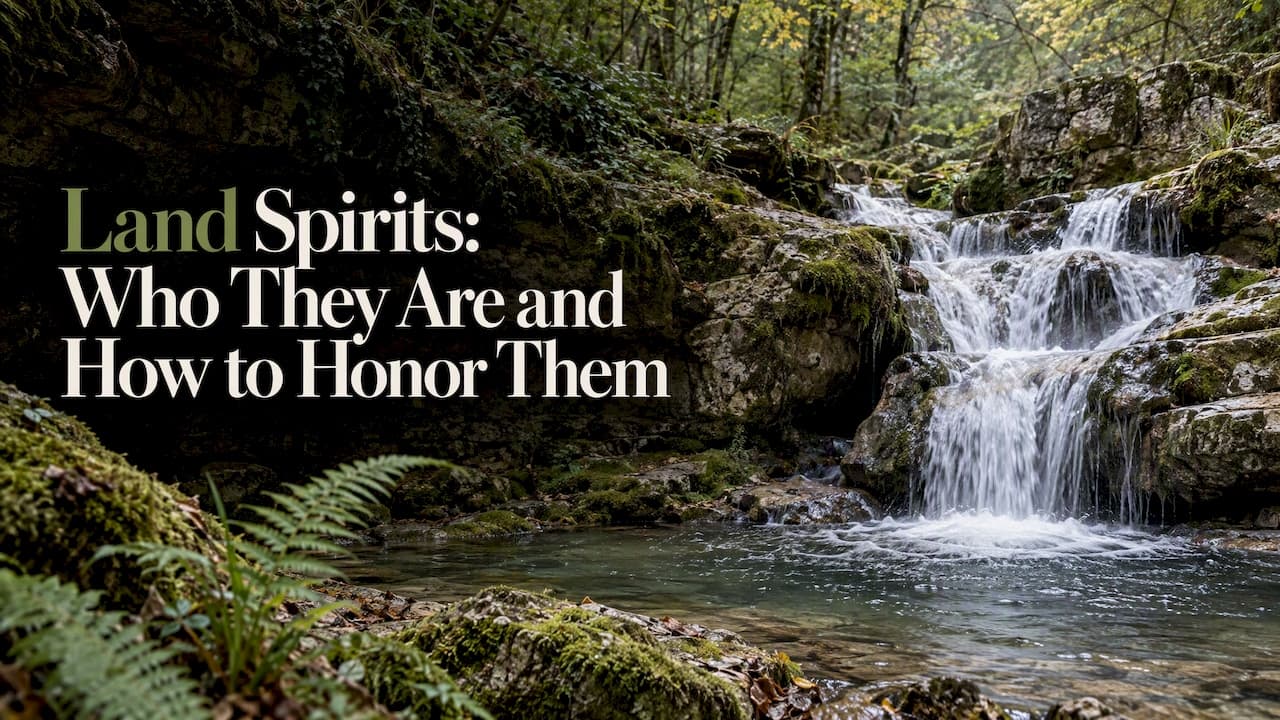
Land spirits are the beings many traditions say live in a particular place: a hill, a spring, a grove, a field, a stretch of coast. The Norse called them landvættir, the Romans spoke of the genius loci, and Tibetan traditions name the lords of the earth and of the site. Across all of them the practice is similar: notice the place, treat it as a living presence, give something back, and do no harm. This guide covers who land spirits are, what the old sources actually say, and how to start a relationship with one in your own life, including offerings that are safe for wildlife.
TL;DR
- Land spirits (landvættir in Old Norse, genius loci in Latin) are the guardian presences of specific places, found in the Norse, Roman, Celtic and Tibetan worlds alike.
- Historical sources describe them as neither tame nor automatically kind: they could help or harm, and respect was the point.
- You begin with attention, not equipment: visit often, sit quietly, use your senses, speak if you want to, and ask how you can help.
- The best offerings are simple and leave no trace: water, a song, picking up litter. Never leave food where wildlife can reach it.
- Treat the historical material as history and the modern practice as a personal relationship, not a proven mechanism.
Table of Contents
- What is a land spirit?
- Genius loci: the Roman version
- Landvættir: land spirits in Norse belief
- Earth spirits in other traditions
- How to begin a relationship with the land spirits near you
- Offerings to land spirits and the earth
- Making an offering without harming the place
- A simple ritual you can do this week
- Our perspective
- Going deeper with us
- FAQ
- Sources
What is a land spirit?
A land spirit is a spirit tied to a place rather than to a person, family or object. The key word is place. A land spirit is not a roaming ghost and not a general nature deity. It belongs to this valley, this waterfall, this particular old oak at the edge of a field.
The idea is old and widespread. Daniel Bray's peer-reviewed study of Norse and Celtic religion describes landscapes inhabited by gods, elves, dwarfs, fairies, giants, land spirits, guardians, ancestors and the dead, with contact associated with groves, rivers, waterfalls, wells, rocks, trees, hills and burial mounds. The sacred was not somewhere far away. It was the ordinary landscape around a farm.
If you are searching for the meaning of a related term, the next section covers it.
Genius loci: the Roman version
Genius loci is Latin for "spirit of place." The Italian Society of Aesthetics explains that the Romans understood it as a local guardian spirit, while modern usage often describes a place's distinctive ambience and character. That second meaning is why architects and landscape designers still use the phrase: it names the singular qualities that make one place feel different from another, and "sense of place" is our human ability to feel that difference.
Britannica's entry on the concept notes that Roman religion recognized guardian spirits of places, including buildings, communities and the state, alongside the genius of an individual person. So a Roman household might honor the genius of the home, and a town might honor the genius of the town.
This double meaning is useful. You can approach a place as an aesthetic fact (it has a character) or as a spiritual one (it has a presence). Most people who work with land spirits hold both: the character is how the presence shows up to the senses.
Landvættir: land spirits in Norse belief
Searchers who type "land spirits" are often looking for the Norse term. Landvættir (singular landvættr) are the spirits of the land in Old Norse religion, later folk belief and modern Heathenry.
What do the sources say about them?
- They are tied to territory. Nicolas Meylan's 2013 study describes landvættir as normally invisible beings associated with particular territories, dwelling in places such as thickets, mounds and waterfalls.
- They mattered to livelihood. The same study reports a Landnámabók narrative linking them with livestock fertility, and says they accompanied people to the assembly, hunting and fishing.
- They were taken seriously enough for law. One account of early Icelandic law says ships had to remove carved dragon heads from the prow before coming within sight of land, so as not to frighten the guardian spirits of the coast.
- They are not servants. The Troth's resource says landvættir are generally not bound to a particular family, farm or grave, and that like wilderness itself, they may help or harm humans and owe us nothing.
That last point is the heart of it. The Norse picture is not of a friendly garden fairy. It is of a neighbor you did not choose, who was there first.
To see how landvættir fit with the rest of the Norse world, see our guide to Norse cosmology, the nine worlds and Yggdrasil.
Earth spirits in other traditions
The names change, the pattern holds.
| Tradition | Term | What the sources say |
|---|---|---|
| Roman | Genius loci | Guardian spirit of a place, building or community |
| Norse | Landvættir | Invisible territorial beings in mounds, thickets, waterfalls |
| Norse and Celtic | Land spirits, guardians, fairies, elves | Encountered at wells, trees, rocks, hills and burial mounds |
| Tibetan | sa bdag, gzhi bdag, yul lha | Lords of the earth, lords of the site, deities of the locality |
The Tibetan material is especially clear about reciprocity. Zsóka Gelle's entry in Brill's Encyclopedia of Buddhism says these beings inhabit rivers, lakes, trees, rocks and mountains and may bring harm when disturbed or protection when properly propitiated. Disturb the place carelessly and there are consequences; honor it and you gain protection and opportunity.
Bray's study makes the same point for Norse and Celtic worldviews: respectful relations with local spirits could bring peace, prosperity and good fortune, while offending them could bring suffering. That is a description of what those people believed, not a verified claim about cause and effect today. It is worth knowing precisely because it explains the tone of the practice: courtesy, not bargaining.
How to begin a relationship with the land spirits near you
You do not need a special site or a particular lineage. You need a place and some regular time. Elyse Welles, writing for Llewellyn, recommends making regular time to be present with the local land, speaking aloud if you wish, and listening for practical ways to help the place. A second Llewellyn piece suggests sitting quietly, observing the surroundings, using the senses and suspending judgment and expectations.
Here is a practical way to do that.
- Choose one place and keep it. A backyard corner, a creek bank, a park tree. Relationships need repetition, so pick somewhere you can return to weekly.
- Go without an agenda. Leave the phone in your pocket. Sit for twenty minutes. Notice sound, temperature, smell, which birds and insects come and go.
- Introduce yourself. Say your name and why you are there, aloud or silently. Plain language is fine.
- Ask what the place needs. Then act on what is practical. Picking up litter, watering a dry plant or removing a discarded fishing line is a real answer.
- Keep a record. Write down what you saw, felt and dreamed. Patterns appear over months, not days.
- Give thanks when you leave. A few words are enough.
A walk with intention can deepen step three and four. Our guide to the medicine walk describes a structured way to move through land and pay attention. If you want to explore how people receive impressions from the unseen world, shamanic journeying is a beginner-friendly method. Keep your expectations modest and your skepticism intact: an impression is something to hold lightly and test against what you observe in the physical place.
Offerings to land spirits and the earth
An offering is a gesture of reciprocity. It says: I have taken your air, your shade, your water, and I give something back. The old forms are modest.
Roman offerings. A 2026 article on working with the genius loci describes historically attested Roman offerings as wine, olive oil, grain cakes, incense and flowers, and says libation, pouring liquid onto the ground or into water, was a central gesture.
Bread and salt. The same article reports bread and salt as a recurring combination in 19th-century ethnographic accounts from Poland, Russia and Ukraine, read as an extension of human hospitality to place spirits. That framing is helpful: you are treating the place the way you would treat a guest or a host.
Water. Welles suggests bringing water outside and offering it at a tree that needs it, a new garden, or at your feet. It is the simplest offering and the safest.
Service. Cleaning up, planting native species, removing invasive plants where permitted, and reporting damage to land managers are offerings in the fullest sense.
Your voice. A song, a poem, or a spoken thanks costs nothing and leaves no trace.

If you want a ceremonial frame with Norse roots, our article on the blót ceremony explains how a gift-giving rite is structured and how to hold one today.
Making an offering without harming the place
This is where many well-meant practices go wrong. A pile of bread, fruit or sweets left in a forest is not a gift to the spirits. It is food for animals that should not eat it.
The National Park Service warns that human food can harm wildlife, alter natural behavior, habituate animals to people and expose them to predators or other dangers. Its Leave No Trace guidance also says to pack out trash and leftover food, avoid damaging vegetation or cultural features, leave natural objects where found, and follow local rules. Those principles apply directly to any offering in a public or wild place. Separate guidance for Muir Woods adds that visitors should stay on trails and leave plants, animals, rocks and artifacts as found.
In practice:
- Use water, not food, in wild areas. Pour a small amount onto bare soil away from streams, or onto a plant that needs it.
- Skip candles and incense where fire is a risk, and anywhere that rules forbid open flame. Check the land manager's rules first.
- Do not leave objects. No ribbons, crystals, coins or figurines. They become litter, and in protected areas they can violate regulations.
- Do not take anything either. Stones, feathers and bones stay where you found them.
- Ask about the land. Sacred sites for living Indigenous communities carry their own protocols. If a place matters to a nation, learn whose it is and follow what its people ask of visitors. Our piece on how to meet your spirit animal while respecting Indigenous traditions covers the same care.
- On your own property, you have more freedom, but the same principle holds: give what the place can use.
A simple ritual you can do this week
A 2023 Llewellyn Unbound ritual uses a candle, a bowl of water and a simple invitation to the spirits of the place, followed by quiet observation, thanks and a water libation. Here is a version adapted for a yard or balcony, where a candle is safe.
- Set a small bowl of water on a stable surface outdoors. Light a candle in a jar or lantern, away from anything flammable.
- Stand or sit quietly for a few minutes until your breathing slows.
- Say, in your own words: "I live here. I would like to know this place and treat it well. You are welcome to make yourself known."
- Sit in silence for ten to fifteen minutes. Watch the light, listen, notice what your attention is drawn to.
- Thank the place. Snuff the candle.
- Pour the water onto the soil beside a plant or tree.
- Write down what you noticed.
Then repeat the visit without the ritual. The ceremony opens the door, but the relationship is built from ordinary returning.
Our perspective
We teach shamanism on a rewilded 18th-century farm in Burgundy, and land spirits are not a theory for us. They are the first lesson. Before anyone learns a drumming pattern or a journey method, we ask them to spend time with the ground under their feet.
Two things we have learned. First, the land does not respond to performance. People arrive wanting a dramatic encounter and miss the quiet ones: the way a field changes at dusk, the sense of being watched kindly by an old hedge. Experience comes through repetition and attention, which is why our teaching is experiential rather than informational. Reading about landvættir will teach you words. Sitting with a place for a year will teach you something else.
Second, reciprocity is not decoration. The Norse, the Romans and the Tibetan traditions all arrived at the same insight from different directions: you do not take from a place without giving back. We would add that giving back should be real. A gift that harms a hedgehog is not a gift. Practical care is the offering that never goes wrong.
We draw on several cosmologies, including Andean and Norse, and we are careful not to claim that any of them are the same thing. A landvættr is not an apu, and neither is a genius loci. What they share is a posture: humility toward a place that was here before you.
— Angell
Going deeper with us
If this subject calls to you, there are a few ways to practice with others. The Monthly Shamanic Circle is a community gathering where you can work with land and ceremony alongside other people. For a longer path, Sacred Paths Shamanic School offers a two-year initiatory training in Andean and Norse shamanism, through the EarthWalker and FireKeeper programs, rooted in nature and held at La Ferme du Cerf Bleu in Burgundy, France.
If you would rather start with one-to-one guidance, a Shamanic Healing Session is $245, and Shamanic & Spiritual Coaching is $395 as a one-off.

For current schedules and availability, use the pages above, since they change through the year.
FAQ
What is a land spirit?
A land spirit is a spirit associated with a specific place, such as a hill, spring, grove or farm, rather than with a person. Norse tradition calls them landvættir, and the Romans called the equivalent the genius loci. Historical sources describe them as powerful neighbors who could help or harm, not as servants.
What does genius loci mean?
It is Latin for "spirit of place." To the ancient Romans it was a guardian spirit of a place, building or community. Today the phrase is also used for a place's distinctive atmosphere and character, which is why designers and architects use it.
What are earth spirits called?
There is no single name. Norse sources use landvættir, Roman religion used genius loci, and Tibetan traditions use terms such as sa bdag, gzhi bdag and yul lha. Celtic and Norse sources also mention fairies, elves, guardians and ancestors tied to wells, trees and mounds.
What can I offer to land spirits?
Water, spoken thanks, a song, and practical help such as picking up litter are the safest. Historical offerings included wine, oil, grain cakes, bread and salt, but food left outdoors can harm wildlife. In parks and wild areas, follow Leave No Trace rules and pack out anything you bring.
Do land spirits help or harm people?
Historical Norse and Celtic sources say both were possible: good relations were linked with peace and prosperity, and offense with suffering. These are beliefs recorded in the past, not proven effects. Today, most practitioners treat the relationship as one of respect and attention rather than a trade for favors.
Sources
- The Place of the Interactions with the Spirit World, Sydney Studies in Religion
- International Lexicon of Aesthetics: Genius Loci
- Britannica Kids Scholars: Genius
- The (Re)conversion of the Spirits of the Land, Revue de l'histoire des religions
- Landvættir: Iceland's Guardian Spirits of the Land
- Spirits of the Land and Sea, The Troth
- Spirits of the Soil, Land, and Locality in Tibet, Brill
- How to Begin a Relationship with Land Spirits, Llewellyn
- Connecting with the Spirits of the Land, Llewellyn Unbound
- How to Work With the Genius Loci, Strange & Twisted
- Leave No Trace, White Sands National Park
- Leave No Trace and Zero Waste, Muir Woods