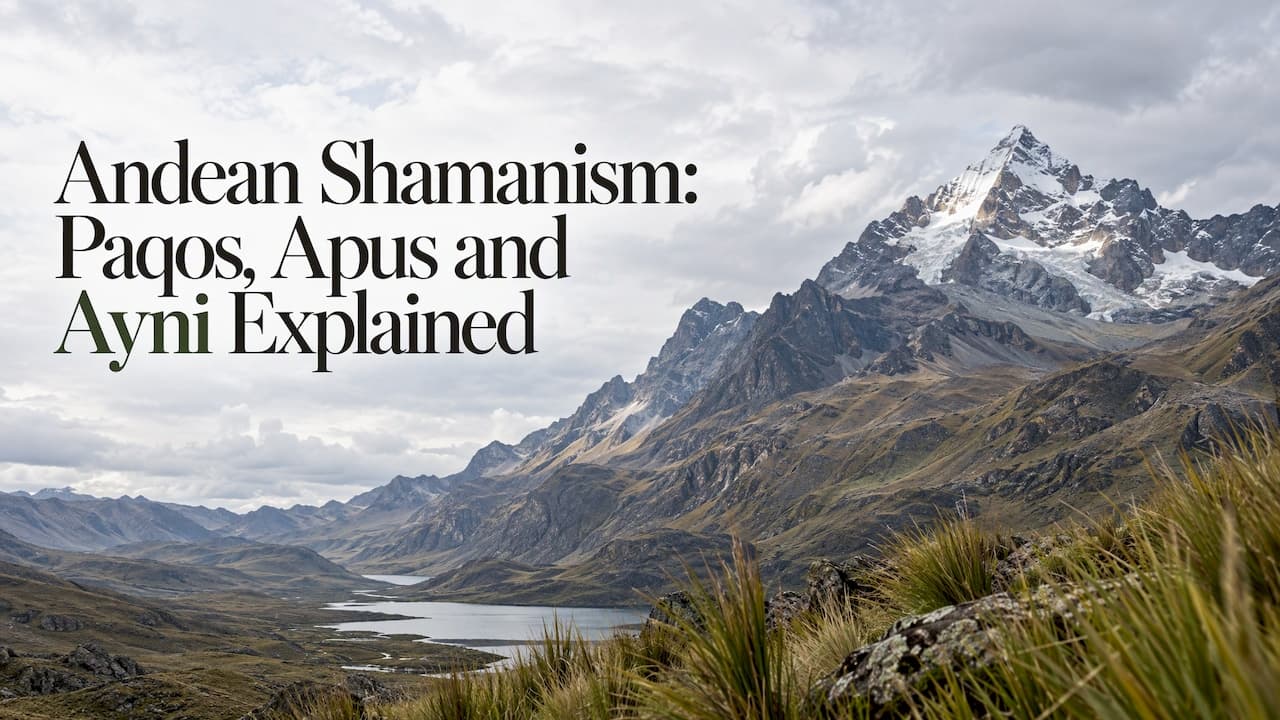
Andean shamanism is the ritual and healing tradition of the Quechua-speaking highland peoples of Peru, and its practitioners are usually called paqos, not shamans. A paqo mediates between people and the living world around them: mountains, earth, water, ancestors. The work rests on reciprocity, not on personal power. This guide explains the core ideas, the roles, the ceremonies, how initiation is understood, and how to tell a rooted practice from a generic one.
TL;DR
- Andean shamanism centers on relationship: with the Apus (mountain spirits), Pachamama (Mother Earth) and the community, kept in balance through reciprocity, called ayni.
- Among the Q'ero of Peru, the people most often associated with the tradition, practitioners are called paqos, and researchers debate whether "shaman" fits at all.
- Paqos hold different roles. Some handle everyday offerings and divination, while a rarer level is said to speak directly with the Apus.
- Initiation is traditionally a calling confirmed by experience and training inside a lineage, not a weekend certificate.
- If you study it, look for honesty about lineage, reciprocity with the source communities, and a practice you can do at home.
Table of Contents
- What Andean shamanism is
- The worldview: Apus, Pachamama and ayni
- Paqos and their roles
- Ceremonies and practices
- How initiation is understood
- Telling rooted practice from generic "shamanic" offers
- If you travel to Peru
- Perspective: why we teach Andean practice alongside other paths
- Begin with practice, not just reading
- Simple ways to practice ayni at home
- FAQ
- Sources
What Andean shamanism is
The phrase "Andean shamanism" is a convenient label that outsiders gave to a set of living practices. In the ethnographic literature on the Q'ero, paqos are described as ritual specialists who mediate relationships between humans and non-humans. The same research notes that the words "shamanism" and "shaman" are themselves debated, which is why you will see careful teachers use paqo, altomesayoq or pampamesayoq instead.
That matters for a practical reason. In much of the Western imagination, a shaman is a lone figure who journeys into an other-world and returns with power. The Andean picture is more communal and more earthy. The world is populated by beings who have to be fed, thanked and listened to, and a paqo's job is to keep those exchanges healthy for the whole community: the family, the herds, the fields, the weather.
The Q'ero are a Quechua-speaking people from the high Andes of the Cusco Region, with a strong living tradition of oral literature and weaving. Their spiritual life is also dynamic. The same fieldwork describes Q'ero practices as changing over time while remaining central to identity, including for families who now live in Cusco. This is not a museum tradition. It adapts, and it belongs to people who are alive and making choices about how to share it.
The worldview: Apus, Pachamama and ayni
Three ideas carry most of the tradition.
Apus. These are the mountain deities, each peak a presence with its own character and territory. Academic work on Andean belief describes highland religion as centered on Apu mountain deities and Pachamama. Mountains are not scenery. They are relatives who protect, provide water and can also withhold it.
Pachamama. Usually translated as Mother Earth, she is the ground you stand on and the source of food. Depending on who is speaking, the term can point to the whole cosmos or to nature as a mother. Offerings to her, often of food, coca leaves, chicha or flowers, are a way of paying back what has been received.
Ayni. Reciprocity is the working principle. The same academic overview names reciprocity and complementarity as essential to personal and social well-being. If you take from the land, from a teacher or from a neighbor, you give back in a form that is fitting. Illness, bad harvests and conflict are often read as signs that an exchange has gone out of balance.
For a Western reader, ayni is the most useful idea to carry away. It turns spirituality into a daily ethic: how you treat water, how you thank people, what you give back to the place that feeds you.

Paqos and their roles
The Q'ero use the word paqo for their ritual practitioners, and it is sometimes glossed as "priest" or "practitioner". Neither English word is exact. Researchers describe a loose hierarchy of skill and spiritual power:
| Role | What the research describes |
|---|---|
| Pampamesayoq | Handles common rituals and offerings, and serves as a diviner and healer |
| Altomesayoq | A higher-level practitioner said to communicate directly with non-human beings such as the Apus |
These descriptions come from fieldwork with Q'ero migrants. The same source notes that paqos may specialize in different areas, so two paqos from neighboring communities can be strong in quite different work. One may be known for reading coca leaves, another for rituals around crops or animals.
Two cautions help here. First, the categories are a simplification, and families and regions describe them differently. Second, a title in English marketing copy is not evidence of a title in a community. When someone presents themselves as an altomesayoq, it is fair to ask who recognized them and where.
Ceremonies and practices
Andean ritual life is practical. It addresses health, land, weather and livelihood. The Q'ero research lists healing bundles called haywakuy, made with coca leaves and other products, alongside rituals for healing, crops, weather and the reproduction of animals.
Some of the practices you will meet most often:
- Coca leaf offerings and reading. Leaves are arranged as an offering (the k'intu) and blown with a prayer. Reading the fallen leaves is a form of divination.
- Despacho or payment offerings. A bundle of symbolic gifts is assembled with intention and returned to the earth. We describe the layers, materials and meaning in our guide to the despacho ceremony.
- Healing and cleansing. Practitioners work to remove heavy or stagnant energy from a person or place, then restore balance with offerings.
- Seasonal and agricultural rites. Planting, herding and weather are all addressed ritually.
Practices vary by community, valley and family. There is no single canonical rulebook, which is one reason a good teacher will always tell you where a technique comes from.
How initiation is understood
This is the question behind many searches for Andean shamanism initiation, and it deserves a careful answer. Here is what can be said without overreaching.
In the Andean framework, becoming a paqo is generally described as a calling before it is a career. People may be marked out by unusual experiences, by illness that resolves, or by a dramatic event. Some teachers describe surviving a lightning strike as one traditional sign of being chosen. Others describe a symbolic "lightning" of insight. After the call comes a long apprenticeship: learning offerings, prayers, the names and personalities of the mountains, and the rules of reciprocity, usually through a family member or an established teacher.
Some practitioners also describe formal transmissions, often called karpay, in which a teacher passes on a form of power or connection at a sacred site. Details differ between lineages, and published accounts come largely from teachers themselves, so treat them as one tradition's self-description, not a standard everyone follows.
What follows initiation is responsibility. A paqo is expected to serve the community, to keep their own exchanges in balance, and to keep learning. Training does not end with a ceremony. In oral traditions, transmission happens through years of watching, helping, and being corrected, which is why a short workshop cannot reproduce it.
That does not make an introductory course worthless. It means an honest course says what it is: a doorway into the worldview and a set of practices you can live with, not a replacement for being raised in, or apprenticed to, a community lineage.

Telling rooted practice from generic "shamanic" offers
The research on Q'ero migrants makes a useful point. Their spiritual practices remain integral to identity and to connection with the home community, even as some take part in the tourism industry. So the Andean tradition and the spiritual travel economy overlap, and that is not automatically a problem. Q'ero people also define themselves through dedication to ancestral practices and community-based values, even in a city like Cusco.
When you evaluate any Andean-inspired offer, ask:
- Where does this come from? A good teacher names their teachers, communities or sources instead of saying "ancient wisdom".
- Is reciprocity real? Is there a fair exchange with the people whose tradition is being shared, or only a fee going to the seller?
- Is the language honest? Beware promises of guaranteed healing, instant powers or "authentic initiation" in a weekend.
- Does it ask for your discernment? Rooted traditions invite questions. Pressure and secrecy are warning signs.
- Can you practice it at home? Good teaching gives you offerings, prayers and attention practices that fit an ordinary life.
Our longer guide on how to choose a shamanic teacher goes through these questions in more detail, and our piece on respecting Indigenous traditions around spirit animals covers the same principle from another angle.
If you travel to Peru
Many readers want to meet the tradition in place. A few principles keep the visit respectful.
- Ask who is hosting and how the host communities are paid.
- Prefer arrangements that keep money in local families, such as community-based tourism, over anonymous packages.
- Treat plant medicines with real caution. They are powerful, they interact with medications and medical conditions, and they should be taken only with a prepared, experienced team and after talking to your doctor.
- Arrive as a guest. Bring a small offering, learn a few words of Quechua and Spanish, and accept that some things will not be shared with you.
Perspective: why we teach Andean practice alongside other paths
At Sacred Paths we come to Andean shamanism as students and practitioners, not as owners of it. I trained as a veterinarian before I became a medicine man, and that background taught me to respect what can be observed, what takes years to learn, and what cannot be faked. Andean ayni fits that respect perfectly: you give, you receive, you pay attention to what comes back.
What draws people to us is rarely curiosity about a technique. It is the feeling of being cut off from the land, from community, from their own sense of purpose. The Andean view answers that directly. You are not separate from the mountain, the river or your ancestors, and your well-being is tied to how well those relationships are kept.
That is why our two-year initiatory path is built on experience, not information. In our school at La Ferme du Cerf Bleu in Burgundy, people practice in circle, work with the land of a rewilded 18th-century farm, and learn to carry offerings and ceremony into daily life. Our path brings Andean and Norse traditions together, and we are clear about where each practice comes from.
Our approach is our own, shaped by years of practice, and it does not claim to replace the lineages of the Andean communities. It offers a serious, grounded way to begin your own relationship with the earth, with guidance and a community around you.
Angell
Begin with practice, not just reading
Reading will take you only so far. Andean ideas become clear when you act on them: making an offering, walking a landscape with attention, thanking the place that feeds you. If you want to start with something structured, our site offers guided programs such as the 21-day practice Becoming the Medicine and the Becoming the Mystic course, and the school's two-year path for those who want to go deeper.

You can see the full range of programs, retreats and one-to-one work on the Sacred Paths home page. If you are not sure where to begin, start with the program that matches the time you can actually give.
Simple ways to practice ayni at home
You do not need a mountain to start working with reciprocity. These steps are drawn from the principles above, not from any claimed lineage.
- Choose a place. A tree, a river, a corner of a garden or a houseplant. Visit it regularly.
- Give before you ask. Offer water, a pinch of food, a song or simply your attention. Do it quietly and without expectation.
- Notice what returns. Keep a short journal of what you observed: weather, animals, your own mood. Relationship is built on noticing.
- Extend it to people. Ayni applies to neighbors and teachers too. Who have you been taking from without giving back?
- Ground your inner work. Journeying and ancestral work deepen when they are tied to a real place. Our beginner's guide to shamanic journeying and our article on ancestral healing are good companions, and land spirits shows how to honor the place where you live.
If you live with a medical or psychological condition, keep your usual care in place. Shamanic practice can sit alongside it but does not replace a doctor or therapist, and any breathwork or plant-based work should be discussed with your own physician first.
FAQ
Is an Andean shaman the same as a paqo?
Not exactly. Paqo is the Quechua term Q'ero communities use for their ritual practitioners, and researchers note that "shaman" itself is a debated label. Using "paqo" is more accurate and more respectful when you are speaking about the Andean tradition.
What is the difference between a pampamesayoq and an altomesayoq?
In Q'ero accounts, a pampamesayoq handles common rituals and offerings and serves as a diviner and healer. An altomesayoq is a higher-level practitioner described as able to communicate directly with the Apus. The distinctions are simplified and vary between communities.
Can anyone be initiated into Andean shamanism?
Traditionally, initiation follows a calling and a long apprenticeship within a lineage, so it cannot be bought in a weekend. Outsiders can study the worldview and practices, and some teachers offer ceremonies, but you should ask honestly what a given ceremony means and who stands behind it.
What is ayni?
Ayni is the Andean principle of reciprocity. Academic work on highland belief treats reciprocity and complementarity as essential to personal and social well-being. In daily life it means giving back to the land, the community and your teachers whenever you receive.
Do I have to go to Peru to learn it?
No. Travel can be meaningful, but the core of the practice, reciprocity with the place you live, can start at home. If you do go, choose arrangements that treat local communities as partners and not as scenery.
Sources
- Embedded and borrowed subjectivity in the shamanic practices (Q'ero research)
- What We Mean When We Say "Religion": The Q'ero Migrants
- Deities and Spirits in Andean Belief