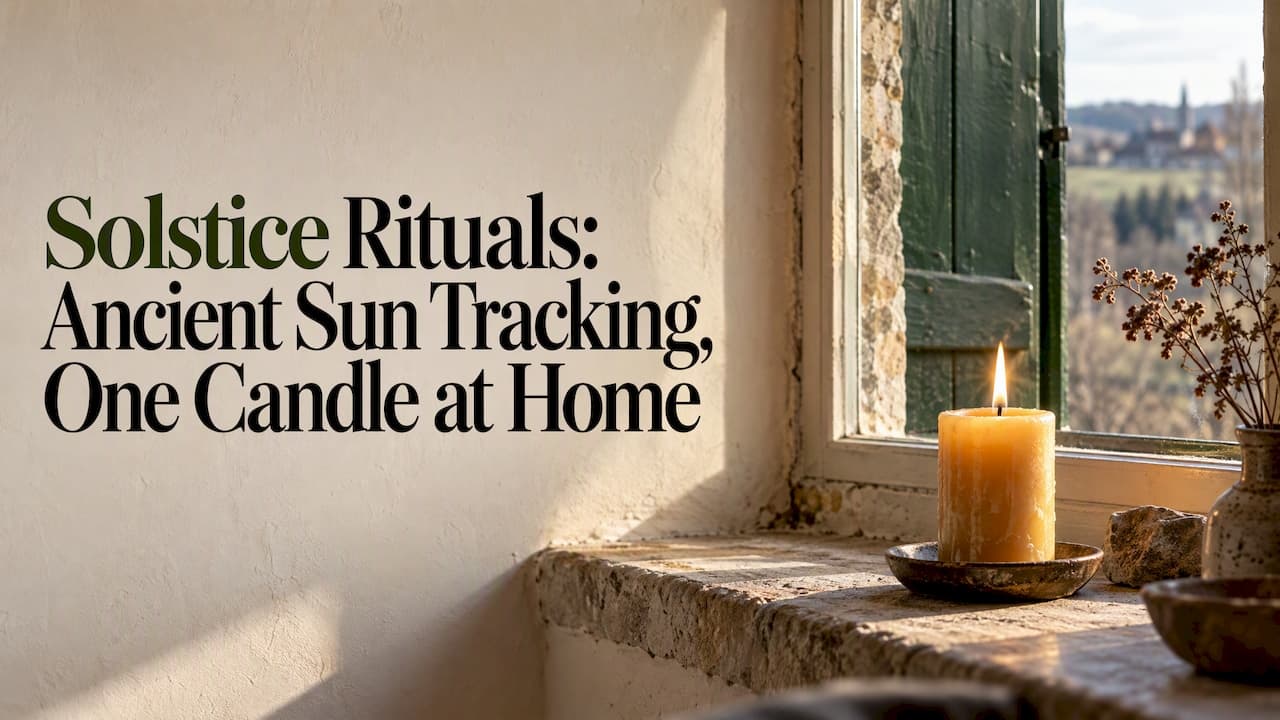
A solstice ritual is a deliberate act that honors the moment the sun appears to stand still, a word that comes from the Latin for "sun" and "to stand still," according to the United Nations. To start today, light one candle at sunrise or sunset, name one intention aloud, and let it burn down. The solstices fall around June 21 and December 21.
TL;DR:
- Solstices can fall between June 20 and 22 or December 20 and 23; check your local time zone for the exact moment.
- Choose fire and light for summer, or rest and warmth for winter; without an open flame, use a candle in a jar or a bowl of water.
- A brief ceremony needs only a candle, spoken thanks, an intention, and quiet; longer gatherings can add a walk, shared reflection, movement, or a meal.
- When borrowing a cultural practice, learn its origins, name its community, and avoid sacred ceremonies unless the community has invited you to participate.
Table of Contents
- What is a solstice and when does it happen?
- Which cultural traditions shaped modern solstice practice?
- Which solstice rituals can you try at home?
- How do you build a short solstice ceremony?
- How can you adapt solstice rituals to your life?
- Why does ritual matter more than information?
- Where can you go deeper with guided solstice practice?
- FAQ
- Sources
What is a solstice and when does it happen?
The solstices mark the points when the sun reaches its northernmost or southernmost limit in the sky. The UN's observance page places the Northern Hemisphere summer solstice around June 21 and the winter solstice around December 21. Hemispheres flip: when the north celebrates its longest day, the south marks its longest night.
- Date windows: The solstices can fall between June 20 and 22 in summer and between December 20 and 23 in winter.
- Exact timing: the National Weather Service's astronomical seasons page lists 2026 as June 21 at 1:24 am MST and December 21 at 1:50 pm MST, so check your own time zone.
- Why it mattered: these turning points anchored farming calendars and told communities when to plant, rest, feast, or gather.
Which cultural traditions shaped modern solstice practice?
People across many societies have marked the solstices. Anthropologists describe solstice observance as near-universal, reflecting a human need to acknowledge our connection to nature, as Penn Today reports.
- Pyrenean fire descents: villagers carry blazing torches down the mountains, and roles are assigned to specific community members, as described in UNESCO's committee decision.
- Ancient sites: some communities built structures aligned with the sun and incorporated solar observations into ceremonies.
- Majorville Medicine Wheel: a site associated with ceremonies and calendrical observations.
- Inti Raymi: a Peruvian festival associated with the winter solstice and the sun.
Archaeoastronomy research from the National Air and Space Museum shows ancient sites such as those in Chaco Canyon combined solar and lunar tracking as ceremonial and calendrical systems.
Beyond timekeeping, these rituals bound people together. UNESCO's listing of the Pyrenean fire festivals shows they are as much about social cohesion and life-stage transitions as about celebrating the sun.

Which solstice rituals can you try at home?
Pick one or two of these and adapt them to your space and comfort level.
- Candle or small fire: write an intention on paper, then burn it in a fireproof bowl or fire pit, adding dried herbs like lavender or chamomile as an offering. No open flame? Use a single candle in a jar, or place the paper in a bowl of water until the ink lifts.
- Sun-charged water: set a jar of water with fresh flowers in direct sunlight for a few hours, then use it to bless your hands, your threshold, or your plants.
- Ritual bath: soak with lemon balm, lavender, or chamomile. Test the water temperature, skip essential oils on broken skin, and avoid herbs you are allergic to.
- Altar: gather gold or yellow objects, a candle, a seasonal flower, and a stone. Set it in a sunny spot so the light itself charges it.
- Seed ritual: whisper an intention over a few seeds, then plant them in soil or a pot. Tending the plant becomes tending the intention.
- Movement: try sun salutations at dawn, or improvise a "sun dance" with no choreography, only gratitude in the body.
- Golden food: share round or golden dishes such as citrus, honey cakes, or corn bread, and ask each person what they are grateful for.
Pro Tip: Choose rituals that match the season: fire and light for summer, rest and warmth for winter.
How do you build a short solstice ceremony?
A ceremony can have an opening, a central act, and a closing. Scale the middle to the time you have.
Gather first:
- A candle and matches or a lighter
- Paper and a pen
- A bowl of water or a small plant
- Seasonal flowers or herbs, such as St. John's Wort, mugwort, or lavender, which contemporary guides like Country Living suggest
Then choose your length:
- A brief ceremony: light the candle, say a sentence of thanks to the sun, write an intention, and sit quietly while the candle burns.
- With more time: add a short walk outside, a spoken blessing over the altar, and a sprinkle of herbs into your flame or water.
- For a longer gathering: add movement or drumming, a round of sharing for groups, and a closing meal or tea.
For groups, invite participation with a simple prompt: "What are you ready to release?" and "What are you ready to grow?" To keep the intention alive afterward, journal it, bury it with seeds, or offer it to the fire.
How can you adapt solstice rituals to your life?
You do not need a field, a forest, or a free afternoon.
- Micro-rituals: a brief sun blessing at a window, a quick altar refresh, or an intention card tucked in your pocket.
- Small groups: assign a fire keeper, a reader, and a host, set candles on stable trays, keep water nearby, and offer seats for anyone who cannot stand long.
- Ethical borrowing: learn where a practice comes from, credit it by name, and avoid copying sacred ceremonies you were not invited into.
Pro Tip: If you borrow a tradition, read at least one source from the community it comes from before you use it.
Why does ritual matter more than information?
Reading about the sun is not the same as standing in it. In my practice, I have found that rituals rooted in nature work because the body learns what the mind only describes. Repeating a small act at the same time each season builds a rhythm that holds you through change, and doing it alongside others makes the change feel witnessed rather than lonely. Information tells you what a solstice is. Practice lets it change how you live.
— Angell
Where can you go deeper with guided solstice practice?
If you want a teacher beside you, we offer several ways in. Our Monthly Shamanic Circle is a low-commitment way to experience guided group ritual around the seasons, and our Breathwork Shamanic Ceremony offers an embodied, nature-rooted practice. For sustained work, our spiritual coaching and Sacred Paths Shamanic School help you turn seasonal observance into a lasting practice. Choose the step that fits where you are now.

FAQ
What should you do on the solstice?
Spend time outdoors and mark the moment with a simple act. Light a candle, write an intention, share a meal, or sit quietly at sunrise or sunset. Keep it short enough that you will actually do it.
How do witches celebrate Litha?
Litha is the summer solstice sabbat, usually marked with bonfires, herbs, and gratitude for the sun's peak. Practitioners often use fire, water blessings, flowers, and shared feasts. Many adapt the same ideas with candles when open fire is not possible.
Who celebrates the solstice?
Nearly every culture has some form of solstice observance, according to Penn Today's overview of anthropologists' findings. Observances range from Pyrenean villagers carrying torches to Andean communities celebrating Inti Raymi to modern gatherings at sites like Stonehenge.
What are pagan traditions for the summer solstice?
Common practices include bonfires, gathering herbs such as St. John's Wort, wearing flower crowns, and feasting outdoors. These echo older European fire festivals, though modern pagan paths vary widely. Choose the elements that feel genuine to you.