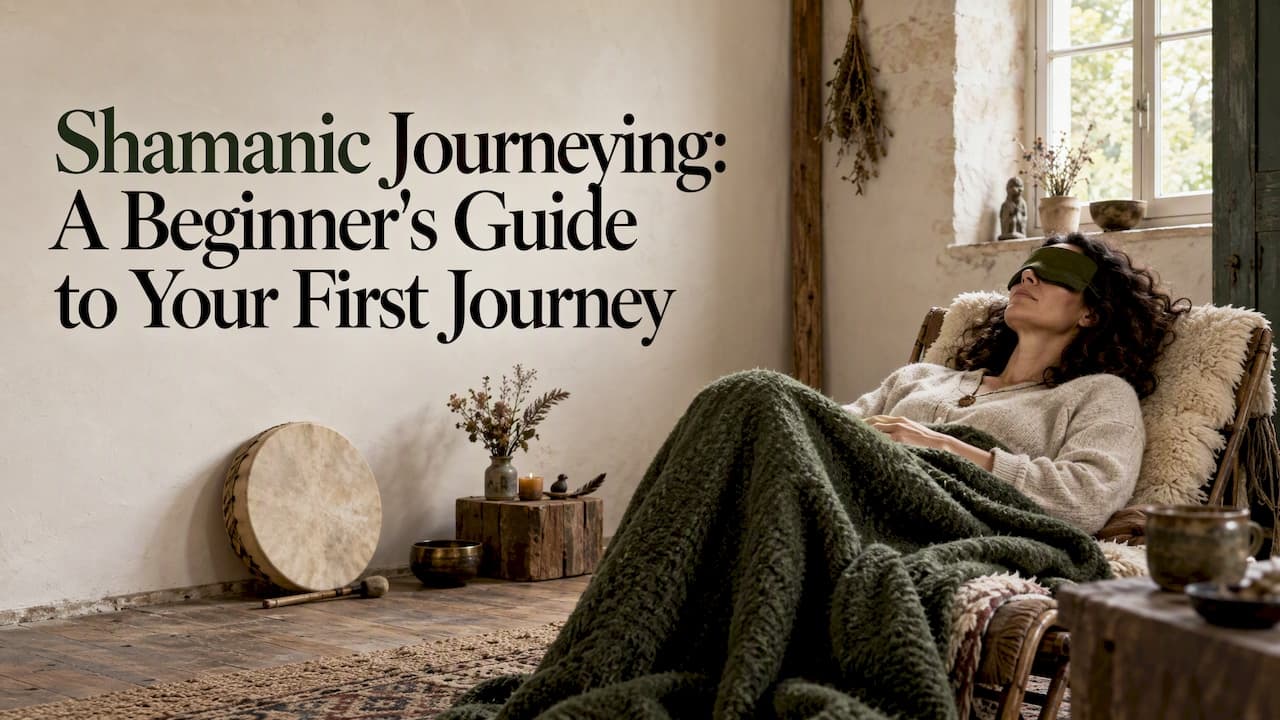
Shamanic journeying is a guided inner trip into an altered state of awareness, usually triggered by steady drumming, in which you hold one question and observe the images, sensations and "story" that arise. You can learn the basics in an afternoon. A first session takes about 20 minutes, a quiet room, something to cover your eyes and a recording of rhythmic drumming. This guide covers how to prepare, the steps, what to do with what you see, what science does and does not show, and how to practice without turning a living tradition into a lifestyle gadget.
TL;DR
- A journey is a 15 to 30 minute session: you lie down, cover your eyes, listen to monotonous drumming and follow a single, pre-set intention.
- The most common beginner mistake is trying to direct the story. The practice is about observing, not scripting.
- Research shows drumming produces measurable brain changes, but the evidence for shamanic work as a treatment is still early. Treat it as a practice, not a medical therapy.
- Write everything down immediately afterward. The meaning usually shows up in the days that follow, not during the journey.
- Respect where the practice comes from, and learn with a teacher once you want to go deeper.
Table of Contents
- What shamanic journeying actually is
- What happens in the brain and body
- What you need before you start
- How to do a shamanic journey, step by step
- Making sense of what you saw
- Common mistakes and how to fix them
- What science says, and what it does not
- Respecting the roots of the practice
- Our perspective: journeying is a doorway, not a destination
- Going further with a teacher
- Building a regular practice
- FAQ
- Sources
What shamanic journeying actually is
In shamanic traditions across many cultures, practitioners deliberately change their state of consciousness to meet helping spirits, gather insight, and work on behalf of their community. A scoping review of shamanistic trance practices describes shamanism as a tradition in which trance practitioners modify their state of consciousness to interact with an invisible world and resolve problems for community members.
What most people in the US mean by "shamanic journeying" is a modern, portable form of that: a short, solo or small-group session with drumming or rattling, an intention, and a mental landscape you travel through. It resembles guided meditation in some ways, but the posture is different. In a meditation you often watch your thoughts settle. In a journey you move through imagery, meet figures or animals, and ask something specific.
That difference matters for what you can expect. You are not trying to empty your mind. You are letting an inner world unfold while you stay awake and curious.
What happens in the brain and body
The drum is not decoration. A 2021 neuroimaging study of the shamanic state of consciousness reports that repetitive sonic driving, typically in the range of 3 to 7 beats per second, can induce a distinct non-drug altered state, with changes in brain activity that include increased gamma power and particular connectivity patterns. The authors compared it with psychedelic states and found it was not identical to them.
A separate experiment looked at stress. In a 2014 study on shamanic journeying and cortisol, 15 minutes of drumming with journey instructions lowered salivary cortisol, but no more than instrumental meditation music did. The mean drop was 0.35 ng/ml. The honest reading: you do not need to believe journeying beats meditation for relaxation. What it offers is a different kind of experience, one of imagery, narrative and felt meaning, and that is what participants in the study reported.
Another small project, a phenomenological study of a 20-minute shamanic-like drumming session, asked 22 people to describe their experiences in writing. It is a good read if you want to know what ordinary beginners report before you try it.

What you need before you start
Keep it simple. A Llewellyn encyclopedia entry on the shamanic journey describes the standard beginner setup as a session of roughly 15 to 30 minutes, lying down in a quiet, darkened space, with an eye covering and rhythmic drumming.
Your checklist:
- A quiet room and 45 minutes. The journey is 15 to 30 minutes. Give yourself time before and after.
- An eye mask or a dark cloth. Closing your eyes is not the same as blocking light. Darkness helps imagery.
- Drumming with a callback. For a first journey, a recording is easier than playing for yourself. Look for one that ends with a faster rhythm that signals the return. A live drummer or a friend with a rattle also works.
- Headphones or a decent speaker. The beat should be steady and not too loud.
- A notebook and a pen within reach. You will want them in the first minute afterward.
- Water. Drinking after a journey helps you feel grounded.
If you want a calmer lead-in, a short guided breathing or settling routine works well. This beginner meditation guide with simple cues is one way to practice arriving in your body before you add drumming.
How to do a shamanic journey, step by step
This is the sequence most beginner guides share, adapted for a first solo session.
1. Choose one question
Write a single line, phrased openly: "What do I need to understand about this change at work?" or "What wants my attention in my life right now?" Avoid yes/no questions and avoid asking about other people's private lives. The Llewellyn entry above stresses expressing your intention and holding it through the session. One question is plenty.
2. Set the space
Silence your phone, tell the people you live with you are unavailable, dim the light and lie down on your back with a blanket. Cover your eyes. Take a few slow breaths and feel the weight of your body on the floor.
3. Start the drumming and repeat your question
Press play and quietly say your question to yourself two or three times. Then stop repeating it. Let the beat carry you. Your mind will wander. Return to the sound.
4. Find your way in
Most people use a doorway: a hollow in a tree, a cave, a stairway down, a pool of water. Choose a place from nature you know well and picture it in as much detail as you can: temperature, smell, the ground under your feet. Then step through. You are not forcing a vision. You are creating a threshold and walking across it.

5. Travel and observe
Notice what appears: an animal, a landscape, a person, a color, a feeling in the body. Here the key lesson from practitioners applies. As one practitioner guide to journeying puts it in essence, surrendering control and letting the imagery lead is the point, since the practice is observation, not dictation. If you catch yourself writing the plot like a screenwriter, soften your grip and ask what is actually in front of you.
You can ask your question to whatever you meet, then listen. Answers often come as images or small scenes rather than sentences.
6. Return when the callback sounds
When the drumming changes to a fast rhythm, retrace your path: back through the doorway, back through the place you started from. Feel your hands and feet. Wiggle your fingers. Stay lying down for a minute.
7. Write it all down
Before you stand, take the mask off and write for five to ten minutes without editing. Record images, sounds, colors, emotions, and any phrase that came up. Dreams fade quickly and journeys do too.
Making sense of what you saw
"Am I making this up?" is the question nearly every beginner asks. Honestly, in part you are. Imagination is the medium. The useful question is not whether the image came from "outside," but whether it tells you something you did not know you knew, and whether it changes how you act.
A few ways to work with the material:
- Read your notes the next day. Underline what surprised you.
- Look for repetition. If the same animal or place returns across several journeys, pay attention.
- Ask for a small action. A good journey ends with something you can do: call someone, rest, walk by a river, finish a task you have been avoiding.
- Take your time with symbols. Do not assume a dictionary meaning. If an animal appears, ask what it did and how you felt around it. Our post on meeting your spirit animal and respecting indigenous traditions goes deeper on how to test signs without over-reading them.
Common mistakes and how to fix them
| Mistake | What happens | What to do instead |
|---|---|---|
| Trying to control the story | You get a daydream you already knew | Observe what arises, even if it is dull or strange |
| Asking five questions | Scattered images, nothing clear | Hold one open question |
| Falling asleep | Nothing to recall | Try sitting up against a wall, or journey earlier in the day |
| Judging it as "doing it wrong" | Tension keeps you out of the imagery | Treat a blank journey as data. Write down the blankness and try again |
| Skipping the notes | Meaning disappears | Write for ten minutes before standing up |
| Journeying when exhausted or upset | Overwhelm, not insight | Rest first, or ground with breath and a walk |
Expect your first few attempts to feel awkward. Many people find the second or third session easier than the first.
What science says, and what it does not
Research is interesting but young. A 2025 scoping review of shamanism as a clinical intervention notes that small studies report positive outcomes for well-being and a sense of agency, while the field still lacks large, rigorous, placebo-controlled trials. That makes shamanic work a developing practice, not an established treatment.
So be clear with yourself about what you are doing. Journeying can be a rich way to reflect, find perspective and feel connected. It is not a replacement for therapy or medical care. If you live with trauma, severe anxiety, a history of psychosis, or are in crisis, speak with a licensed mental health professional before you start altered-state practices, and tell any teacher you work with. The same review describes shamanic practice as potentially a valuable supplement to psychotherapy for personal well-being, which is a more modest and accurate claim than a cure.
Respecting the roots of the practice
Journeying as sold in US workshops is often a simplified, individual version of something that was communal and tied to place. The review above describes it as originally intended for community service, not only personal transformation. Critics such as Robert Wallis, discussed in this chapter on the cultural appropriation debate, argue that neo-shamanism can decontextualize indigenous traditions and turn them into individual consumer tools.
You do not have to abandon the practice because of that. You can practice with care:
- Name what you are learning and from whom. Do not claim a tradition you have not been initiated into.
- Be skeptical of anyone selling a sacred title or an "authentic ancient ritual" for a weekend fee.
- Give back: to the land where you live, and to the communities whose cosmologies shaped what you are using.
- Prefer teachers who are open about their lineage and training.
Our perspective: journeying is a doorway, not a destination
At Sacred Paths we teach at La Ferme du Cerf Bleu, a rewilded 18th-century farm in Burgundy, France, and we have seen what happens when people treat journeying as a quick fix. A single vivid session can feel like a revelation. Then Monday arrives, and nothing changes.
What shifts people is practice over time, in a community, with real life as the test. That is why our school favors experiential learning over information. We do not want you to collect techniques. We want you to come back to yourself, and to the land and the people around you. Journeying is one way in. Walking in the woods without your phone is another. Sitting in a circle and telling the truth is a third.
My own path is a bridge between modern training as a veterinarian and the Andean and Norse teachings I work with. That is also why I encourage you to hold the experience with both wonder and discernment. Ask what a journey gave you that you can test in your life. If it gave you nothing, say so. If it gave you a clear next step, take it.
— Angell
Going further with a teacher
Solo journeys are a good start. If you want guidance, there are a few directions we offer:
- Community practice: our Monthly Shamanic Circle is a place to practice with others and ask questions.
- One-on-one support: shamanic and spiritual coaching is $395 one-off, and a shamanic healing session is $245 one-off.
- A long path: our two-year initiatory path in Andean and Norse shamanism, with the EarthWalker and FireKeeper programs, is described on the Sacred Paths Shamanic School page.
If you are not sure where to begin, start at sacredpaths.earth and tell us what you are looking for.
Building a regular practice
A realistic rhythm for the first month looks like this:
- Week one: two 15-minute journeys, same place to enter, different questions. Focus on getting comfortable with the callback and the notes.
- Week two: one 20-minute journey and one nature walk without headphones. Compare what you notice.
- Week three: return to one question from week one and see what has moved.
- Week four: read all your notes in one sitting. Write three sentences: what repeated, what surprised you, what you will do.
Keep your first month modest. Daily journeys are not necessary, and more is not better. Space lets you integrate.
FAQ
How long should a beginner's shamanic journey be?
Fifteen to 30 minutes is standard. Start with 15 if you are new. Add the time you need to settle in beforehand and to write afterward.
Do I need a drum, or can I use a recording?
A recording is fine and is the easiest way to start. Look for steady, monotonous drumming with a callback signal at the end. Research on drumming uses a steady beat in the 3 to 7 beats per second range, so a simple, even rhythm is what matters, not an expensive instrument.
What if I see nothing during a journey?
That is common and does not mean you failed. Some people sense feelings, sounds or a bodily impression instead of pictures. Write down whatever you did notice, including the blankness, and try again another day with a more specific question.
Is shamanic journeying safe?
For most healthy adults it is a quiet, low-risk practice, but it can bring up strong emotions. If you have a history of trauma, psychosis or severe anxiety, talk with a licensed mental health professional first. Never journey while driving or in any situation where you need to stay alert.
Is it the same as meditation?
They overlap but are not the same. Meditation often aims at stillness and attention. Journeying involves active imagery and a question, and the 2014 cortisol study found similar stress-hormone drops for both, while participants described the journey experience differently.
Sources
- Neural Correlates of the Shamanic State of Consciousness
- Exploring Shamanic Journeying: Repetitive Drumming and Cortisol
- Altered States During Shamanic Drumming: A Phenomenological Study
- The Shamanic Journey, Llewellyn Encyclopedia
- How To Do Shamanic Journeying, Spirit of Ma'at
- Shamanism as a Clinical Intervention: A Scoping Review
- Scoping review on shamanistic trances practices
- The Cultural Appropriation Debate