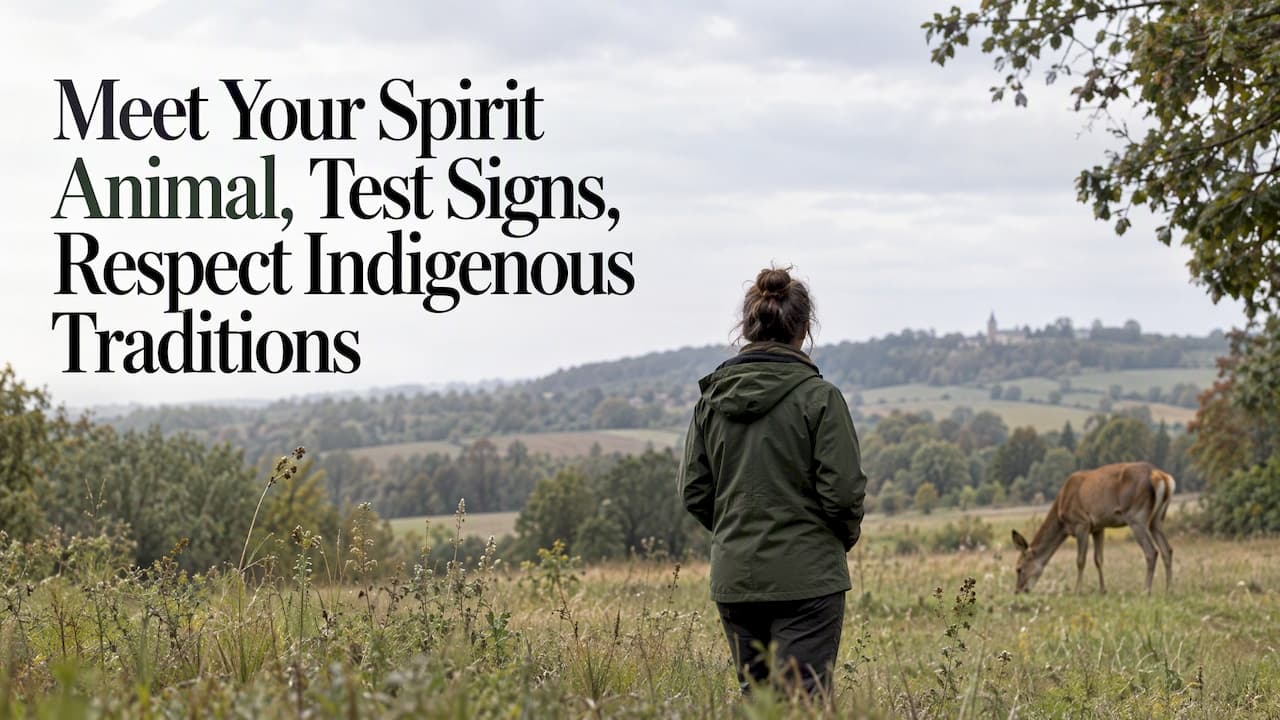
You can meet your spirit animal by noticing repeated animal signs, confirming them in your body, and using short guided visualization and dreamwork to test the connection. This is experiential work, so clarity may arrive over days or weeks rather than in one sitting. Start with a notebook, a quiet moment, and the willingness to treat every impression as something to check, not something to assume.
TL;DR:
- Log each encounter, its date, and your feelings; compare waking signs with dreams or visualizations instead of treating one appearance as proof.
- During a body scan, compare the animal you noticed with an unrelated one; record physical changes before assigning meaning to either impression.
- After a dream, replay the encounter, ask the animal one question, and write it down immediately; nighttime meditation may help you remember and examine it.
- Call it a personal animal ally or guide, not a totem, unless you belong to a tradition where that term carries collective responsibilities and protocols.
- Return to a nearby outdoor sit spot weekly, learn local wildlife, and keep a respectful distance rather than chasing an encounter.
Table of Contents
- How do you notice repeated animal signs in daily life?
- How can your body confirm the connection?
- How does guided visualization invite a spirit animal?
- How do dreams and middle-of-the-night meditation help?
- How do you test an impression through journaling?
- How can you meet your guide respectfully?
- How do you deepen the relationship once you recognize a guide?
- What do common spirit animals symbolize?
- Where do spirit animals come from across Indigenous traditions?
- How do spirit animals, power animals, and totems differ?
- How should you prepare before seeking a spirit animal?
- Why does time in nature matter?
- How does shamanic drumming and journeying work?
- An author's note on practice, not performance
- Can we support you in going deeper?
- FAQ
- Sources
How do you notice repeated animal signs in daily life?
The working rule among practitioners is that repetition is the message. One hawk overhead is a nice moment. The same hawk image on a billboard, in a dream, and on a friend's phone case can be a pattern worth your attention. Coincidence tends to be isolated and forgettable. Meaningful repetition keeps returning and often arrives with a small jolt of recognition.
You do not need a forest to collect evidence. Try these:
- Slow down on walks and listen before you look, since animals often announce themselves by sound first.
- Pay attention to media, logos, book covers, and social feeds where the same creature keeps appearing.
- Watch your commute for repeat encounters, such as the same crow on the same wire.
- Notice animals that arrive when you are in a strong emotional state.
- Count real encounters and symbolic ones separately, so you can compare them later.
Keep a simple two-column log. In the left column, write the date and the encounter. In the right column, write what you felt at that moment, in plain words. After some time, read it back. Patterns you could not see day to day often show up on the page, and that gives you concrete material to work from instead of a vague hunch.
How can your body confirm the connection?
Somatic confirmation means checking whether an animal impression changes something physical, not just whether it makes sense in your head. Many practitioners trust the body more than symbolic reasoning, because the mind can talk itself into almost any meaning. A real connection tends to register as a shift: your breath changes, your chest warms, or a sudden stillness settles in.
Try a short body scan. Sit comfortably and hold the image of the animal you have been noticing. Then move your attention slowly from your feet up to your head. Notice your heart rate, your breathing, your belly, your hands. Next, picture a different animal that means nothing to you and scan again. The contrast is the test.
Look for three quick signs:
- A physiological shift, such as a slowed breath, warmth, goosebumps, or a settling heartbeat.
- A distinct energy quality, like steadiness, alertness, or playfulness that feels specific to that animal.
- A felt sense of recognition, the quiet feeling of "oh, there you are."
Pro Tip: Scan before you interpret. Write down what your body did first, then decide what it might mean.
How does guided visualization invite a spirit animal?
A short guided visualization gives the animal a place to show up. Research on mindfulness training finds that meditation can increase decentering and self-transcendence, and those states in turn support a stronger sense of nature connectedness. In plain terms, a calm, open mind makes nature-based encounters more meaningful. Here is a repeatable workflow.
Prepare first. Choose a quiet spot, silence your phone, and sit or lie in a gentle posture. Set one clear intention, such as "I am open to meeting an animal ally." Take a few slow breaths and feel your weight on the ground.
- Open and invite. Picture a natural place that feels safe, like a meadow, a riverbank, or a forest edge. Silently invite any animal that wishes to meet you to come forward. Do not choose one.
- Notice details. When something appears, observe it without steering. Look at its size, coloring, movement, and the way it looks at you. Notice what your body does.
- Receive. Ask for one quality or short message, then wait. It may be a word, a feeling, or an image. Thank the animal and return slowly to the room.
Afterward, journal right away. Write what you saw, heard, and felt, and the first meaning that came to mind before you edit it.
How do dreams and middle-of-the-night meditation help?
Dreams often surface animal imagery, and they can be rich meeting places because the analytical mind steps back. Clinical and experimental work finds that middle-of-the-night meditation paired with dream reliving can increase dream lucidity and reflective engagement with dream content. That makes dream imagery easier to remember and work with.
A simple routine:
- Before sleep, set an intention such as "If an animal guide wants to meet me, I will remember it."
- If you wake in the night, try a few minutes of quiet meditation, then let yourself drift back to sleep.
- Replay a vivid dream in your mind, staying with the animal, and imagine asking it a question.
- Keep a notebook by the bed and write the dream down the moment you wake, before details fade.
- Judge the encounter by lucidity markers, such as awareness that you are dreaming, and by emotional tone. A calm, steady, or deeply moving feeling suggests more than a chaotic one.
How do you test an impression through journaling?
Journaling turns a passing impression into something you can test. After each encounter, answer four prompts: what happened, where I was, how I felt, and what changed afterward. The last one matters most. A real connection often leaves a trace in your mood, choices, or attention in the following days.
Use a simple triangulation rule. One source alone is a lead, not a conclusion. Two different source types, say a waking sighting plus a dream or visualization, together with a somatic response, make a much stronger case.
Reflect on a few things:
- Did the animal appear in at least two different ways?
- Did your body confirm it each time you tested?
- Did the quality you received show up in real life?
- Does the impression still feel steady over time?
On naming, wait. Give the guide a name only once the pattern has held. Until then, treat the animal as a visiting ally. That keeps you honest and leaves room for the relationship to unfold.
How can you meet your guide respectfully?
The phrase "spirit animal" carries real history, so a little care goes a long way. In many traditional Indigenous cosmologies, animals are sentient relatives and knowledge holders whose relationships are localized, often tied to a clan, family, or territory, not universal archetypes. Scholarship on Canadian Inuit traditions likewise shows animals treated as partners with agency, within norms of respect and reciprocity. Experts also warn that the popular label can strip community-specific protocols from those relationships and suggest focusing on respectful relationships with your local environment instead of collecting guides.
Practical ethics:
- Prioritize the animals and ecology of the place where you actually live.
- Ask permission of the place before you sit and listen.
- Seek local elders or teachers where it is appropriate, and wait for invitation before borrowing any Indigenous-specific rite.
- Avoid claiming a tradition's ceremonies or titles as your own.
Respectful alternatives are plentiful: nature-based mindfulness, community practice, or training with a teacher who is open about their lineage.
How do you deepen the relationship once you recognize a guide?
Depth comes from small, steady attention. Daily micro-practices work better than occasional big ceremonies.
- Offer a moment of gratitude each morning, spoken or silent.
- Learn the animal's habitat, diet, and seasonal rhythms, and watch how they shift through the year.
- Take a weekly walking meditation with the animal in mind.
- Keep a seasonal journal that tracks encounters and what they stirred in you.
- Leave the place you visit cleaner than you found it.
Guided support can help when progress stalls, when strong emotions surface that you would rather not carry alone, or when you feel a pull toward apprenticeship.
Pro Tip: Spend more time observing the real animal than imagining it. Real behavior will teach you things your imagination cannot.
What do common spirit animals symbolize?
Symbolism varies by culture and by person, so treat any list as a starting point and let your own experience have the last word. Still, certain associations come up again and again in popular and contemporary practice.
Wolf is often linked with loyalty, instinct, and community. Bear tends to stand for strength, protection, and the pull toward rest and introspection. Owl is associated with perception, intuition, and seeing through what is hidden. Hawk and eagle are linked with vision, perspective, and messages arriving from above. Fox often points to cleverness and adaptability. Deer is tied to gentleness and sensitivity, while snake is associated with shedding the old and transformation. Crow and raven are commonly connected with mystery, intelligence, and thresholds.
Your question about protection comes up often, and bear and wolf are the animals most people mention first. Even so, a meaning is only useful if it matches what you felt in your body and noticed over time. If a dragonfly keeps appearing and a book says it means "illusion" while your experience says "lightness," follow what you lived. Pair a quiet look at the animal's real behavior with your own notes. A crow that steals, plans, and plays teaches you more about crow medicine than any chart can, and it keeps the meaning rooted in the living animal and its place instead of in a generic definition.
Where do spirit animals come from across Indigenous traditions?
There is no single origin story, and that is the point. Human and animal kinship appears in many societies around the world, each with its own language, obligations, and protocols. Scholarship describes animals in many Indigenous cosmologies as sentient kin with agency, and those bonds are often specific to a clan, a family line, or a stretch of land.
Among Canadian Inuit communities, for example, oral traditions and ritual practice treat animals as partners within systems of respect, regeneration, and reciprocity. Hunting, sharing, and gratitude are part of the relationship, not separate from it. That is very different from the modern idea of picking a favorite animal that reflects your personality.
The phrase "spirit animal" itself entered popular English through cultural exchange, and it has since been stretched far beyond its roots. Inclusive language guidance from a university housing office notes that casual use of the label can flatten community-specific meanings. If you want to learn the real history, read Indigenous authors directly, support their communities, and pay attention to whose tradition you are touching. Learning where the idea came from does not shut the door on your own practice. It simply roots that practice in honesty and in the place where you live.
How do spirit animals, power animals, and totems differ?
These words get swapped constantly, yet they point to different things. Keeping them apart helps you choose language that is accurate and respectful.
A spirit animal is the broadest and most informal term. In everyday use it means an animal you feel a personal bond with, or one that seems to guide you. Because the phrase is borrowed from Indigenous contexts, many teachers prefer other words.
A power animal is a term from contemporary shamanic practice. It describes a helping spirit, often met in a journey or visualization, that brings strength, protection, or a particular quality. In that work, the animal is a relationship you tend, and some practitioners describe a practice called power animal retrieval when someone feels they have lost that support. The approach is experiential, not intellectual.
An animal totem traditionally refers to an emblem tied to a family, clan, or community, and it carries inherited responsibilities and rules. It is not something an individual picks from a list. This is why using "totem" casually can be especially misleading.
A quick comparison of how each is usually used: a spirit animal is personal and informal, a power animal is a helper met in practice, and a totem is a collective emblem with obligations. If you are not part of a tradition that holds totems, "personal animal ally" or "guide" is a clear, honest alternative.

How should you prepare before seeking a spirit animal?
Preparation is mostly about settling yourself so you can notice what is actually there. Begin with intention. Ask why you want this: curiosity, comfort, direction, connection? A clear reason keeps you from chasing a flattering answer.
Next, calm your system. A few minutes of slow breathing, a short walk, or quiet sitting before each practice lowers mental noise. Presence practices help here, and a coaching article on mindfulness and nervous-system regulation offers a good complement for readers who want grounded tools for staying steady while they explore.
Prepare your space and your expectations:
- Pick a regular time and place so your mind learns the cue.
- Put the phone away and tell people you are not available.
- Release the idea that you must get a "cool" animal. The ally that shows up may be a small, plain, or even unwelcome one.
- Accept that nothing may happen in a given session, and that this is normal.
- Decide in advance how you will care for yourself if a strong emotion surfaces, whether that is a walk, a call, or a warm drink.
Finally, commit to the ethics above. Respect for place and for the traditions that shaped this language is part of readiness, not an afterthought. People who prepare this way tend to report clearer, calmer encounters, and they are less likely to mistake wishful thinking for contact.
Why does time in nature matter?
Nature is where animals actually live, so it is the most natural meeting place. Transpersonal and ecopsychological writing describes profound animal encounters as exceptional experiences that can catalyze deep personal change, and frames nature-based mindfulness as a way of re-embedding human awareness in the living world.
There is also a mental side. Mindfulness research suggests that decentering and self-transcendence help raise nature connectedness, which means that stepping out of your own chatter makes the living world feel closer and more significant. That is why unhurried sitting in a park can feel different from time spent on a screen.
Make your time outdoors count:
- Choose a "sit spot" near home and return to it weekly, in every season and weather.
- Arrive without a goal for the first few minutes. Let birds resume their activity after you settle.
- Use all your senses: scent, sound, temperature, texture underfoot.
- Notice tracks, feathers, and nests, and learn what they tell you about who lives there.
- Keep a respectful distance from wildlife and never chase an encounter.
Over weeks, you start to see the animals of your own place, and the ones that keep showing up are exactly the evidence the first section asked you to collect. Nature immersion is not an extra step. It is the ground that every other practice grows from.
How does shamanic drumming and journeying work?
In traditional practice, drumming and journeying are not casual tools. They sit inside living lineages, with teachers, protocols, and responsibilities. The broad idea is that a steady rhythm helps the mind shift into a focused, dreamlike state, where a person travels in imagination or vision to meet helping beings and bring back guidance.
If you want to try a gentle, non-appropriative version, keep it simple. Lie down in a quiet room and play a steady recording of a drum or rattle at a comfortable volume. Set an intention, such as asking to meet an animal ally. Imagine entering the earth through a familiar place, like a tree root or a cave, and follow it down into a landscape. Wait for an animal to approach, notice how your body responds, and ask one question. When the rhythm changes or the recording ends, return the same way you came and write everything down.
Be honest about the limits. A recording is not an initiation, and it does not make you part of any tradition. Practices connected to specific peoples carry their own rules, and some are not open to outsiders. If you feel drawn to deeper work, look for a teacher who is clear about their lineage and training and who welcomes questions. That mix of curiosity and humility is what keeps this work safe, respectful, and rewarding for you and for the traditions it comes from.
An author's note on practice, not performance
I met my first real guides slowly, and not alone. Years of sitting in circles and learning from teachers taught me that this is apprenticeship, not a test you pass. I now favor an approach that is embodied, gradual, and rooted in community. Treat every session as practice. If nothing appears today, the day still counted.
— Angell
Can we support you in going deeper?
The practices in this article are the foundation of our guided work. If you want company on the path, we offer Shamanic & Spiritual Coaching, a Shamanic Healing Session for one-on-one exploration, and retreats in Burgundy. Start with our coaching page to see which format fits you.

FAQ
How do you know what your spirit animal is?
Look for an animal that keeps appearing in your waking life, dreams, and visualizations, and then check whether your body responds when you focus on it. A repeated sign plus a physical sense of recognition is a stronger indicator than any quiz result. Give it a few weeks before you decide.
Which spiritual animal symbolizes protection?
Bear and wolf are the animals most often linked with protection in popular symbolism, while owl is tied to watchful awareness. Meanings vary across cultures and people, so use these as starting points and trust what you notice in your own experience.
What animal am I, according to a quiz?
A quiz can be a fun prompt, but it only reflects the questions it asks. Treat the result as an invitation to look closer, then test it with repeated signs, body awareness, and journaling before you accept it as meaningful.
How do I know what my spirit guides are?
Notice who or what shows up consistently across different channels, such as sightings, dreams, and quiet meditation, and pay attention to how you feel afterward. Calm, steady, or deeply recognizing feelings are a good sign. If you are unsure, a teacher or mentor can help you sort through impressions.