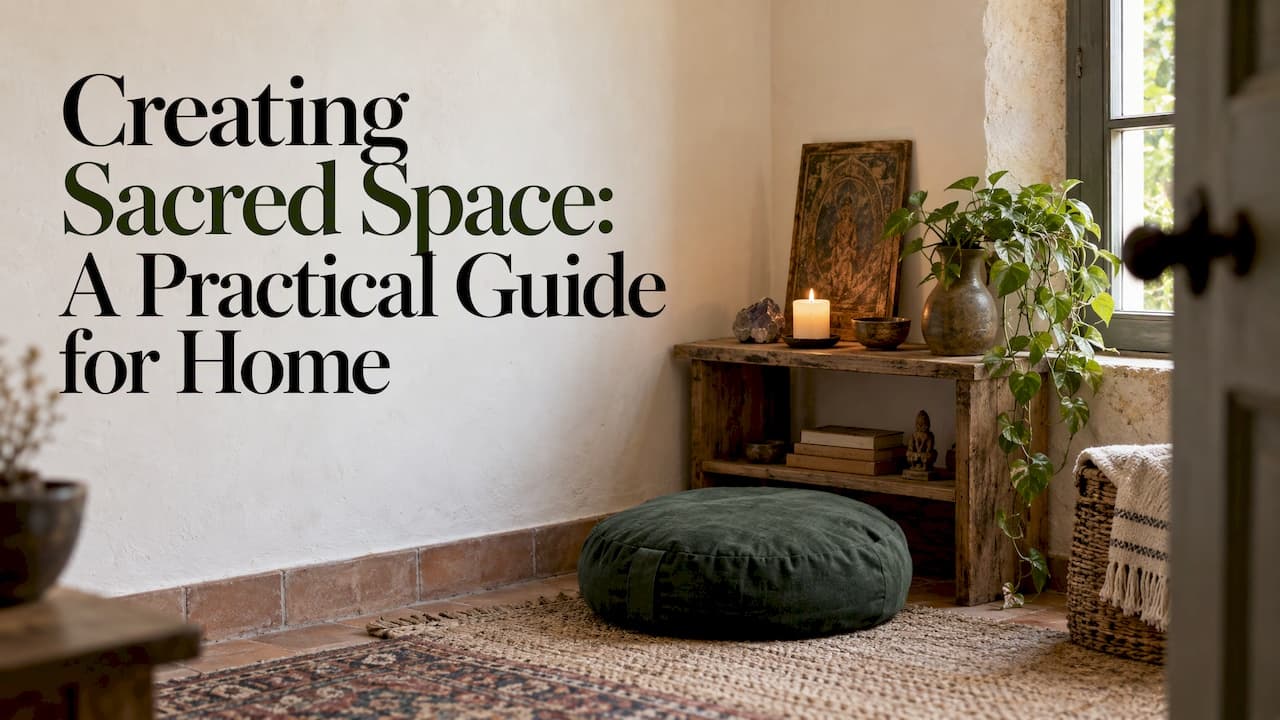
You create a sacred space by choosing a spot, clearing it physically, filling it with a few objects that mean something to you, and then using it regularly with a clear intention. It can be a whole room or a single shelf. What makes it sacred is not the furniture. It is the attention you bring to it, and the consistency with which you return.
This guide walks through each step, from the first decision about where to put it to how to clear a room's energy without burning anything, and how to do so with respect for the traditions many of these practices come from.
TL;DR
- Pick one defined spot, even a corner, shelf or windowsill, and give it a single purpose.
- Clean and declutter first, then add only a few objects that are meaningful to you: something from nature, a light source, a sound.
- To clear a room, open windows, use sound, or tidy with intention. Smoke is optional, and "smudging" is a word that belongs to specific Indigenous nations.
- Use the space daily, even for five minutes. Consistency matters more than decoration.
- If you burn candles or incense, ventilate and keep flames away from anything flammable.
Table of Contents
- What a sacred space actually is
- Step 1: Decide what the space is for
- Step 2: Choose the place
- Step 3: Clear the space physically
- Step 4: Choose what goes in it
- Step 5: Clearing the energy of a room
- Safety: candles, incense and smoke
- Step 6: Open, use and close the space
- Keeping it alive
- Our perspective
- Take the next step with us
- FAQ
- Sources
What a sacred space actually is
Scholars of religion describe a sacred place as a defined place set apart from ordinary ones. It focuses attention on actions and objects that carry meaning, and it can serve as a point of access between human and divine realities. Anthropologists add that such places are typically marked by a threshold separating sacred from everyday space.
Two ideas from that definition are useful at home. First, the space is distinguished: you can tell, physically, when you have stepped into it. Second, it has a threshold: some small act that marks the crossing, such as lighting a candle, ringing a bell, or taking three slow breaths.
A published review in the medical literature notes that sacred spaces can give people a sense of transcendence and connection to something larger than themselves, and that they can be inherently serene, like a forest clearing, or created on purpose through ritual and intent. That second kind is what you are building.
You do not need to hold any particular belief for this to work. People use sacred spaces for prayer, meditation, journaling, breathwork, grief, gratitude, or simply to stop for a moment in a loud life. The purpose is yours to name.

Step 1: Decide what the space is for
Before you move a single object, answer one question: what do I want to do here?
A space for morning meditation looks different from one for ancestor remembrance, creative work, or a weekly ritual with friends. Write the purpose in one sentence. "This is where I sit quietly before the day begins." "This is where I honor the people I have lost." That sentence becomes your filter for every object you consider.
It also keeps the space from becoming a decorative shelf. A space with no purpose tends to collect clutter, and a cluttered sacred space defeats itself.
Step 2: Choose the place
Look for three qualities: relative quiet, a sense of being slightly apart, and a place you will actually pass often enough to use.
Good options include:
- A corner of the bedroom, away from the bed's foot if you want to keep it separate from sleep.
- A spot by a window with natural light.
- A low table in a living room that you can clear in a minute.
- A balcony, porch or a place under a tree in the yard.
- A single shelf or a small box that opens into a portable altar.
If you have little room or share your home, you do not need a dedicated room. One guide on creating a sacred space at home suggests that a corner, shelf, windowsill or portable box works, and that you can put it away when it is not in use. The same piece recommends talking with the people you live with about whether they may use or add to the space.
That conversation matters more than it sounds. A shared home works when the boundaries are spoken: which corner, which hours, and whether children or partners may touch the objects. A simple agreement such as "this shelf is mine, and you are welcome to sit with me" prevents most friction.
If you live in a busy home
Three habits help:
- Use a tray or box. Everything lives in it. You set it out, practice, and put it away.
- Anchor the space with time, not only place. Ten minutes before others wake can feel more sacred than a permanent altar in a noisy hallway.
- Use a portable threshold. A particular scarf, a small bell, or a stone you hold. When it is in your hands, the space is open.
Step 3: Clear the space physically
The first thing most people skip is the plainest: cleaning. Sweep, wipe the surface, dust, wash the floor and wall nearby, and remove what does not belong. Take everything out of the corner before you decide what returns to it.

This is not only a preparation for ritual. It is the ritual's first act. Putting your hands to a surface and saying "this place is being made ready" does more to change how a room feels than most objects you can buy.
A practical order:
- Remove everything from the spot.
- Clean the surface, floor and nearby wall.
- Let in fresh air by opening a window for a few minutes.
- Return only what supports the purpose you wrote down.
- Donate or discard the rest, rather than moving it to another corner of the room.
If the clutter in your life is bigger than the corner, start small anyway. A cleared shelf is a start, and a cleared shelf you use will prompt the next clearing.
Step 4: Choose what goes in it
Less is better. Three to five things are enough. Choose from these categories.
Something from nature
Stones, shells, a branch, feathers you found yourself (check local rules on wildlife feathers), seeds, a bowl of water, or a living plant. Environmental psychology research on spaces that support attention points to natural elements, plants, natural light and calm colors such as green as helping people focus, and it also mentions gentle sounds such as chimes or ambient music.
A light source
A candle, a lamp with warm light, or the daylight itself. Place the space where morning or evening light falls if you can.
A sound
A small bell, a singing bowl, a rattle, or a short piece of music you use only here. A repeated sound becomes a signal to your body that you have arrived.
A personal object
A photograph, a gift from someone you love, a book you return to, a piece of jewelry from a grandmother. These carry the story that nothing store-bought can.
A representation of the directions or elements, if that is your tradition
Some people place four stones for the directions or objects for earth, water, fire and air. If you want to explore this, our piece on the four directions prayer explains the meaning and how to pray it with care.
Avoid adopting sacred items from closed traditions because they look beautiful. If an object belongs to a living culture's ceremony, ask whether it is yours to use. When unsure, choose what comes from your own land, family and life.
Step 5: Clearing the energy of a room
Many people want to clear a room after an argument, an illness, a move, or a period of heaviness. Whatever you believe about energy, ritual works partly through psychology: slowing down, setting an intention and attending to a space can mark a transition and change how your home feels.
Here are ways to do it, from simplest to most ceremonial.
| Method | What you do | Good for |
|---|---|---|
| Fresh air and sunlight | Open windows and let light in for 10 to 15 minutes | Any room, any day, no equipment |
| Sound | Ring a bell, clap in the corners, or play a singing bowl | Small rooms, apartments, shared homes |
| Salt | Place a small dish of salt in corners | Quiet, long-term anchoring |
| Spray | Use a water-based spray with a scent you like | Quick resets |
| Intentional tidying | Clean while speaking your intention aloud | Preparing a new space |
| Plant smoke | Burn dried herbs or resin in a heatproof dish | Those who like the ritual of smoke, with ventilation |
Guides on cleansing a home's energy commonly list bells, clapping, singing bowls, salt in corners, sprays, and open windows as smoke-free options. Others also describe sound, sprays and burned herbs or resin for clearing residual energy.
A simple method that works in most homes: open a window, walk the room clockwise or in the direction that feels natural, ring a bell in each corner, and say aloud what you are inviting in. Finish at your sacred space. It takes about five minutes.
A word on "smudging"
The word smudging names a specific, closed ceremony within certain Indigenous nations, involving particular plants and protocols. Writers on home cleansing advise non-Indigenous people to say "smoke cleansing" for general plant burning instead, and to avoid borrowing the ceremony's name or its procedures.
This is a matter of respect, not rules for their own sake. If you want language that honors the difference between a borrowed practice and your own, read about respectful alternatives to culturally loaded ceremony terms. The same habits apply at home: name your practice for what it is, learn where an element comes from, and use what belongs to your own lineage or what you have been taught directly by a teacher who has the right to share it. Our guide to choosing a shamanic teacher gives questions to ask when you are not sure who that is.
Safety: candles, incense and smoke
A sacred space often includes flame. Treat it with the same care you would give any open fire.
The National Fire Protection Association advises that you blow out candles when leaving the room or going to bed, keep them at least one foot from anything that can burn, and avoid using them in rooms where people may fall asleep. It also suggests flameless candles as an alternative, which is a good choice for a space shared with children or pets, or a bedroom corner.
For incense and burned herbs, ventilation matters. Laboratory research on incense found that burning it releases fine particulate matter in large quantities compared with other indoor sources. If you have asthma, a heart or lung condition, are pregnant, or share your home with infants or pets, talk with your doctor before burning anything indoors, and choose sound, light and fresh air instead.
Practical habits:
- Open a window or door while burning anything.
- Use a heatproof dish or holder on a stable surface.
- Never leave burning material unattended.
- Fully extinguish it before you leave, then check again.
- Keep matches and lighters out of children's reach.
Step 6: Open, use and close the space
A space becomes sacred through use. Create a short opening and closing, the threshold we described earlier.
An opening might be:
- Stand or sit in front of the space.
- Take three slow breaths.
- Light a candle or ring the bell.
- Say your intention in a sentence: "I am here to listen."
Then do what the space is for. Sit in silence, journal, pray, move, sing, or practice a journey. If you are curious about the last, our beginner's guide to shamanic journeying describes a first journey step by step.
A closing is the same in reverse: thank whatever you addressed, extinguish the flame, and take one breath as you step out. The ritual of closing is what lets you carry the calm back into the rest of your day.
Keeping it alive
Consistency is what separates a sacred space from a pretty corner. Writers on this subject agree that using the space daily, even for a few minutes, reinforces its purpose in everyday life.
Some ways to keep it going:
- Attach it to something you already do. Sit there with your morning tea.
- Change it with the seasons. Swap a stone for a leaf in autumn, add a candle for winter's long nights. Our piece on solstice rituals shows how a single candle can mark the turning of the year.
- Dust and reset weekly. A neglected altar turns into storage.
- Let it hold hard seasons too. In times of loss, the space can become where you grieve. Our article on grief rituals explains why meaning matters more than how often you practice.
- Take it outside. The land around your home has its own presence, and honoring the land spirits can extend your space past the front door.
Mistakes people make: buying too many objects at once, copying someone else's altar, burning things they do not understand, and abandoning the space after two weeks. Start with less, and let it grow with your practice.
Our perspective
At Sacred Paths we have seen that people rarely come to us because they lack information. They come because they feel disconnected: from themselves, from the land, from a sense of purpose. A sacred space is often the first, humblest answer to that disconnection.
We believe a space becomes sacred through experience, not through the things in it. That is why our school at La Ferme du Cerf Bleu, a rewilded 18th-century farm in Burgundy, is built around practice, community and nature rather than passive study. We teach that the first sacred space is the one you carry in your body, and the one you make with your hands in your own home is its rehearsal.
Start with a corner, a stone and five minutes. Then come back tomorrow. When you are ready to deepen, a circle, a teacher and the land itself will carry you further than any list of tips can.
Angell
Take the next step with us
If your space has become a place you return to and you want guidance to go deeper, we offer structured ways to do it. Becoming the Medicine: 21-Day Practice is $67 and gives you a daily rhythm to build, and Becoming the Mystic is $197. Both are on our main site, alongside our retreats and school at La Ferme du Cerf Bleu.

If you would rather work one to one, we also offer coaching and healing sessions, and our two-year initiatory path in Andean and Norse shamanism, you can explore through the Sacred Paths home page.
FAQ
How do I create a sacred space in a small apartment?
Use a shelf, windowsill or a box that you can open and close. Put in three or four meaningful objects, and keep the rest of the room clear. Setting it out and putting it away each time is itself a way of marking the threshold.
Do I need to burn sage or incense to make a space sacred?
No. Open windows, sound, salt, a spray, or simply cleaning with intention all work as ways to clear a room. If you do burn plants or resin, ventilate well and call it smoke cleansing rather than smudging, which is a closed ceremony of specific Indigenous nations.
How often should I use my sacred space?
Daily if you can, even for five minutes. Regular short use builds the space's purpose more reliably than occasional long sessions. If a day is missed, simply return the next one.
Can I share a sacred space with my family or roommates?
Yes, with a conversation first. Agree on which corner is yours, the hours you use it, and whether others may touch or add to it. A portable box or tray helps when the space is shared.
Sources
- Sacred Space, Encyclopedia.com
- Symbolic and Sacred Space, OpenStax Introduction to Anthropology
- Sacred Space, PMC (2018)
- How To Create A Sacred Space In Your Home, HuffPost
- The Architectural Design Strategies That Promote Attention, MDPI Buildings (2024)
- How to Cleanse Your Home's Energy, Celesian
- Creating a Sacred Space: A Complete Guide, Sacred Essence
- Candle Safety Tips, NFPA
- Characterization of emissions from burning incense, ScienceDirect