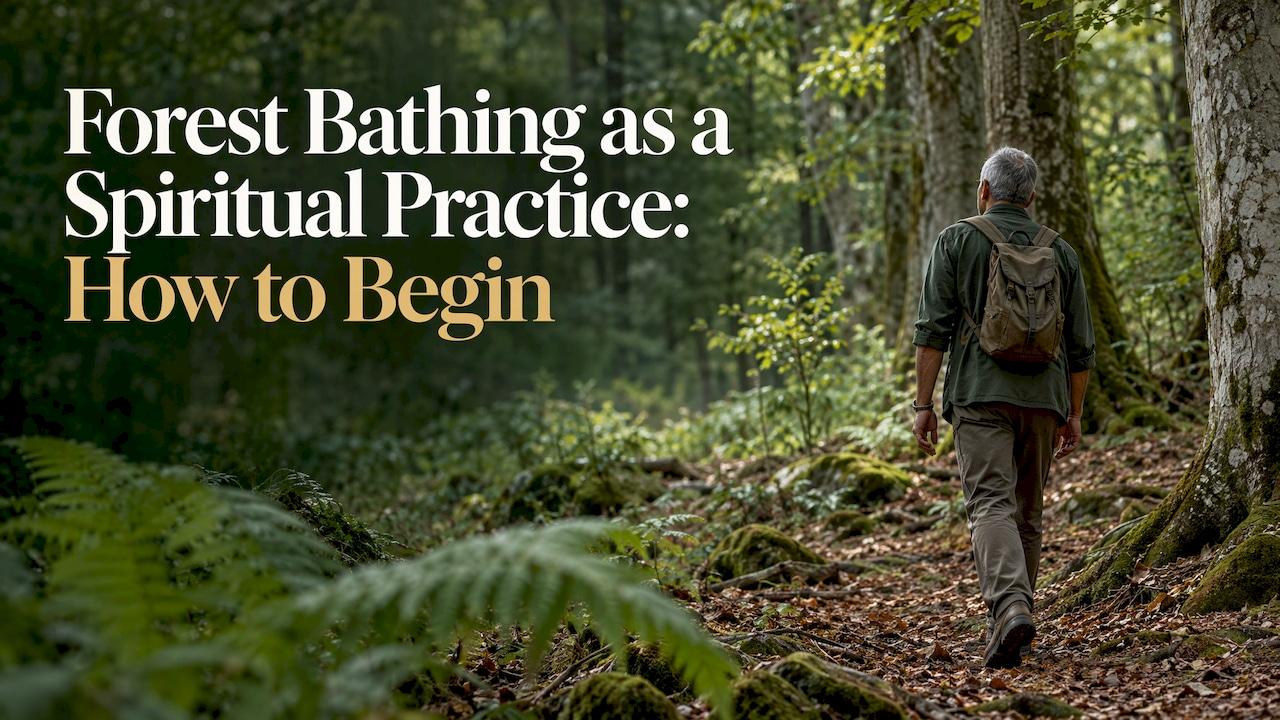
Forest bathing becomes spiritual when you stop treating the forest as scenery and start meeting it as a living presence. You slow down, open all five senses, and let the place work on you instead of you working through it. Anyone can start with 20 minutes under trees. The depth comes from intention, repetition and a way to carry what you notice back into your life.
This guide explains where the practice comes from, how to do it step by step, what to bring, what research says about its effect on stress, and how to turn a pleasant walk into a real practice of reconnection. It is written for people in transition, people who feel cut off from their purpose, and healers who want to ground their work in the natural world.
TL;DR
- Forest bathing (shinrin-yoku in Japanese) means immersing yourself in the atmosphere of a forest with all your senses. It is not exercise or hiking.
- It has spiritual roots: Shinto and Buddhist traditions in Japan revere forests as a realm of the divine.
- To practice, silence your phone, walk slowly, pick one sense or one thing to notice for about 20 minutes, pause, then repeat. A session can run from 10 minutes to two hours.
- A 2019 meta-analysis found lower salivary cortisol, a stress marker, in forest groups than in urban groups.
- Journaling after each session, and returning to the same spot, is what turns a relaxing walk into a lasting spiritual practice.
Table of Contents
- What forest bathing actually is
- The spiritual roots of forest bathing
- How to forest bathe, step by step
- How long should a session last?
- What to wear and bring, and how to stay safe
- What happens when you slow down: the effect on mind and body
- Solo or with others: what each gives you
- From a good walk to a spiritual practice
- Perspective: why place and practice belong together
- Where to go next
- FAQ
- Sources
What forest bathing actually is
The phrase is a translation of the Japanese shinrin-yoku, literally "forest bath." Nobody gets wet. The Cleveland Clinic explains that it means immersing yourself in the atmosphere of the forest rather than bathing in a literal stream.
The Global Wellness Institute, as quoted by the American Psychiatric Association, describes it as a conscious, contemplative practice of immersion in sights, sounds and smells, not simply a walk in the woods. The term itself arose in Japan in the 1980s to promote physical and mental health.
The pace is the whole difference. A hike has a destination and a hiker watches the clock. Forest bathing has no destination. You might cover half a mile in two hours.

The spiritual roots of forest bathing
The word is modern. The attitude behind it is old. Japan House at the University of Illinois notes that both Shinto and Buddhism revere forests as a realm of the divine. Folklore there holds that spirits called kodama live in trees. In that light, shinrin-yoku is about fully realizing the intimate physical, emotional and spiritual connection between people and nature.
That idea is not unique to Japan. Many traditions treat land, trees and water as beings to be greeted, not resources to be used. Andean peoples speak of mountain spirits and of reciprocity with the earth, which you can read about in our guide to Andean shamanism, paqos, apus and ayni. Norse traditions also carry a living relationship with the land, covered in our overview of Norse shamanism.
You do not need to adopt any belief system to begin. What the spiritual approach adds is a question: not "what is good for me here?" but "who or what is here, and how do I meet it?"
How to forest bathe, step by step
There is no single correct method. This sequence draws on guidance from clinicians and park organizations, with notes on where people usually stumble.
1. Choose a place and a time
A forest is ideal, but it is not required. Namyun Kil, a certified forest therapy guide and professor at the University of Wisconsin-La Crosse, says the practice works in a park, yard, botanical garden or other natural area. The National Trust suggests picking a quieter time of day, which makes silence easier.
2. Leave the device behind, or silence it
Kaiser Permanente advises silencing your phone and paying attention to your surroundings. The common mistake is keeping it in your hand "just for photos." Put it in a pocket or bag and keep it there.
3. Arrive before you walk
Stand still at the edge of the trees. The National Trust recommends taking 10 slow deep breaths with your eyes closed to clear the mind. If you want a spiritual frame, this is the moment to greet the place silently, in your own words. Nothing needs to be said aloud.
4. Walk slowly, with no agenda
Dr. Suzanne Bartlet Hackenmiller, a physician and author on the practice, describes it as a quiet, contemplative walk or sit in nature with no real agenda other than to notice what you notice. If you catch yourself planning your week, that is normal. Return to the senses.
5. Give each sense its turn
A traditional guided walk, as described by the Trust for Public Land, has a small group focus in silence on one aspect of their surroundings for about 20 minutes, such as what is in motion, sounds, dark colors or physical sensations. Alone, you can do the same:
- Sight: look for what moves, and for the darkest color you can find.
- Sound: identify the farthest sound, then the nearest.
- Smell: crush a leaf or kneel to the soil.
- Touch: feel bark, moss, water, wind on your skin.
- Taste: notice the air itself, cool or damp, and only taste anything you can identify as safe.
6. Pause and reflect
After each round, stop. Hackenmiller advises pausing to reflect, then moving to another category. If walking is hard, use a "sit spot": one place you return to and simply stay.
7. Sit with the place
This is where the spiritual dimension tends to open. Sit for 10 to 20 minutes with nothing to do. Notice whether you feel watched, welcomed or ignored by the place. Do not judge it. Just record it.

8. Close and give thanks
End with a gesture: a few breaths, a hand on a tree, a spoken or silent thank-you. Rituals of closing teach your nervous system that the session has an edge, and the feeling is easier to carry out of the woods.
9. Write it down
Kaiser Permanente suggests tying the practice to a journaling routine to track your experiences and thoughts after each session. Our spiritual journal prompts for healing, shadow work and nature give you questions to start with.
How long should a session last?
Kil says forest bathing typically takes about two hours within a mile or less of walking, but it can happen in as little as 10 to 15 minutes, or stretch over days or weeks. Kaiser Permanente suggests at least 20 minutes daily in any natural setting.
A useful rhythm for beginners:
| Goal | Length | Frequency |
|---|---|---|
| Learning to slow down | 20 minutes | Daily or most days |
| A real reset | 1 to 2 hours | Weekly |
| A turning point or threshold | Half a day or more | When a transition calls for it |
The National Trust notes that two hours is the recommended session length, but even 10 minutes in nature can help you feel refreshed.
What to wear and bring, and how to stay safe
This is the practical side people ask about. Nothing special is needed, but a few basics matter.
- Clothing: the University of Minnesota's guide says to check the weather and dress accordingly. Wear layers and footwear you can stand in for a long time. You will be still more than you expect, and still bodies get cold.
- Water: bring some, as the same guide advises.
- Sun and allergies: Kaiser Permanente says to consider sunscreen and allergies.
- Trails: stay on marked trails.
- Tell someone: let a person know where you are going and for how long, or bring a friend.
- Sound: the University of Minnesota suggests listening with one earbud in if you use audio guidance, so you can still hear the forest. Fully silent is better when you can manage it.
If you have a medical condition that affects mobility, balance or breathing, or severe allergies, check with your doctor before a long outing, and choose a sit spot close to a path or a car.
What happens when you slow down: the effect on mind and body
A clinical psychologist at the Cleveland Clinic, Susan Albers, PsyD, explains that the forest's sights, sounds and smells take us into the present moment, so our brains stop anticipating, recalling, ruminating and worrying. That is the nervous-system side of what many traditions call presence.
The measurable side looks like this:
- A 2019 systematic review and meta-analysis screened 971 articles and included 22 studies. In the 8 studies it pooled, salivary cortisol was significantly lower in forest groups than urban groups, both before and after the intervention. The authors concluded forest bathing can reduce stress in the short term.
- A field study across 24 forests in Japan with 280 participants found that forest settings produced lower cortisol, pulse rate and blood pressure than city settings, along with greater parasympathetic (rest-and-digest) nerve activity.
- A 2017 beginner's account in the Boston Globe described the experience as guided meditation with a component of sensory awareness, and contrasted it with trekking while staring at a fitness tracker.
Calming the body is a necessary first step for any inner work. If you are curious about how a settled nervous system feels from other angles, there is research on massage and the nervous system that looks at the same stress pathways.
Solo or with others: what each gives you
A study comparing guided and self-guided forest therapy, reported by the American Psychiatric Association, found that self-guided practice offered an opportunity for self-reflection to focus on one's inner self. Guided programs offered positive emotional change and social bonds through interaction with others.
That maps neatly onto spiritual work. Solitude is where you listen. Community is where you test what you heard and share it. Kaiser Permanente distinguishes the two, noting that forest bathing is a mindfulness practice that can be done solo, while forest therapy is more structured and usually involves trained guides. Most people benefit from both over time.
From a good walk to a spiritual practice
Plenty of people enjoy a forest bath and never feel anything more than calm. If you want more, these additions are what shift it.
Set an intention. Before you enter, ask one simple question: "What do I need to hear?" or "What am I ready to put down?" Then leave it alone.
Greet the land. Many traditions begin by acknowledging the beings of a place. Our guide to land spirits and how to honor them shows a respectful way to do it.
Walk with purpose, not a goal. A medicine walk is a close cousin of forest bathing: you walk with a question and watch for what the land shows you. Forest bathing builds the quiet attention that makes a medicine walk possible.
Notice signs without forcing meaning. A bird crossing your path or a fallen branch may feel significant. Write it down, then see whether it keeps speaking over the following days. Our piece on meeting your spirit animal and respecting Indigenous traditions explains how to approach this with care.
Go deeper into stillness. When you can sit for an hour without restlessness, you are ready to learn about shamanic journeying, a guided inner journey often practiced after time in nature.
Return to the same place. One tree, one clearing, one bench. Visiting through the seasons teaches you more than visiting a hundred new places once.
Perspective: why place and practice belong together
At La Ferme du Cerf Bleu, a rewilded 18th-century farm in Burgundy, we teach through experience before information. Nature is not a backdrop for our work. It is the teacher.
Many people arrive feeling disconnected from their purpose. In our experience as a school, reading about connection rarely changes that. Standing in a forest, with nothing to do and no one to impress, often begins to.
Forest bathing is a gentle doorway. It teaches the basic skill every shamanic path rests on: paying attention to the living world and answering it with respect. From there, circles, ceremony and mentoring give that attention a shape and a community to grow in.
I am a veterinarian and a medicine man, and I bring both the modern and the traditional to this work. I would encourage you to begin in the simplest way: go outside, slow down and listen.
Angell
Where to go next
If forest bathing has opened something and you want guidance in following it, Sacred Paths offers several ways in. Becoming the Medicine: 21-Day Practice is $67 and gives you a structured, daily way to build a practice. Becoming the Mystic is $197. For one-to-one support, a Shamanic Healing Session is $245, and Shamanic & Spiritual Coaching is $395 as a one-off session.

If you want to practice in person, we hold retreats at La Ferme du Cerf Bleu in Burgundy, surrounded by the rewilded land of the farm. You can explore every current offer on the Sacred Paths site.
FAQ
What is the spiritual meaning of forests?
In Japan, Shinto and Buddhism revere forests as a realm of the divine, and folklore holds that spirits called kodama live in trees, according to Japan House at the University of Illinois. Many other traditions also treat forests as living, sacred places. For the practitioner, a forest is a place of listening, renewal and relationship.
What is Japanese forest bathing?
It is shinrin-yoku, the practice of taking in the forest atmosphere through all your senses. The American Psychiatric Association's blog notes it was developed in Japan in the 1980s to promote physical and mental health. It is slow and sensory, not exercise.
How much does forest bathing cost?
Doing it yourself is free: you need a green space, comfortable clothing and time. Only guided sessions or retreats carry a fee, and these vary by place and length. The practice itself does not depend on any purchase.
What do you wear to forest bathing?
Dress for the weather and for standing still, with layers and comfortable footwear. The University of Minnesota's guide advises checking the weather and bringing water. Add sunscreen if needed, and tell someone where you are going.
Can I forest bathe in a city park?
Yes. Kil notes it can be done in a park, yard, botanical garden or other natural area, and in as little as 10 to 15 minutes. A single tree and a quiet bench are enough to begin.
Sources
- Japan House, University of Illinois: Shinrin-Yoku, Forest Bathing
- American Psychiatric Association: What Is Forest Bathing and How Does It Help?
- Cleveland Clinic: What Is Forest Bathing?
- Kaiser Permanente: Forest bathing, what it is and how to try it
- Trust for Public Land: Happiest Outside, Forest Bathing
- University of Minnesota: Forest Bathing Audio Guide
- National Trust: A beginner's guide to forest bathing
- PubMed: Effects of forest bathing (shinrin-yoku) on levels of cortisol
- Park et al.: The physiological effects of Shinrin-yoku
- The Boston Globe: The un-hike, forest bathing for beginners