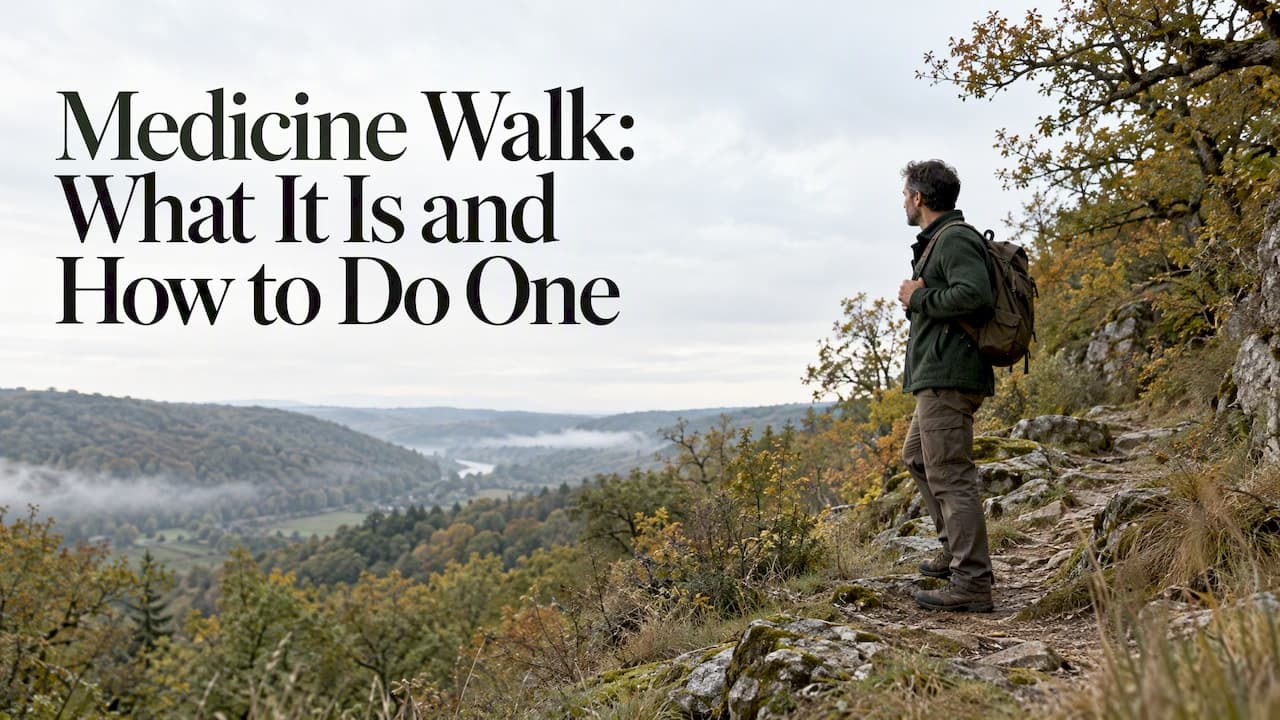
A medicine walk is a ceremony, not a hike: you go alone into nature for several hours, up to a full day, carrying one clear question about a life transition, and you pay attention to what the land shows you. The phrase is also the title of Richard Wagamese's 2014 novel, which is what most search results show. This article is about the practice itself: where it comes from, how to prepare, how to walk it, and how to bring the experience home.
TL;DR
- A medicine walk is a solo, intentional walk in nature, usually a few hours to a day, grounded in Indigenous traditions and ecopsychology and used to seek guidance at a threshold.
- It is shorter and gentler than a vision quest, which typically involves several days of solitude and fasting.
- The three things that matter most: a specific question, a fixed return time with a safety plan, and a journal to record what happens.
- The walk is half the work. Sharing the story afterward with someone who listens without interpreting is where the insight settles.
- The novel of the same name is a different subject, covered briefly below.
Table of Contents
- The novel and the practice: two meanings of one phrase
- What a medicine walk is
- Roots: Indigenous traditions, ecopsychology and rites of passage
- Medicine walk or vision quest?
- How to prepare
- Walking it, step by step
- Coming home: integration
- Our perspective
- Walking with guidance
- Common mistakes
- FAQ
- Sources
The novel and the practice: two meanings of one phrase
If you arrived looking for the book: Wagamese's Medicine Walk follows 16-year-old Franklin Starlight, who takes his estranged, dying father Eldon into the British Columbia backcountry, according to the publisher-derived summary on Google Play. Its follow-up is Starlight, published after the author's death. Speaking to CBC Radio, Wagamese described the medicine walk as a metaphor for gathering the medicines, the truths and histories, that sustain a life, and that those medicines bring a person closer to the centre of their being.
That idea is a good bridge to the practice. In both, walking through land is a way of collecting what you need to carry forward.
What a medicine walk is
Practitioners describe a medicine walk as an experiential practice in which you walk alone in nature for several hours to a full day to seek guidance for a life transition. The Wilderness Guides Council outlines the core pattern: set a clear intention or question, walk mindfully, observe signs in the environment, and share the experience afterward to integrate what you learned.

The word "medicine" here does not mean a remedy. One teacher defines it as your power and abilities, what you can offer to others. A medicine walk asks: what is mine to carry, and what is ready to be set down?
In shamanic practice, the walk rests on a simple premise. The world is not a backdrop. It is speaking, and a person who walks with an open question and a quiet mind will notice things they would otherwise walk past.
Roots: Indigenous traditions, ecopsychology and rites of passage
The practice sits in a long line of threshold ceremonies. Anthropologists describe classic rites of passage as a sequence of severance from the former life, a sacred time apart, and a return. The Encyclopedia of the Great Plains entry on the vision quest places Plains vision quests in this pattern, as rites that often confirmed a change in social status. If you want the three stages explained in plain terms, our guide to rites of passage and the three stages behind modern ceremony design walks through them.
Two things are worth saying plainly about origins.
First, these are living traditions that belong to specific peoples. Anthropologist Robin Ridington, writing about the Dunne-za, shows that medicine stories are treated as sacred secrets of the vision quest, which over a lifetime move from private knowledge to stories honored by the wider community. A walk you take on your own is not the same as a vision quest held inside a community with its own elders and protocols. Honor the difference, do not borrow another nation's songs or names for ceremony, and be wary of anyone who sells "authentic" Indigenous rites without a lineage to show for it.
Second, the modern medicine walk is also a product of ecopsychology. Its proponents argue that the separation of modern people from nature is a primary source of suffering, and that a medicine walk is a practical way to ground the "distress of transition" in direct contact with the living world. That is an argument from practitioners, not a clinical finding, and it is worth holding as a framework rather than a proven treatment.
Medicine walk or vision quest?
The two are related, but they are not interchangeable.
| Medicine walk | Vision quest | |
|---|---|---|
| Length | Several hours to one day | Multiple days |
| Conditions | Walking, usually with water and food available | Solitude, fasting, rigorous preparation |
| Purpose | Guidance on a question or transition | Often marks a change of status or calling |
| Community role | Optional sharing afterward | Typically embedded in community and elders |
| Accessibility | Open to most healthy adults | Needs experienced guides and long preparation |
The Wilderness Guides Council notes that a medicine walk is a shorter, often single-day ceremony, can serve as preparation for longer quests, and is accessible for personal reflection in modern settings. For most people, it is the right first step.
How to prepare
Preparation decides how much the day gives you. Give it a few days, not ten minutes in the car.
Choose your question
Experienced guides report that the deepest insights tend to come when the walker carries a specific, well-articulated question or task. The question works as a container. It focuses attention on signs you might otherwise miss.
Weak: "What should I do with my life?" Better: "I am leaving this job in March. What do I need to carry into what comes next, and what do I leave behind?"
Write the question on paper. Edit it until it fits in one or two sentences and sounds like something you actually need to know.
Pick the place and the time
Choose a place you can walk without a crowd: a quiet trail, a wood, a stretch of coast, a meadow. Familiar land is fine. You do not need wilderness, and you should not go beyond your experience to find it. Check the weather, tell the land managers if permits are needed, and pick a window of daylight with a firm end.
Build your safety container
Practitioners stress that a medicine walk is a ceremony, not a casual hike, and that clear boundaries such as a fixed return time and a buddy system are part of doing it properly. In practice:
- Tell a buddy your route, your start time and the time you will be back. Agree what they do if you are not back.
- Carry water, food, a charged phone for emergencies only, a first aid kit, a layer for weather, and a map.
- Leave your headphones and camera behind. The point is attention.
- If you have a medical condition, a history of trauma that surfaces strongly when alone, or you are in acute emotional crisis, talk to your doctor or therapist first. A walk can stir things up. It is not a substitute for care.
Mark the threshold
The facilitation method documented by METODIC has walkers cross a marked threshold on the way out and on the way back. You can do this simply: lay two stones, or pause at a gate, state your question aloud, and step through. A clear crossing tells the mind that something different is beginning.
Walking it, step by step
- Begin with the question. At the threshold, say it once, quietly or aloud. Then let it rest.
- Walk slowly, without a destination. Aimless wandering is part of the process. Let your feet choose, and stop where you feel pulled to stop.
- Scan for signs. One practitioner describes the walk as walking with an intention firmly fixed in the mind while consciously scanning for signs. Notice animals, weather shifts, a fallen tree, a sudden change of terrain, a song from nowhere.
- Weigh the unusual. The same writer holds that the more unusual or arresting an event, such as a specific animal encounter, the more significant the message is likely to be. Treat that as a tradition's rule of thumb, not a law. If you want a careful take on reading animal encounters, see our piece on how to meet your spirit animal, test signs and respect Indigenous traditions.
- Accept bitter and sweet. A medicine can be hard to hear. A storm that sends you back early may be the answer, not an interruption.
- Record as you go. Write down each moment right away. Immediate journaling is essential for later integration, because the details fade within hours.
- Return at your agreed time. Cross the threshold again and say thank you to the place. Eat something and drink water.
Coming home: integration
Most people stop at step seven. Don't. The walk gives you raw material, and integration turns it into a decision.
Find one person to listen. The METODIC method trains listeners to mirror the walker's story back without interpreting it or imposing meaning, which keeps you the author of your own insights. Tell the story in order, from the threshold to the return. Then ask what stood out, and only then ask what it might mean.
In the days after, reread your notes and sort them into three piles: what is clear, what is puzzling, what asks for action. Choose one small action within the week. Insight that never touches daily life evaporates.
Sharing matters beyond the practical. Change tends to last when it is witnessed. If you are working through something heavy, such as loss, community support is also a recognised pillar of long-term change in recovery settings, and the same logic applies to any deep transition: you do not have to hold it alone. If grief is part of your question, our article on grief rituals and why meaning matters more than frequency may help you shape what comes next.

Our perspective
We teach on a rewilded 18th-century farm in Burgundy, and we have seen the same pattern repeat. People arrive wanting information. What changes them is experience: an hour on the land with a real question does more than a month of reading about one.
We hold three convictions about medicine walks.
The land is a teacher, and the first lesson is slowing down. Most of what people call a message is simply the first moment in weeks they were quiet enough to notice something.
A question beats a wish for revelation. We ask students to write theirs down and to expect the answer to be partial. A walk rarely hands you a plan. It hands you a direction and one honest next step.
Community completes the practice. A solitary walk followed by a circle of people who listen without fixing is a different experience from a walk followed by silence. That is why our work is built around circles and mentoring rather than passive coursework, and why we draw on several cosmologies, including Andean and Norse paths, with respect for where each comes from instead of blending them into a vague "universal" shamanism.
One caution from a veterinarian's training: nature is not sentimental. Prepare for weather, terrain and your own limits as you would for any serious day outdoors. Respect is practical before it is spiritual.
— Angell
Walking with guidance
A first medicine walk is easier with someone who has held the container before. If you are at a threshold, such as a career change, a loss, or a sense of being cut off from your purpose, we offer shamanic and spiritual coaching at $395 one-off, where we can help you shape your question and debrief what you bring back. If you want something more ceremonial, a shamanic healing session is $245 one-off. And if you are drawn to a longer path, you can explore Sacred Paths Shamanic School and its EarthWalker and FireKeeper programs.
Common mistakes
- Treating it as exercise. Pace and distance are irrelevant. Slow down.
- Carrying five questions. One question gives the day a spine.
- Over-reading every leaf. Look for what is unusual and repeated, not for a symbol in every bird.
- Skipping the debrief. A walk without integration often fades into a pleasant memory.
- Going unprepared. Weather, water and a buddy are not optional.
- Appropriating songs or names. Use your own words. Learn from living traditions through teachers who belong to them or are properly trained in them.
FAQ
What is a medicine walk?
It is a solo ceremony in nature lasting several hours to a full day. You carry a specific question about a life transition, walk mindfully, notice signs in the environment, and share the story afterward to integrate it. It draws on Indigenous traditions and on ecopsychology.
Is a medicine walk the same as a vision quest?
No. A vision quest usually involves several days of solitude, fasting and demanding preparation within a community. A medicine walk is shorter, often a single day, and is more accessible for personal reflection. It can also prepare you for a longer quest.
Do I need a guide?
Not strictly, but a guide or a trusted buddy helps with safety and with the debrief. At minimum, tell someone your route and return time, and arrange for someone to listen to your story afterward without interpreting it.
Is the medicine walk the same as the Richard Wagamese book?
The novel shares the name and the idea that land holds healing, but it tells a story of a son and his dying father in British Columbia. The practice described here is a ceremony you do yourself.
Sources
- The Medicine Walk: An Exploration of Ecopsychology and Rites of Passage, Wilderness Guides Council
- Medicine Walk facilitation method, METODIC learn
- The Medicine Walk, Shamanic Poet
- Medicine Walk, Mark Nelson
- Vision Quest, Encyclopedia of the Great Plains
- Ridington, Dunne-za medicine stories, Canadian Journal of Native Studies
- Richard Wagamese on Medicine Walk, CBC Radio
- Starlight: Kanata Classics Edition, Google Play Books