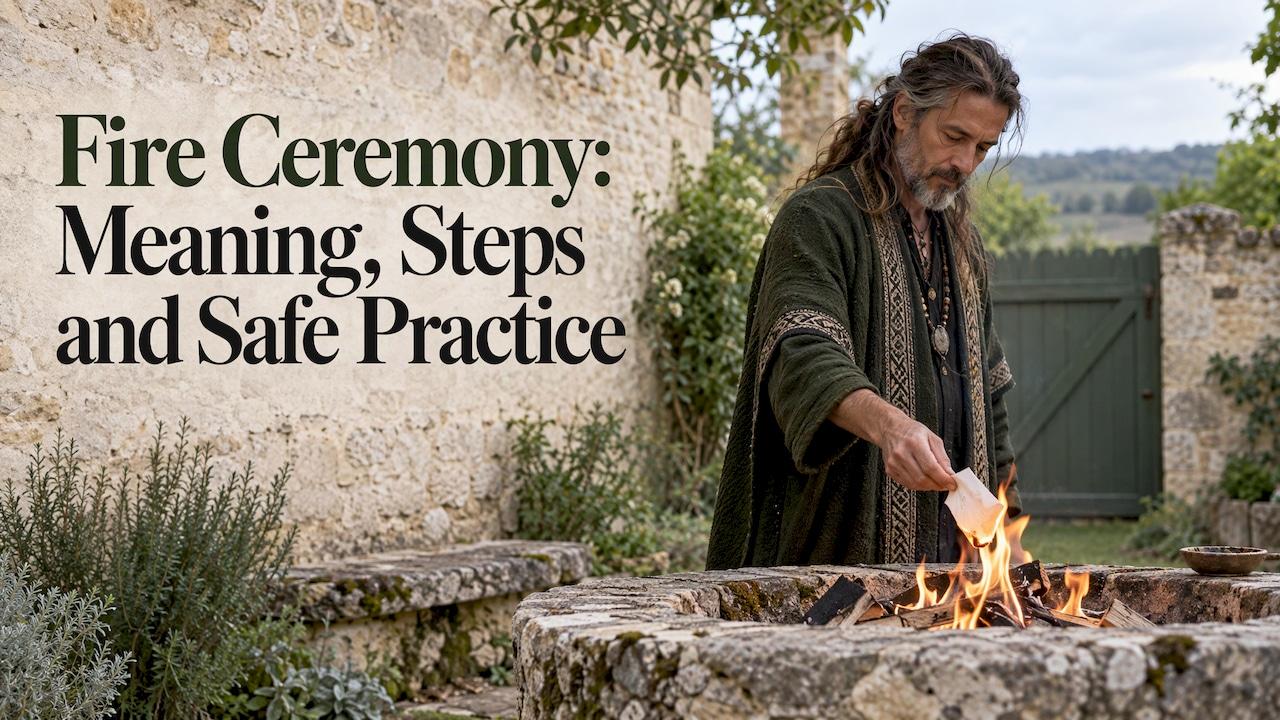
A fire ceremony is a ritual in which fire is the central sacred element: you give a prayer, an intention or something you are ready to release to the flame, and you let it carry that offering onward. You can hold a simple one alone at home with a fireproof bowl and a slip of paper, or you can sit in a circle around a larger fire led by someone trained to tend it. At Sacred Paths, a shamanic school at La Ferme du Cerf Bleu in Burgundy, France, we teach that the form matters less than three things: a clear intention, a prepared space and a respectful closing. This guide gives you the meaning, the roots, the steps and the safety rules.
TL;DR
- A fire ceremony uses fire as the sacred focus for purification, transformation or communion with spiritual forces: you offer something to the flame and let it go.
- A burning ritual, where you write what you release and burn the paper, is the simplest form. Many people also keep the ceremony with a candle only.
- Many Indigenous fire ceremonies belong to specific cultures and their culture-bearers. Learn the meaning, honor the source and do not copy sacred forms you were not given.
- Before you light anything, check your local open-burning rules: distance, permits, wind, water on hand and full extinguishment.
- A full moon is a natural moment for a release ceremony, and the new moon suits setting intentions.
Table of Contents
- What a fire ceremony means
- Burning rituals and the fire communion
- Roots of the sacred fire, and how to honor them
- How to do a fire ceremony, step by step
- A full moon fire ceremony
- Fire safety and local rules to check first
- Our perspective
- Go deeper with Sacred Paths
- FAQ
- Sources
What a fire ceremony means
Fire does something no other element does: it visibly transforms what you give it. Paper becomes light, heat and smoke. That is why so many traditions treat it as a messenger. The meaning of a fire ceremony, in almost every form, comes down to four movements: you arrive, you name what you carry, you offer it, and you give thanks.
The purposes people bring are familiar. Some come to release a habit, a fear, a grief or an old story. Some come to set a direction for a new season. Others come to honor ancestors, mark a threshold such as a birth, a move or an ending, or simply to sit in the presence of something older than their thoughts.
What separates a ceremony from a campfire is not the size of the flames. It is intention, structure and reverence. You decide why you are there, you open and close the space on purpose, and you treat the fire as more than a heat source.

Fire ceremony and smudging are not the same
Smudging uses smoke to clear a space or a person. A fire ceremony is a transformational ritual: offerings go into the fire with a specific intention, and the fire becomes the vehicle for release, prayer and renewal. You can do both in one gathering, but they are different acts, and smudging in particular carries its own cultural protocols in many Native nations.
Burning rituals and the fire communion
The burning ritual is the form most people meet first. You write down what you wish to release, read it, and place it in a fire as a symbolic act of surrender. It needs no special tools and no tradition's permission to be a private act of reflection.
There is also a long-standing communal version in the United States. On or near the first Sunday in January, many Unitarian Universalist congregations hold a fire communion or burning bowl ritual to bid farewell to the old year: each person writes a word or phrase for what they wish to release, then burns the paper before stepping into the new year. It shows how ordinary the practice can be. A bowl, a pen, a few quiet minutes and a shared moment are enough.
If you want to explore the same turning point through the seasons, our guide to solstice rituals with one candle at home offers a gentler version.
Roots of the sacred fire, and how to honor them
Fire ceremonies appear in Hindu yajnas, Native American practice, Mayan tradition, Buddhist Goma rites and modern eclectic gatherings. These are not variations of one thing. They are separate living traditions with their own meanings, lineages and rules.
Two documented examples show the depth behind the word "sacred":
- UNESCO describes fire among the San of the Okavango Delta as a symbol of wisdom, clarity, renewal and unity. The fire circle is the central space of the camp, where stories are told, strength is weighed and healing is called.
- A 2025 peer-reviewed study in Human Ecology found that for several Indigenous Peoples of Colombia, among them the Arhuaco, Tikuna and Uitoto, fire is a sacred and transformative force that symbolizes origin, spirit and deity, and that acts as a source of healing and purification in rituals and ceremonies.
What does this mean for you if you did not grow up in one of these traditions?
- Learn the source before you borrow the form. Know whose ceremony inspired yours and what it is for.
- Do not claim a ceremony as your own. There is no single version of a fire ceremony, so you can build a simple, honest one without copying another people's sacred rite.
- Receive from culture-bearers. When you want an Indigenous ceremony, attend one led by the people who hold it. Some, such as smoking ceremonies, can only be led by a person with the specific cultural knowledge, as one Australian local government's protocols state.
- Name your own lineage honestly. Say what you are doing and where it comes from.
Our article on respecting Indigenous traditions when you meet your spirit animal applies the same thinking, and choosing a shamanic teacher helps if you want guided training instead of improvising.
How to do a fire ceremony, step by step
This is a simple, safe ceremony for one person or a small circle. Plan about 30 to 45 minutes.
1. Choose your intention
Decide what the fire is for: releasing, gratitude, a new beginning, a farewell. Write it as one sentence. A vague intention gives a vague ceremony, and this is where most first attempts go wrong. If you need a list, ask three questions: What am I ready to put down? What am I grateful for? What do I want to welcome?
2. Prepare the place and the tools
Pick a spot that is outdoors or very well ventilated, away from anything that can catch fire, on stable ground. Bring:
- a fireproof vessel or a contained fire pit,
- natural dry seasoned wood, or a pillar candle in a heatproof holder if you prefer a flame without a fire,
- slips of paper and a pen,
- water, a bucket, a hose or an extinguisher within reach,
- something to mark the space, such as stones or a cloth.
A prepared space changes how you feel in it. Our practical guide to creating sacred space at home walks through the details.
3. Open the space
Stand quietly for a minute. Many people greet the four directions, the land and the fire itself, then say aloud why they are gathered. If you pray in the directions, our guide to the four directions prayer gives the meaning and the words. If you are meeting the place for the first time, honoring the land spirits is a respectful way to begin.
4. Light the fire with attention
Light it slowly. Watch it take. In a group, one person acts as the firekeeper and tends it throughout, so everyone else can be present. A common structure for a ceremony is exactly this: prepare the space, gather offerings, have a firekeeper tend the fire and close with gratitude.
5. Make your offerings
One at a time, read what you wrote, say it aloud or silently, and place it in the fire. Keep to natural materials: paper, dried herbs, small twigs. Never burn trash, plastics or treated wood. Stay with the fire until the paper is fully consumed. Notice what you feel. Some people feel relief, some feel emotion, some feel nothing yet. All of it is fine.
6. Sit in silence
After the last offering, sit for a few minutes. This is where the meaning lands. Journaling helps: write one line about what you released and one about what you are making room for.
7. Give thanks and close
Thank the fire, the land and anyone with you. Say the ceremony is closed. Then put the fire out completely: let the wood burn down, spread the embers, douse them with water, stir, and douse again until nothing is warm to the touch. Never walk away from smoldering ashes.

A candle version
You do not need flames in a yard. Place a pillar candle or a large tealight in a heatproof holder on a stable surface, write your offerings on slips of paper, and hold them near the flame in thought, or burn them carefully in a fireproof dish. Keep the candle away from children, pets, drafts and anything flammable, and never leave it unattended.
A full moon fire ceremony
The full moon is traditionally linked with reflection and release, which is why "full moon fire ceremony" is one of the most common ways people begin. The shape stays the same as above, with a lunar frame:
- Check the date and time of the full moon. The night itself or a day either side works.
- Make two lists: what went well this cycle, and what you are ready to set down.
- Read the lists slowly. Burn the second list in your fireproof bowl, or tear it up.
- Keep the first list. Read it again at the next new moon.
- Close with gratitude.
A short written reflection afterwards makes the ceremony stick. A simple evening reflection journal with one-sentence prompts can help you track what you set down from one cycle to the next.
The new moon is the mirror image: instead of letting go, you plant. Our new moon ritual guide shows how to set intentions on that side of the cycle.
Fire safety and local rules to check first
A ceremony is only sacred if it is safe. Rules differ by city and county, so the first step is to call your local fire department or read your municipality's open-burning page. These examples show what you can expect:
| Place | What the official rules say |
|---|---|
| Hudson, Ohio | Fires must be contained and attended at all times, with extinguishing equipment on site. Only natural dry seasoned firewood may be burned, fires are limited to 3 feet in diameter by 2 feet high, and they must be at least 25 feet from structures. |
| Wichita, Kansas | Ceremonial bonfires, recreational fires and portable outdoor fireplaces must be constantly attended until extinguished. Open burning is prohibited when wind exceeds 15 mph, and a current permit must be on site. |
| Chesapeake, Virginia | A bonfire is defined as an outdoor fire for ceremonial purposes. It needs a Fire Marshal's Office permit and must be at least 50 feet from structures or combustible materials unless contained in a barbecue pit. |
Notice the pattern. Cities often treat a large ceremonial fire as a "bonfire" with permit requirements, while a small contained fire in a portable outdoor fireplace can fall under a different rule. In Riverside, California, for example, portable outdoor fireplaces are excluded from the open-burning definition, and bonfires are described as usually large and tied to crowd activity. Your own city may differ, so confirm before you light.
A short safety checklist for any fire ceremony:
- Confirm the local rules and any permit before the day.
- Check the wind and any burn bans on the day.
- Keep water, a bucket, a hose or a 4A extinguisher within reach.
- Assign someone to watch the fire at all times.
- Burn only paper and clean natural wood.
- Keep children, pets, loose sleeves and long hair well back.
- Extinguish completely before anyone leaves.
If you take medication, have a respiratory condition or are pregnant, smoke can affect you, so talk to your doctor about sitting near a fire or breathing smoke, and hold your ceremony with a candle or in open air upwind of the smoke.
Our perspective
We teach that a fire ceremony is a relationship, not a technique. The fire is a living presence, and what you bring to it is only as real as your honesty in the moment.
At La Ferme du Cerf Bleu, on a rewilded 18th-century farm in Burgundy, our work is experiential. People do not learn about ceremony from a page, they learn by sitting in circle, tending a space, speaking truthfully and being witnessed. We draw on Andean and Norse shamanism, and we hold that a ceremony should come from a lineage you can name, taught by someone who has walked it.
That is why we encourage people to start small, with a candle or a bowl, then deepen with a teacher and a community when they feel the pull. Ceremony held alone can open a door. Ceremony held in a circle, with a firekeeper who knows the way, helps you walk through it and bring the change back into daily life.
Angell
Go deeper with Sacred Paths
If you want more than a single evening by the fire, Sacred Paths Shamanic School offers a two-year initiatory path in Andean and Norse shamanism, with programs called EarthWalker and FireKeeper, along with retreats at La Ferme du Cerf Bleu, a Monthly Shamanic Circle and a Breathwork Shamanic Ceremony. You can also book a Shamanic Healing Session for $245 or a one-off Shamanic & Spiritual Coaching session for $395 if you want one-to-one guidance around a life transition.

For a gentle start at home, explore the practices, courses and guides on the Sacred Paths home page, including Becoming the Medicine: 21-Day Practice at $67.
FAQ
What is a fire ceremony?
A fire ceremony is a ritual in which fire is the central sacred element, used for purification, transformation or connection with spiritual forces. You offer prayers, intentions or written words to the flame and let them go. It can be private and simple or held in a circle with a firekeeper.
What is the difference between a fire ceremony and a burning ritual?
A burning ritual is one kind of fire ceremony: you write what you wish to release and burn the paper as a symbolic act of letting go. A fuller fire ceremony adds a prepared space, an opening, offerings, a tended fire and a closing of thanks.
Can I hold a fire ceremony at home?
Yes, if your local rules allow it. Use a fireproof vessel or a contained fire, keep water nearby, stay with the fire the whole time and extinguish it completely. If open fire is not allowed where you live, a candle in a heatproof holder works well.
How often should I do a full moon fire ceremony?
Many people hold one each month, on the night of the full moon or a day either side. Monthly rhythm gives you a regular moment to review the cycle and release what you are done carrying.
Is it disrespectful to hold a fire ceremony if I am not Indigenous?
Building your own simple ceremony of reflection is different from copying a sacred rite. Be honest about where your practice comes from, avoid claiming another people's ceremony, and attend Indigenous ceremonies only when culture-bearers invite you.
Sources
- fire ceremony, IDEA.org Words
- Fire Communion / Burning Bowl, UUA.org
- Fire to guide. Water to feed: San tradition and knowledge, UNESCO
- The Role of Cultural Fire Values among the Arhuaco, Tikuna, Uitoto, Pijao and Embera-Chamí, Human Ecology
- Aboriginal & Torres Strait Islander Cultural Protocols, North Sydney Council
- Burn Permits, Wichita, KS
- Open Burning, Recreational Fires and Portable Outdoor Fireplaces, Riverside, CA