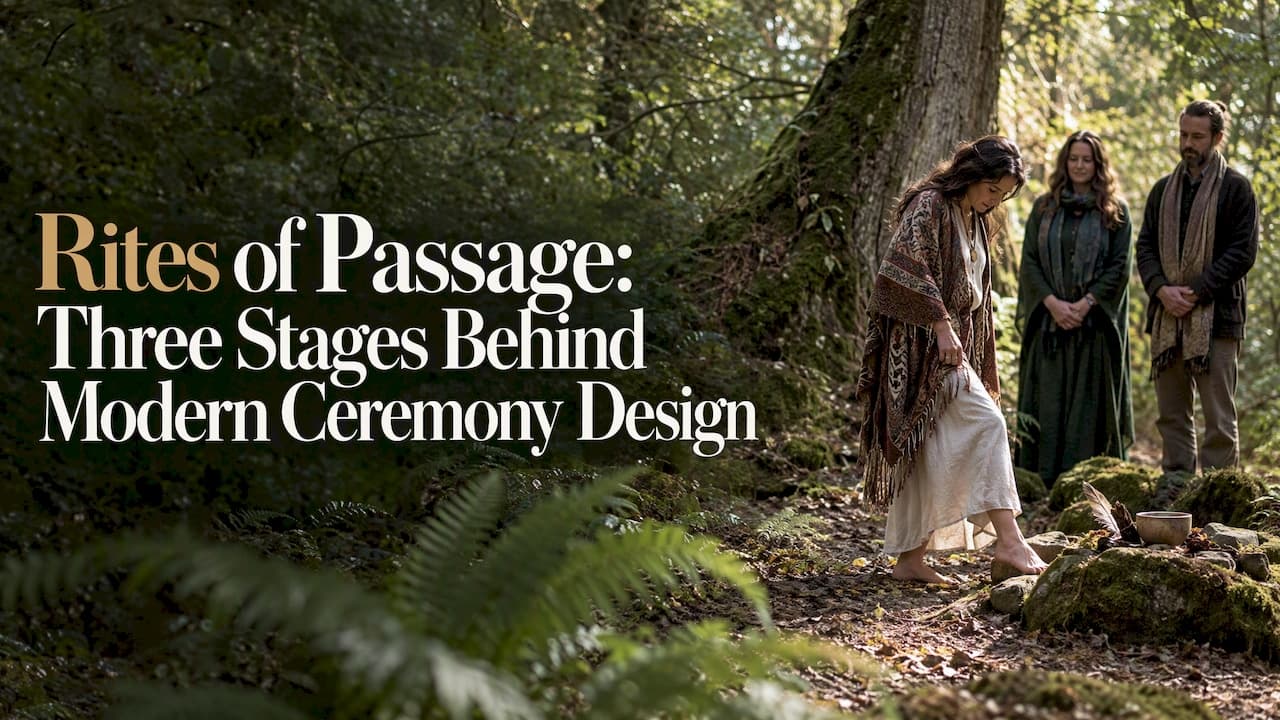
A rite of passage is a structured ritual that marks a person's move from one social or spiritual stage of life to another, built on three stages: separation, liminality (or transition), and incorporation. These stages matter because they give a community a shared way to recognize that someone's role has genuinely changed.
TL;DR:
- Design the threshold around a real task or learning period, then use a symbolic marker and explicit reintegration to assign the participant new responsibilities.
- A rite should state which status ends and begins, involve witnesses or mentors, and give the participant new responsibilities during reintegration.
- Victor Turner argued that liminality temporarily suspends social hierarchies, helping participants form communitas, a bond that can outlast the ceremony.
- Skipping separation and a genuine threshold challenge can leave a celebration without psychological closure, while social recognition alone may feel hollow.
- Structured youth programs have shown measurable benefits for identity development and can reduce risks linked to informal rituals invented by peers.
Table of Contents
- Where the Three-Stage Model Comes From
- Rites That Mark Birth, Growing Up, Marriage, and Death
- How Victor Turner Reframed the Middle Stage
- What Rites of Passage Actually Do for People and Communities
- Designing a Meaningful Rite of Passage Today
- How Experienced Practitioners Approach Ceremony Design
- What We Have Learned From Watching People Cross a Threshold
- A Guided Path Through Your Own Rite of Passage
- FAQ
- Sources
Where the Three-Stage Model Comes From
The anthropologist Arnold van Gennep introduced this framework in 1909, and his work reached English-speaking scholars through the University of Chicago Press edition published in 1960. Van Gennep noticed that ceremonies marking birth, puberty, marriage, and death across unrelated cultures shared the same underlying shape, even when the specific customs looked nothing alike.
The three stages break down simply:
- Separation: the person is symbolically removed from their old status, often through physical withdrawal, a change of clothing, or a ceremonial farewell.
- Liminality or transition: the person exists in a kind of social limbo, no longer who they were but not yet who they will become.
- Incorporation: the person is formally welcomed back into the community with their new status recognized by everyone around them.
A funeral vigil separates the living from a routine relationship with the deceased. A wilderness solo during a coming-of-age ceremony puts a teenager in liminal space, stripped of childhood status but without adult responsibilities yet. A wedding reception incorporates two people into the community as a married couple, complete with new titles and expectations. The stages are a lens, not a rulebook, but once you know them, you start seeing them everywhere.
Rites That Mark Birth, Growing Up, Marriage, and Death
Every culture builds rituals around the same handful of life transitions, even though the specific practices vary enormously.
- Birth rites mark the arrival of a new person into the community. A Christian baptism separates an infant from an unnamed, unblessed state and incorporates them into a faith community with a name and godparents attached.
- Puberty and initiation rites mark the shift from child to adult. A bar or bat mitzvah separates a Jewish adolescent from childhood religious obligation and incorporates them as an adult responsible for the commandments. A quinceañera does similar work for many Latin American girls turning fifteen. Maasai initiation ceremonies in East Africa move young men through seclusion and instruction before welcoming them back as warriors.
- Marriage rites mark the formation of a new household and new social roles. Wedding ceremonies worldwide separate two people from their single status, often through vows exchanged in a liminal setting, before incorporating them as a married unit recognized by family and law.
- Death rites mark the end of a life and a community's adjustment to that absence. Funerals separate mourners from ordinary routine, hold them in a grieving period, and eventually incorporate them back into daily life, often through a defined mourning period that ends with a specific ritual act.
Secular culture has built its own equivalents. A high school graduation separates a student from childhood schooling, the ceremony itself is a liminal threshold, and the diploma and the party afterward incorporate the graduate into adult or collegiate life. Prom, retirement parties, and even a first apartment lease carry traces of the same structure, even without religious language attached. The Navajo Kinaaldá ceremony, a multi-day puberty rite for girls, is often cited alongside these secular examples precisely because it shows the same three-part logic in a non-Western, fully intact tradition.
How Victor Turner Reframed the Middle Stage
Van Gennep named the three stages, but it was Victor Turner who gave the middle one its deepest theoretical weight. Turner argued that liminality is not just a gap between statuses, it is a kind of anti-structure, a temporary suspension of the normal rules that govern who outranks whom and who owes what to whom.
- Turner described the bonding that happens inside this suspended space as communitas, an intense, often leveling solidarity among people who are experiencing the threshold together.
- He drew on fieldwork and ritual theory discussed in sources like a 1978 Smithsonian festival program exploring liminality and communitas as central ritual effects.
- Later scholarship, synthesized in resources like the NCBI overview of ritual and rites of passage, has extended the tripartite model to account for cultural diversity and for rites that blend or repeat stages rather than moving through them cleanly once.
Why does this matter beyond the seminar room? Because it explains why initiation experiences can feel disorienting and bonding at the same time. When normal hierarchies drop away, even briefly, people often form connections that outlast the ceremony itself. A cohort that goes through basic training, a retreat, or a shared ordeal together tends to carry that communitas forward as lifelong loyalty. Understanding this helps explain why a poorly designed rite, one with no real liminal phase, often fails to produce any lasting sense of change.
What Rites of Passage Actually Do for People and Communities
Rites of passage are not decorative. They do specific, measurable work on three levels.
- Social function: a rite gives everyone else in the community a clear signal that someone's role has changed, which affects how they are treated, what is expected of them, and sometimes what legal or civic status they hold.
- Psychological function: a rite gives the person going through it a sense of closure on the old identity and a coherent story about how they became who they are now, rather than a vague, undefined drift.
- Communal function: a rite pulls a group together around a shared event, transmitting values, expectations, and sometimes practical skills or responsibilities to the next generation.
Pro Tip: A rite only delivers its psychological payoff when the person experiences real separation first; skipping straight to the celebration without any liminal challenge tends to produce a party, not a transformation.
These three functions reinforce each other. Social recognition without psychological processing can feel hollow, a party where nothing actually shifted inside. Psychological processing without communal witness can feel isolating, since no one else acknowledges the change. The strongest rites hit all three at once.
Designing a Meaningful Rite of Passage Today
Many people today reach adulthood, change careers, or lose a parent without any formal ritual to mark it, and that absence is not neutral. Research into school-based rites of passage programs suggests that when formal rites disappear, adolescents often invent their own, frequently through risky peer-driven substitutes, and that intentional programs can reduce that risk while supporting healthier identity development.
One study of structured youth rites of passage programs found measurable benefits for identity development when communities replaced informal, peer-invented rituals with intentional programs. That finding matters for anyone designing a rite from scratch, whether for a teenager, a new parent, or someone marking a divorce or a career change.
A workable design checklist, drawn from the OpenStax anthropology overview of ritual stages, includes:
- A clear, stated intention for what status is ending and what status is beginning.
- Active roles for community members as witnesses, mentors, or guides, not just spectators.
- A genuine threshold task or learning period, something that takes real effort or discomfort.
- A symbolic marker, an object, mark, or new name that signals the new status.
- An explicit reintegration step that assigns new responsibilities, so the rite does not end at the ceremony itself.
Modern programs that borrow this structure, from community-run coming-of-age circles to adult initiation retreats, tend to outperform one-off celebrations precisely because they build in all five elements rather than just the party at the end.
How Experienced Practitioners Approach Ceremony Design
We draw on a background that blends clinical training with ceremonial practice. Our guidance during initiatory work emphasizes attention to physiological and emotional detail.
Our programs are built around elements that research points to as essential: separation from daily routine, time in nature, ongoing mentorship, and a defined reintegration period where new commitments take hold. We treat the threshold phase as the working part of the rite, not a formality to rush through on the way to a celebration.

What We Have Learned From Watching People Cross a Threshold
The moments that stay with us are rarely the ceremonies themselves. They are the quiet shift afterward, when someone who arrived uncertain starts making decisions from a steadier place. That shift does not come from a single dramatic event. It comes from the structure around it: real separation, real difficulty, and a community that notices the change and holds it.
Rites of passage are not nostalgia. They are infrastructure for identity, and most of us are living without enough of it. Building one, even a small one, with intention is worth more than waiting for life to hand you a transition unmarked.
— Angell
A Guided Path Through Your Own Rite of Passage
If reading this has you thinking about a transition in your own life that never got marked, that is exactly the gap we built our programs to address. Our shamanic and spiritual coaching sessions give you a guided structure for separation, threshold work, and reintegration, with mentorship that continues after the ceremony ends rather than stopping when it does.

For a lower-commitment first step, a single shamanic healing session offers a focused, ceremonial space to work through a specific transition without a long-term program attached. For those ready for something more immersive, our Sacred Paths Shamanic School runs multi-year initiatory paths, including EarthWalker and FireKeeper, built on the same separation, threshold, and reintegration structure described above, set at La Ferme du Cerf Bleu in Burgundy, France, and open to participants worldwide. Whichever entry point fits where you are, the goal is the same: a rite of passage designed with real intention, not left to chance.
FAQ
What purpose do rites of passage serve?
Rites of passage give communities a clear, shared signal that a person's social role has changed, while giving the individual psychological closure and a coherent sense of identity. They also strengthen communal bonds by transmitting values and responsibilities from one generation or stage to the next.
Who wrote the foundational book on rites of passage?
Arnold van Gennep wrote Les rites de passage, originally published in 1909, which introduced the three-stage model of separation, liminality, and incorporation. The English translation was published by the University of Chicago Press in 1960 and remains the standard reference for the concept.
What are some common examples of rituals?
Common rituals include baptisms and naming ceremonies at birth, bar and bat mitzvahs or quinceañeras at puberty, wedding ceremonies at marriage, and funerals at death. Secular equivalents include graduations, retirement parties, and coming-of-age programs built around the same separation and incorporation structure.
What are the five main rites of passage?
Most frameworks group rites of passage around five life transitions: birth, puberty or initiation, marriage, death, and sometimes a fifth category covering seasonal, territorial, or vocational passages such as entering a new career or community. Each of these follows the same underlying structure of separation, liminality, and incorporation first described in van Gennep's original framework.
How does liminality relate to community bonding?
Liminality is the in-between stage of a rite, when a person has left their old status but has not yet taken on the new one. Victor Turner argued this stage often produces communitas, an intense sense of solidarity among people experiencing the threshold together, since normal social hierarchies are temporarily suspended.