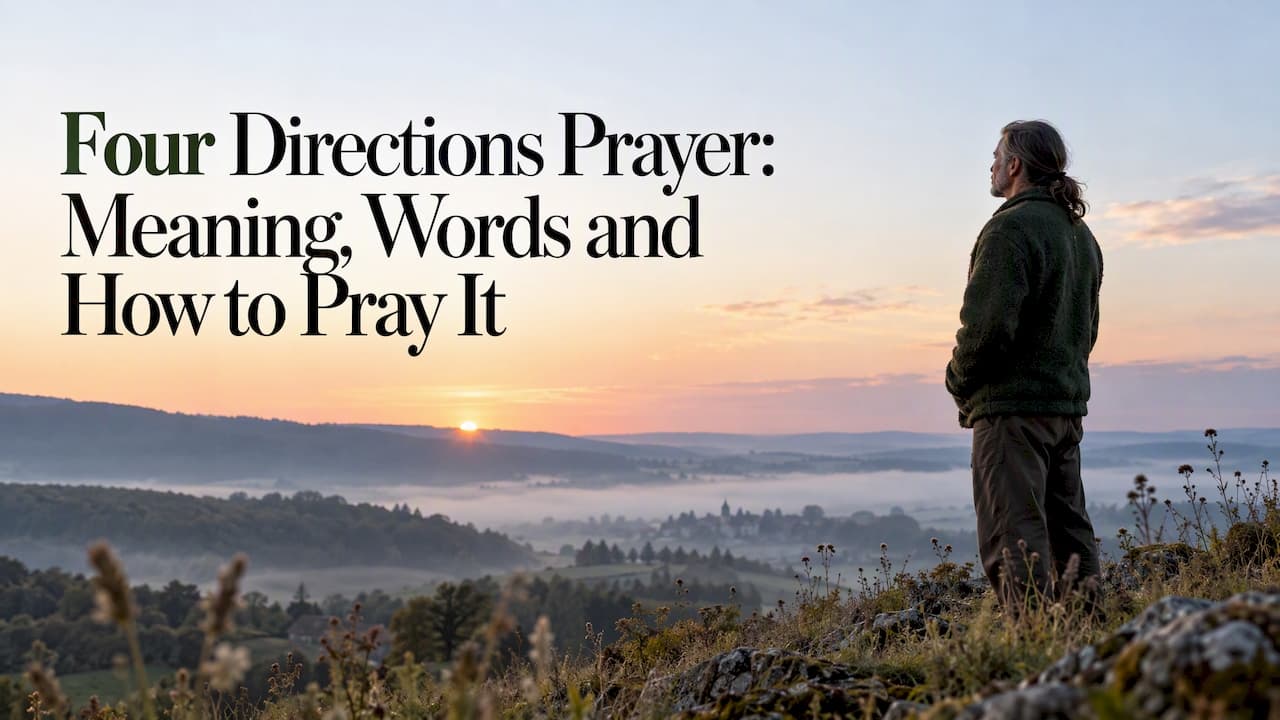
A four directions prayer is a way of turning to east, south, west and north in turn, naming what each one holds, and asking for its help before you begin something that matters. You stand in the center, you face each direction, and you speak. That is the whole structure. What you say, and what each direction means to you, depends on the tradition you come from or the one you are learning from with respect.
This guide gives you the meanings in their best-documented form, an original prayer you can adapt, a step-by-step way to practice, and honest guidance on where this practice comes from and how to hold it with care.
TL;DR
- The four directions prayer is a practice of facing east, south, west and north, honoring each, and asking for guidance and protection before ritual, prayer or a big decision.
- In the Lakota tradition, east stands for a new day and wisdom, south for life and growth, west for the end of life and water, and north for cleansing and endurance. Colors and meanings differ between nations.
- Many traditions add above and below, so you may see six or seven directions, not four.
- You can pray it in your own words. Speak plainly, name what each direction means to you, and say thank you.
- Learn from Indigenous teachers and sources, and do not treat any one version as universal.
Table of Contents
- What the four directions prayer is
- What each direction means
- The medicine wheel behind the prayer
- How the directions appear in Lakota ceremony
- A simple four directions prayer you can use
- How to practice it step by step
- Calling in the directions versus praying them
- Praying the directions with care
- Our perspective at Sacred Paths
- Going deeper with us
- FAQ
- Sources
What the four directions prayer is
Across many Native American cultures, the directions are not just compass points. They orient the body, the seasons and the spirit. The Lakota see the world as having four directions whenever they pray or do anything sacred. The Diné (Navajo) use the directions to orient themselves physically and spiritually, tied to four sacred mountains and four sacred colors.
So when people search for a "four winds prayer" or ask about "calling in the directions," they are usually pointing at the same gesture. You acknowledge each direction, ask for its presence, and by doing so you place yourself inside a larger order: the day, the year, a life, the land under your feet.
The gesture also shows up well outside Indigenous ceremony. Some Christian congregations have used it in services. St. Clement's in Canada, for one, has published a liturgy that moves through east, south, west and north with a congregation standing. Others use it to open a circle, a meditation or a healing session.
What each direction means
The most widely quoted meanings in American English come from Lakota teaching. The Aktá Lakota Museum and Cultural Center, run through St. Joseph's Indian School in South Dakota, describes them this way:
| Direction | Lakota meaning | Themes you might bring to it |
|---|---|---|
| East | Where the sun rises: a new day, wisdom | Beginnings, clarity, gratitude for a fresh start |
| South | Life, warmth and growth | Relationships, vitality, what you are tending |
| West | The end of the day and of life; the source of water | Endings, grief, release, what you let go of |
| North | Cleansing, patience, endurance through hardship | Resilience, steadiness, long work |
The museum also notes that color placement varies with individual tribal customs, so there is no single color map to memorize.
Why you will find different versions
If you compare sources, you will find disagreement, and that is not a mistake. The Diné, for example, name the directions in a particular order and link them to sacred mountains and colors that do not match the Lakota scheme. Animals, colors, seasons and even the starting direction change from nation to nation and from one practitioner to the next.
The Anglican Church of Canada makes the same point in its own guidance: respect the diversity of these teachings and their local adaptations rather than treating them as one universal rulebook. If a website tells you there is one "correct" meaning for each direction, be cautious.
Above and below
Lakota prayer often reaches past four. The sacred songs collected by Calvin Standing Bear include a Four Directions song, and Lakota prayer traditionally includes the sky above, where the Great Spirit dwells, and Grandmother Earth below. That is why you will hear about six or seven directions: four around you, one above, one below, and the center, which is you.
The medicine wheel behind the prayer
The four directions are often drawn as a circle with a cross inside it. The U.S. National Park Service explains that the medicine wheel, also called the Sun Dance Circle or Sacred Hoop, is an ancient symbol used by many tribes to signify the Earth's boundary and all the knowledge of the universe. Its four colors, often black, white, yellow and red, stand for the four directions, the four seasons and the sacred paths of the sun and of human beings. Stone wheels in places such as Alberta are thousands of years old.
The circle matters as much as the cross. Nothing is left outside it. That is why a prayer to the directions tends to feel less like asking for favors and more like taking your place.
How the directions appear in Lakota ceremony
In Lakota practice the directions are not decoration. At a Sun Dance, the dancers circle a sacred tree while singers sing Lakota songs, and as they dance they give praise to the four directions. The prayer is carried by song, by the body and by the whole community, not by one person reading a script.
That context is worth holding in mind. When you pray the directions at your kitchen table or on a hillside, you are using a gesture that, in its home setting, belongs to a living people with their own protocols, teachers and ceremonies. You can honor that without pretending to stand inside it.
A simple four directions prayer you can use
The words below are an original, plain-language prayer, not a Lakota or any other nation's text. Use them as a starting frame and replace them with your own. If you belong to a tradition with its own prayer of the directions, use that instead.
Facing east: East, where the day begins, thank you for the light. Help me see clearly. Show me what is new.
Facing south: South, place of warmth and growth, thank you for life. Help me tend what I love and let it grow.
Facing west: West, where the day ends and the water comes from, thank you for what has finished. Help me let go with grace.
Facing north: North, wind of cleansing and patience, thank you for what has tested me. Give me endurance for the long road.

Above, below, and within: Sky above, Earth below, thank you for holding me. I stand here, in the center, grateful and listening.
How to practice it step by step
- Choose the place. A yard, a park, a quiet room. If you can, find out which way is actually east before you start, using a compass or your phone.
- Settle first. Stand still and take a few slow breaths. Calling in the directions is, as one practitioner puts it, about setting intention and grounding your energy, not reciting words fast.
- Begin in the east. Many Lakota teachings start there, though other nations begin elsewhere. Face it, speak, and pause to listen.
- Turn with the sun. Move clockwise to south, west and north, giving each direction the same attention.
- Acknowledge above, below and the center. Look up, touch the ground, place a hand on your chest.
- Say thank you and close. Thank each direction in reverse or all at once, and step out of the circle slowly.
- Write down what you noticed. Which direction came easily, and which one did you rush? That is often where the work is.
What to expect
For most people the first few attempts feel awkward, and that is normal. Notice what you feel as you face west, the direction of endings. Many people find it the hardest to speak to. That reaction is information, not failure.
Calling in the directions versus praying them
People use "calling in the directions" for the opening of a circle, a retreat or a healing session, and "four directions prayer" for the spoken prayer itself. In practice they overlap. In a group setting, one person leads and the others turn with them, which is why many facilitators create what they describe as a container for transformation with invited guidance, protection and presence.
Some facilitators work from a script, and some from direct experience. One practitioner argues that the best way to learn is to meet each direction through a journey, one at a time, and learn to honor it from its own perspective rather than memorize a ceremony from a book. We agree with that instinct. A script can start you off, but the relationship is what makes the prayer real.
If you want to see how another healing practitioner opens sacred space and ties her work to natural cycles, Ella Isakov's spiritual healing and mentorship offerings for women are one place to look.
Praying the directions with care
The popularity of this practice raises fair questions. Here is how we think about them.
Credit the source. If you use Lakota meanings, say they are Lakota meanings. If you learned them from a book, a teacher or a museum page, say so. Do not present a generic scheme as ancient universal truth.
Do not imitate sacred ceremony. Pipe ceremonies, the Sun Dance and other sacred rites belong to the Lakota. The religion is organized around the Seven Sacred Rites, given according to Lakota tradition through White Buffalo Calf Woman. Offering your own simple prayer of thanks is not the same as performing one of those rites.
Keep your own faith intact if you have one. Christians sometimes ask whether this fits their prayer life. The Vatican's 1989 document on Christian meditation says Christian prayer can be enriched by methods from other religions but must stay grounded in the structure of the Christian faith. Other Christian communities, such as the Anglican Church of Canada, have adapted Indigenous teachings on the directions for reconciliation and stewardship. If this matters to you, talk with your own pastor or spiritual director.
Listen to Indigenous voices first. Museums and cultural centers run by Native communities are a good starting point, and a better one than a random blog post.

Our perspective at Sacred Paths
At La Ferme du Cerf Bleu, a rewilded 18th-century farm in Burgundy, we teach by experience before information. The directions are a good example of why. You can read about east for a year and still not know what it feels like to stand in a field at dawn and ask for clarity.
Our school draws on Andean and Norse shamanism, and we weave in other cosmologies the way a traveler learns: with humility, and by credit to the people who carried the teachings. We do not present the four directions as one universal map, because they are not one. Every place has its own winds. The directions of a Burgundy hillside are not the directions of the Dakotas, and a good practice begins by admitting that.
What we have seen, working with people in transition and with healers deepening their craft, is that the prayer works best when it stays simple. Face the direction. Say what is true. Listen. Thank it. The rest is practice, repeated until it becomes a relationship with the land you actually live on.
If you are drawn to the directions, start with the ground under you. Watch where the sun comes up from your window for a week. Learn the local wind. Then pray to those, and let the borrowed words fall away.
— Angell
Going deeper with us
If you would like guidance rather than a script, there are a few ways to work with us:
- A one-to-one Shamanic & Spiritual Coaching session is $395, and a Shamanic Healing Session is $245, available remotely or in person.
- The Monthly Shamanic Circle is a community way to practice together.
- The two-year path at Sacred Paths Shamanic School, through EarthWalker and FireKeeper, is for those ready for immersion.
If you like marking natural cycles at home, our post on solstice rituals with a single candle is a gentle companion to this practice. You can also begin at our main page.
FAQ
What is the Lakota prayer to the four directions?
In Lakota tradition, prayer turns to each direction, and each carries meaning: east for a new day and wisdom, south for life and growth, west for the end of life and for water, north for cleansing and endurance. The Aktá Lakota Museum shares these teachings. Spoken prayers are given by Lakota people in Lakota context, so for exact words, look to Lakota sources and elders.
Can anyone pray to the four directions?
Yes, in the sense of offering your own respectful words of thanks. What you should not do is claim to be performing an Indigenous ceremony you were not trained or invited into. Credit where the meanings come from and speak in your own voice.
Why do some prayers include six or seven directions?
Lakota prayer traditionally adds the sky above, where the Great Spirit dwells, and the Earth below, the Grandmother. Adding the center, where you stand, gives seven. The sacred songs collected by Calvin Standing Bear reflect this wider frame.
Which direction do you start with?
Many Lakota teachings begin in the east, where the sun rises. Other nations and practitioners start elsewhere, and the Diné order of the directions differs from Lakota practice. Pick the order of the tradition you are following and keep it consistent.
Is the four directions prayer the same as the medicine wheel?
They are closely linked but not identical. The medicine wheel is the symbol, a circle holding the four directions, seasons and colors. The prayer is the act of turning to each direction and speaking to it, as the National Park Service describes the wheel.
Sources
- Lakota Four Directions Meaning, Aktá Lakota Museum & Cultural Center
- Four Directions in Lakota Culture, Aktá Lakota Museum & Cultural Center
- Directions Symbolism, NHMU Baskets
- The Medicine Wheel, U.S. National Park Service
- Sun Dance, Afraid of Bear–American Horse Tiospaye Foundation
- Sacred Songs, Calvin Standing Bear
- Seven Sacred Rites
- Calling in the Four Directions (Script), Meredith Rom
- Calling in the Directions, Practical Healing Journeys
- Praying in the four directions, St. Clement's
- Honouring the Four Directions, Anglican Church of Canada
- Christian Meditation, Vatican