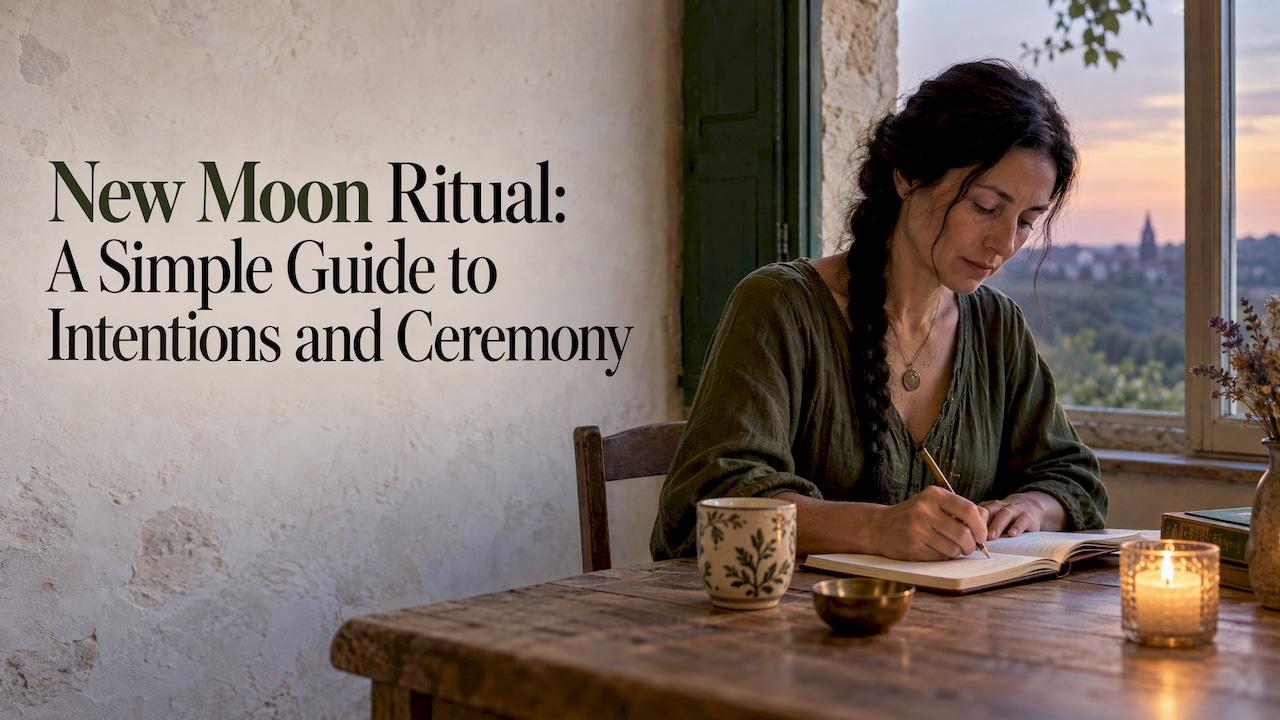
A new moon ritual is a short, deliberate pause at the start of the lunar cycle. You clear a quiet space, settle your breath, reflect on the past month, write one to three intentions and name one small action to take this week. Thirty minutes, a pen and a notebook are enough. This guide walks you through the whole thing, with journal prompts, ways to adapt it to your own beliefs and the safety details people tend to skip.
TL;DR
- The new moon begins a lunar cycle of about 29.5 days, which makes it a natural moment for fresh starts and inward reflection.
- You need a calm space, 20 to 45 minutes, a journal and a pen. No special belief system or equipment is required.
- Write one to three present-tense intentions, each paired with one concrete action for the coming days.
- Check in at the full moon about two weeks later, then close the loop at the next new moon.
- Keep candles at least 1 foot from anything that burns and put them out before you leave the room.
Table of Contents
- What a new moon ritual is and why people keep one
- When to do it
- How to prepare your space
- A step-by-step new moon ritual (about 30 minutes)
- New moon intentions: the follow-through that makes them stick
- New moon journal prompts
- Adapting the ritual to your beliefs and circumstances
- Safety and what to avoid
- Our perspective
- Deepening your practice
- FAQ
- Sources
What a new moon ritual is and why people keep one
The new moon is the phase when the Moon sits between Earth and the Sun and its lit side faces away from us. NASA describes the lunar phases as a cycle that repeats about once a month, and the new moon is where it begins. Traditions around the world treat that dark, quiet moment as a threshold. Some Greek households still keep Noumenia, a household observance marking the start of the lunar month, with offerings, a family meal and household goals.
A modern new moon ritual borrows the same idea without needing a specific religion. According to one guide to moon ceremonies, it is a personal or shared practice used for inward reflection and fresh starts, and it does not require a particular belief or elaborate equipment.
Whether you call it a ritual or a ceremony, the shape is the same:
- Arrive and settle.
- Look back.
- Choose a direction.
- Give it a physical form.
- Close it.
The rest is style.
When to do it
The exact moment of the new moon can fall at any hour, so you do not have to be awake at midnight. Most practitioners pick the evening of the new moon or the evening after. One astrology teacher suggests the first 48 hours after the new moon as the strongest window for setting intentions. Treat that as a tradition, not a rule. If your week is full, the evening that you can actually protect is the right evening.
Look up the date for your time zone in any lunar calendar. The date shifts depending on where you live.
How to prepare your space
Preparation takes ten minutes and does most of the work of getting you into the mood.
- Choose a calm spot. A corner of your bedroom, a table by a window or a patch of garden all work. Aim for 20 to 45 minutes without interruption.
- Tidy the surface. Clear the table or floor space in front of you. A clear surface is a simple way to mark the start of something new.
- Dim the light. Candles or a lamp make a softer atmosphere. See the safety notes below if you use flame.
- Gather your tools. A journal and pen are the essentials. Add only objects that mean something to you and fit your tradition: a stone, a feather, a bowl of water, a sprig of rosemary.
- Prepare something warm to drink. Tea or hot chocolate turns the ritual into something you look forward to.
If you like to cleanse the room, smoke is one option and an open window is another. Some guides suggest opening windows to release stagnant air when smoke is not an option. Choose what your household and your tradition are comfortable with. Smoke can bother neighbors, pets and people with asthma, and some plants used for smudging are sacred to specific Indigenous nations, so a window and a bowl of water are a respectful default.
A step-by-step new moon ritual (about 30 minutes)
This sequence combines the elements that recur across the practices we have seen and adds structure so that you finish with something you can act on.
1. Ground yourself (3 minutes)
Sit with your feet flat on the floor. Take three slow breaths: in for a count of four, hold for four, out for six. One step-by-step guide follows this with a body scan and one question: What am I ready to begin? You do not need to answer yet. Let the question sit.
2. Look back at the past month (7 minutes)
Before you plan ahead, look behind. Write down three things that went well and three things that drained you. Notice patterns. Which people, habits or commitments gave you energy? Which took it?
This step stops intentions from becoming a wish list detached from your real life.
3. Choose a theme (2 minutes)
Pick one word for the month: calm, courage, focus, rest, repair. Every intention you write should fit under it.
4. Write your intentions (8 minutes)
Write one to three intentions. Several sources recommend keeping the list to two or three, phrased in the present tense and in your own voice, as a direction rather than a demand. Fewer is better. Three intentions you act on beat ten you forget.
The difference between a wish and an intention is concrete. One writer puts it this way: "Be healthier" is a wish, while "I walk for twenty minutes after dinner on weekdays" is an intention.
| Vague wish | Intention you can live |
|---|---|
| I want less stress | I stop working at 6 p.m. and take a slow walk |
| I want more creativity | I write for fifteen minutes each morning |
| I want to feel connected | I call one friend every Sunday |
| I want to find my purpose | I spend one hour a week exploring what lights me up |
Try to include one inner intention (how you want to feel) and one outer intention (what you want to do).
5. Name the first step (3 minutes)
Beside each intention, write the smallest action that points you that way this week. Some guides say within 24 hours, others within a few days. Pick a time and put it in your calendar. If you can name the obstacle most likely to stop you, write that down too, with an if-then plan: If I am tired after work, then I will do the ten-minute version.
6. Give it a physical form (3 minutes)
Read your intentions aloud. Light a candle. Plant a few seeds in a pot. The same moon ceremony guide notes that writing an intention down, lighting a candle, planting seeds or speaking it aloud can give an inner desire a physical form. Seeds are a natural choice at a new moon, because both begin in the dark.

7. Close the ritual (2 minutes)
Write one sentence of commitment, say thank you in whatever way fits you, and put out the candle. Keep the list where you will see it every day: on the fridge, by your bed, inside your notebook cover.
New moon intentions: the follow-through that makes them stick
Most of the value is in what happens afterward. A simple rhythm works well:
- At the new moon: set the intention and name the first step.
- In the first days: take the action. Do not wait until you feel ready.
- At the full moon, about two weeks later: check in. One guide suggests asking whether you moved in this direction at all, what got in the way, and whether it is still something you want, or something you thought you should want.
- At the next new moon: close the loop. Keep what worked, release what did not and write the next set.
Sharing one intention with a trusted friend adds accountability. You do not have to share all of them.
New moon journal prompts
You do not need all of these. Choose three or four and write for as long as the pen keeps moving.
Looking back
- Which part of my life feels out of balance?
- What did I begin last month, and what happened to it?
- What am I ready to let go of?
Looking inward
- What do I need right now?
- Where do I feel limited, and who set that limit?
- How can I bring more joy into my life?
Looking ahead
- What do I want to invite into my life this month?
- Which project or habit am I ready to begin?
- What do I need to focus on until the next full moon?
Several of these echo prompts from a seed-planting ceremony guide. If you find the prompts keep leading to the same difficult material, our guide to shadow work journaling offers a slower, deeper way into it.
Adapting the ritual to your beliefs and circumstances
A ritual works when it is honest. If an element feels false, drop it. Some people want a formal circle with the four directions and a closing. Others want only to sit beside a plant, touch the soil, light a candle and speak one honest intention. Both are valid forms of nature-based or circle practice, as long as they are rooted, respectful and truthful to you.
Some ways to adapt:
- If you are religious: begin with prayer instead of breathwork, and use only objects that fit your tradition.
- If you are secular: treat it as a monthly planning and reflection session with candlelight.
- If you live with others: do it in the kitchen with a shared meal and invite everyone to name one household goal, the way Noumenia does.
- If you are outdoors: sit under the open sky and use the real darkness. A new moon is a good night to see stars.
- If you have only ten minutes: do the breath, one intention and one action.
- If you practice with a group: read intentions aloud in turn and let others simply listen.
A word on borrowing. Rituals from living traditions carry training and heritage. Take inspiration respectfully, name your sources and do not claim a lineage that is not yours. When in doubt, build from your own relationship with the land, the moon and your life.
Ceremony sits in a long line of human practice. Our article on rites of passage explains the three stages behind most ceremonies: separation, threshold and return. A new moon ritual is a small version of all three.
Safety and what to avoid
- Candles. The National Fire Protection Association advises keeping candles at least 1 foot away from anything that can burn and blowing them out when you leave the room or go to bed. Flameless candles are a perfectly good substitute.
- Smoke. Ventilate the room, keep a bowl of water or sand nearby for embers and skip it if anyone in the house has breathing trouble.
- Other people. Keep intentions about your own healing, boundaries, courage and growth. A ritual aimed at controlling another person is not consent-centered, and it moves you away from the point of the practice.
- Forcing a style. If incense, crystals or chanting feel false to you, leave them out.
- Heavy emotions. If the reflection step brings up grief or distress that feels bigger than a journal can hold, talk to a licensed therapist or your doctor. A ritual is a support for your life, not a replacement for care.
Our perspective
We have held new moon circles on the land at La Ferme du Cerf Bleu, and what we notice is that the ritual is rarely the problem. People collect lists of crystals, oils and prompts, then wonder why nothing changes.
The moon is a teacher of rhythm. Dark, then slow growth, then fullness, then release. When you set an intention at the new moon, you are agreeing to live inside that rhythm for a month. The candle matters less than the walk you take the next morning.
In our work we favor experience over information. That is why we ask people to bring the practice out of the house and onto the ground: sit with a tree, listen to the wind and notice what the land is doing this week. Intention-setting becomes more honest when it is tied to place and season. A medicine walk before your ritual is one way to arrive with something real to write about.
Do not rush to make your ritual grand. Make it regular. A simple practice repeated for a year will teach you more about yourself than one spectacular night.
Angell
Deepening your practice
Once a monthly rhythm feels natural, you can widen it. Pair the new moon with the turning of the year through solstice rituals, or learn how to honor the spirits of the land where you do your ceremony.
If you want guidance rather than going it alone, Sacred Paths offers structured ways to practice. Becoming the Medicine: 21-Day Practice is $67 and gives you a daily rhythm to build on. Becoming the Mystic is $197. For one-on-one support, our shamanic and spiritual coaching is $395 as a single session.

You can explore all current offers, from digital practices to the school and retreats in Burgundy, on the Sacred Paths home page.
FAQ
What should I do on a new moon?
Keep it simple: ground with a few slow breaths, reflect on the past month, write one to three intentions in the present tense and choose one action for this week. Light a candle if you like and close with a sentence of thanks. The whole thing can take 20 to 45 minutes.
What is the best time to set new moon intentions?
The evening of the new moon or the next one is the most common choice, and some astrologers favor the first 48 hours. The exact moment can fall at any hour, so choose a time you can protect. What matters more is checking in at the full moon, about two weeks later.
What should I avoid during a new moon ritual?
Avoid leaving candles unattended or placing them near anything flammable, and avoid setting intentions meant to control another person. Skip any element that feels false to you. If you have strong emotions that a journal cannot hold, speak with a licensed professional.
Do I need crystals, sage or special tools?
No. A calm space, a journal and a pen are enough. Add only items that are meaningful to you and fit your tradition. If you want to cleanse the space, an open window works as well as smoke.
Can I do a new moon ritual if I am not spiritual?
Yes. You can treat it as a monthly reflection and planning session by candlelight. The structure of looking back, choosing a direction and taking one small step works whatever you believe.
Sources
- Moon Phases, NASA Science
- Noumenia, Hellenion
- How To Perform a Full Moon Ceremony, New Moon Ceremony
- How to Set New Moon Intentions, Astrologer Coach
- New Moon Rituals and Intentions: A Step-by-Step Guide
- New Moon Intentions: How to Set Them and Why They Work, Lunarly
- How to set new moon intentions, fullmoon2027.com
- Using the New Moon to Plant Seeds of Intention
- Wiccan New Moon Ritual: Circle Casting, Elements, and More
- Candle Safety Tips, NFPA