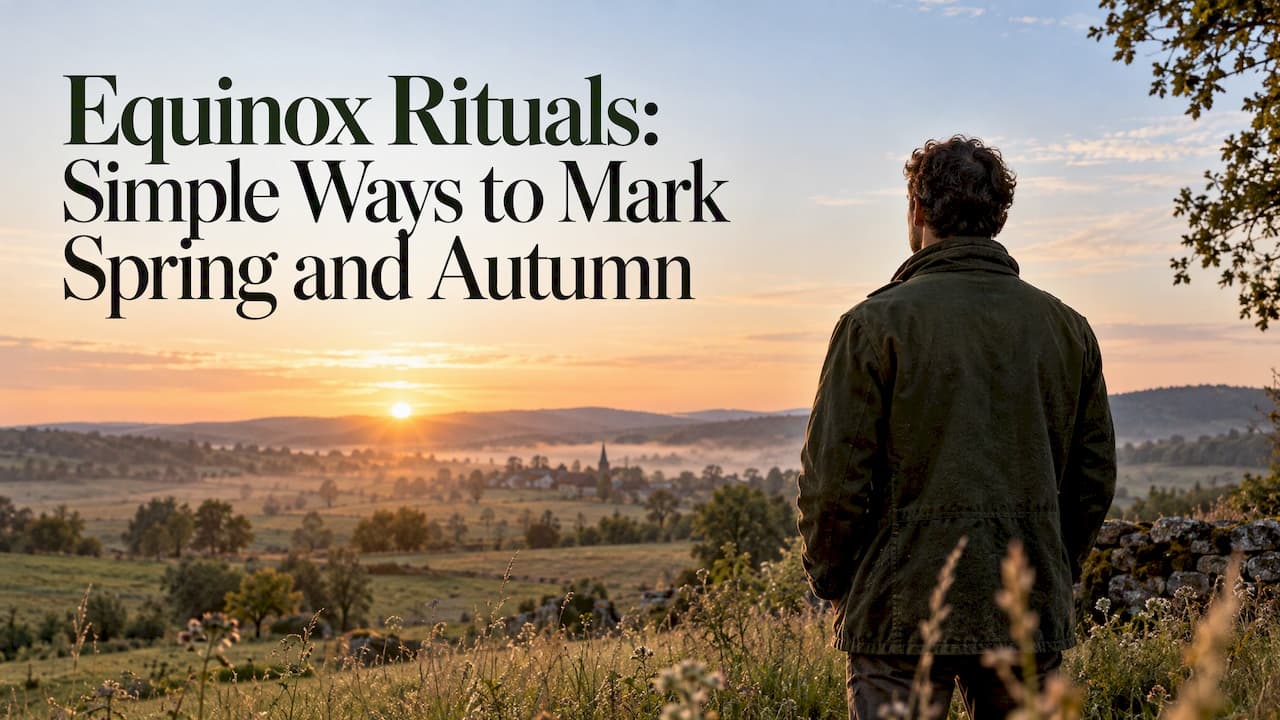
An equinox ritual is a small, deliberate act that marks the moment day and night come into balance: lighting a candle at sunset, planting a seed, writing a gratitude list, sharing a meal. You do not need special tools or a tradition to inherit. You need a little time, an honest question about where your life is out of balance, and one or two simple actions that make the moment feel real.
This guide covers both equinoxes. You will find ready-to-use spring and autumn ceremonies, the traditions that inspired them, how to find the exact time in your time zone, and how to adapt everything to your hemisphere, your space and your beliefs.
TL;DR
- Pick one or two practices, not ten. Sunrise or sunset watching, planting, clearing a space, a seasonal meal and a written intention are enough.
- Spring equinox rituals lean toward renewal, planting and setting intentions. Autumn equinox rituals lean toward gratitude, balance and release.
- The equinox is a precise astronomical instant. Look up the time for your location on the U.S. Naval Observatory's tool, then build your ritual around it.
- Many cultures mark the equinoxes in their own ways, from Nowruz to Higan. Borrow with respect and learn what a practice means before you use it.
- Seasons flip in the Southern Hemisphere, so "spring" and "autumn" rituals swap dates there.
Table of Contents
- What an equinox is and when it happens
- Spring equinox rituals
- A simple spring equinox ceremony you can do alone
- Spring equinox traditions around the world
- Autumn equinox rituals
- A simple autumn equinox ceremony
- Harvest festivals and modern celebrations
- Adapting equinox rituals to your life
- Our perspective
- Take the practice further
- FAQ
- Sources
What an equinox is and when it happens
An equinox is not a day. It is an instant when the Sun crosses the celestial equator, marking the astronomical beginning of spring or autumn. The U.S. Naval Observatory publishes equinox dates and times for the years 1700 through 2100, and you can enter your own time-zone offset to get the moment in local time.
That precision is useful for ritual. Some people gather at the exact minute. Others simply choose the sunrise or sunset nearest to it. Both work. If you want sunrise and sunset times for your exact spot, the Royal Astronomical Society of New Zealand notes that the Naval Observatory can generate them for any location from latitude and longitude.
The dates shift slightly from year to year, so check the tool for the current year rather than relying on a fixed calendar date you remember from the past.
One more point of orientation: the same tool describes the seasons as hemisphere-dependent. In the Northern Hemisphere the March equinox starts spring and the September equinox starts autumn. In the Southern Hemisphere it is the reverse. If you live south of the equator, read "spring ritual" below as something you do in September, and "autumn ritual" as something you do in March.
Spring equinox rituals
Spring rituals share a theme: something is starting, and you are making room for it. These are contemporary personal practices, assembled from traditions across cultures, and you can mix them freely. A 2026 Motherly guide suggests a handful of accessible ones, and most of the popular versions overlap with them.
Welcome the sun
Watch the sunrise, or the sunset, on purpose. That means no phone, no podcast, and enough time to notice the light change. Stand or sit facing the direction of the sun. Take a few slow breaths. Say, aloud or silently, what you are ready to welcome in.
If you cannot be outside, sit by a window. The act is the attention, not the scenery.
Clear a space
Spring cleaning is one of the oldest equinox practices still alive. Choose one area: a desk, an altar, a closet, a corner of the kitchen. Clear it completely, clean it, and put back only what belongs. As you do, ask what else in your life is crowding the space you want for new growth.
Plant something
Planting seeds is among the most common modern spring practices, according to Mental Floss. It works because it turns an intention into something you must tend. Choose a seed that suits your climate, name your intention as you press it into the soil, and water it. If you have no garden, a pot on a windowsill is plenty.

Set a table of intentions
Place objects on a table or shelf that stand for your hopes for the season: a stone, a feather, a photograph, a sprig of something green. Leave them where you will see them daily. Motherly's guide also suggests cooking with seasonal ingredients and inviting each person at the table to share one hope for the coming season, which turns a simple dinner into a ceremony.
Write a balance check-in
Equinox means balance, so use it as a prompt. Write two short lists: what depletes you and what replenishes you. Look at the proportions. Then choose one thing from the first list to reduce and one from the second to increase over the coming weeks.
A note on balancing eggs
You may have heard that eggs stand on end only at the equinox. They do not. HISTORY reports that equinox gravity has nothing to do with it: with enough skill and patience, an egg can be balanced on any day. Treat it as a playful symbol of fertility and balance, which is how Mental Floss frames it, and enjoy the challenge without expecting magic from the date.
A simple spring equinox ceremony you can do alone
Here is a short ceremony built on a personal ritual from Outdoor Apothecary. It uses a pot, soil, locally native seeds, a candle and water, and takes about twenty minutes.
- Prepare. Set the pot, soil, seeds, a glass of water and a candle on a table, preferably outdoors or by an open window.
- Ground. Sit and breathe slowly for a minute or two. Let your attention drop from your thoughts into your body and the surface beneath you.
- Light the candle. Say what this season is for. Keep it to one sentence.
- Plant. Fill the pot with soil and press in the seeds, one at a time, naming each as a small intention.
- Water. Pour the water slowly. This is the act of commitment: you are now responsible for tending what you started.
- Record. Write the intention in a notebook with the date.
- Close. Thank the season, the soil and yourself. Extinguish the candle.
Choosing locally native seeds matters. It ties your ceremony to the actual land you live on rather than to an imported idea of spring. If you want to deepen that relationship, our guide to honoring land spirits explores how people approach the places they live with respect.
Spring equinox traditions around the world
Before you borrow, it helps to know where practices come from. Several living traditions mark the spring equinox, and each has its own meaning.
Nowruz
Nowruz, the Persian New Year, coincides with the vernal equinox and begins a 13-day festival. According to HISTORY, it originated roughly 3,000 years ago, citing the United Nations. The Conversation describes it as an Iranian spring festival rooted in Zoroastrian practice. Preparation commonly includes khaneh tekaani, a vigorous spring cleaning, and a Haft-Seen table holding seven items associated with birth, growth, health, beauty and wisdom. Before the new year, Chaharshanbeh Soori uses fire symbolically for purification, and the festival closes with Sizdah Bedar, an outdoor gathering and picnic on the thirteenth day.
Notice how much of this echoes the practices above: cleaning, a symbolic table, fire, time outdoors. If your own ritual includes those, Nowruz is a good place to learn why they feel so natural.
Higan
In Japan, Higan observances occur around both equinoxes. Nippon.com explains that they run from three days before to three days after the equinox and commonly include visiting ancestors' graves and paying respects. Spring Higan traditionally uses botamochi rice cakes as offerings, while the autumn version is called ohagi. A Buddhist temple in West Los Angeles describes Higan as a week-long reflection on harmony in nature and in inner life, emphasizing the Six Paramitas.
Higan shows another way to hold an equinox: as a threshold between seasons and between the living and the dead. If that resonates, our article on ancestral healing looks at how people honor their lineage today.
Ostara
Ostara is a Pagan observance associated with the spring equinox, renewal, balance and emerging growth. According to The Pagan Club, practices include going outdoors, planting seeds, decorating eggs, tending an altar with flowers and spring symbols, spring cleaning, meditation, and celebrating alone or in a group. If you came here asking what Pagans do for Ostara, that is the short answer, and you will notice it matches most of the personal rituals above.
Autumn equinox rituals
Autumn rituals turn from beginning to harvest. The mood is gratitude, honest accounting and letting go. Common contemporary practices, gathered across guides, include a gratitude list or meal, reviewing what you have cultivated, reflecting on balance, clearing a physical space and naming what you are ready to release.
Gratitude
Sit quietly at home or in nature, notice what you appreciate, and write a list. wikiHow suggests keeping it in a gratitude jar or box so you can revisit it later. Include the difficult things that taught you something, not only the pleasant ones. AstraTalk's meditation guide makes the same point, recommending gratitude for both successes and difficulties.
Review what you planted
The autumn equinox is a natural moment to look back at the intentions you set in spring. AstraTalk recommends acknowledging what actually developed, not what you hoped would. Some seeds grew, some did not, and some turned into something you did not expect. Write each one down and note what you learned.
Balance reflection
The Writual Planner's autumn ceremony pairs mindful breathing and gratitude with a balance reflection. Its suggested pairs are work and rest, giving and receiving, solitude and connection, and holding on and letting go. Pick one pair, and ask where you lean too far to one side.

Release
Name what you are ready to put down: a habit, a grudge, a role, an expectation. The Pagan Grimoire suggests burning a written release list as one option. If you do, treat fire seriously. Use a fireproof dish or a proper burner, keep water at hand and never walk away from it. Singapore's environment agency, in its advisory on burning joss paper, says to use designated or personal burners, avoid open burning on the ground, grass, walkways or driveways, keep clear of vehicles and buildings, and never leave a burner unattended. That is sound practice for any small ritual fire. Check your local fire rules too, since open burning is restricted in many places and dry seasons often bring outright bans. If fire is not an option, tear the paper up, bury it in the garden or soak it in water until the ink runs.
A seasonal altar and a shared meal
Vogue's 2025 guide describes altars with candles and foraged leaves, nuts or berries. Its gathering idea combines moonlight, lanterns or candles, food, and a conversation about the season ahead. You can do something similar with a pot of soup, bread and a few friends. Ask each person to name one thing they are grateful for and one thing they are setting down.

A simple autumn equinox ceremony
This sequence draws on the common elements above and takes 30 minutes.
- Set the space. Put a candle, a piece of seasonal fruit, a sheet of paper and a few natural objects, such as leaves or acorns, on a table.
- Breathe. Take ten slow breaths. Let the day settle.
- Light the candle to acknowledge the light within the dark, as many autumn rituals put it.
- Give thanks. Write three things you are grateful for from the past six months.
- Check the balance. Choose one pair, such as work and rest, and write one sentence about which side is heavier.
- Release. Write what you are ready to let go of. Keep it, tear it, bury it or burn it safely.
- Eat. Share the fruit, or a simple meal, slowly. Eating is the closing act, and it brings you back to your body.
Harvest festivals and modern celebrations
Modern Pagans celebrate Mabon on the autumn equinox, a harvest festival and a time to celebrate the gifts of the Earth, as HISTORY reports. The same article notes that Mid-Autumn Festival celebrations include lanterns, family and friends, giving thanks, sharing food and watching the moon. The Pagan Grimoire also points to Japan's ancestor visits, Korea's Chuseok harvest observance and Lithuania's Miķeļi harvest customs.
The pattern is consistent. People feed one another, light something, and say thank you. That is the core of an autumn ritual, whatever name it goes under.
If you are drawn to the Norse side of the year, our guide to the blót ceremony explains what it is and how people hold one today.
Adapting equinox rituals to your life
A ritual that does not fit your life will not last. Here is how to adjust.
- Hemisphere. Swap the seasons, as described above. Keep the themes: planting and intention at the start of spring, gratitude and release at the start of autumn.
- Climate. If it is snowing at the spring equinox, plant indoors and move your sunrise watch to a window. If it is hot in September, hold your autumn gathering after dark.
- Living space. A shelf is an altar. A bowl of water and a candle on a kitchen counter is a ceremony. wikiHow lists nature walks, seasonal feasts, decorations, meditation and gratitude or release practices as options, which shows how flexible the form is.
- Beliefs. You can hold an equinox ritual as a religious act, a spiritual practice or simply a secular pause. Use the language that is true for you. If you borrow from a living tradition, learn what it means first and acknowledge where it comes from.
- Company. Alone, with family, or in a circle. Solo rituals tend to be quieter and more reflective. Group rituals add food, laughter and witness.
And if you feel pulled toward the other turning points of the year, our article on solstice rituals offers a one-candle practice for the longest and shortest days.
Our perspective
We have watched many people treat ritual as decoration: a candle here, a crystal there, and no change underneath. An equinox is an invitation to do something different. It is one of the few moments when the sky itself shows you what balance looks like, and it asks whether your life matches.
At La Ferme du Cerf Bleu, the rewilded farm in Burgundy where we teach, we learn the turning of the year by living it: the light on the fields, the first green, the smell of the harvest. Our approach to shamanic practice is experiential. We do not want you to read about balance; we want you to stand in it, with your feet on the ground and your attention in your body.
That is why we favor small, honest acts over elaborate ceremonies. One seed planted with a real intention does more than an hour of borrowed words. Gather people when you can, because a circle holds what you cannot hold alone. And keep the practice going after the equinox has passed, because the real work happens in the weeks between the turnings.
Angell
Take the practice further
An equinox ritual is a good beginning, and the weeks after are where it takes root. If you would like guidance in turning a seasonal pause into a daily practice, we offer Becoming the Medicine: 21-Day Practice for $67, a guided three-week path for building your own ritual rhythm. For deeper study, you can explore our two-year shamanic school, our coaching and our retreats on the Sacred Paths site.

We are glad to help you find the next step that fits where you are.
FAQ
What rituals can you do on the spring equinox?
Choose one or two simple practices: watch the sunrise, clear a space, plant a seed, cook a seasonal meal or set out objects that represent your hopes. A short written check-in on what depletes and what replenishes you also works well. Quality of attention matters more than the number of rituals.
What do Pagans do for Ostara?
Ostara is a Pagan observance linked to the spring equinox, renewal and balance. Practices include going outdoors, planting seeds, decorating eggs, tending an altar with flowers and spring symbols, spring cleaning and meditation. Many people celebrate alone, and others gather in a group.
How do I find the exact time of the equinox where I live?
Use the U.S. Naval Observatory's Earth Seasons service, which lists equinox dates and times from 1700 through 2100. Enter the year and your time-zone offset to get your local time. You can then plan your ritual for that moment or for the nearest sunrise or sunset.
What are good autumn equinox rituals?
The most common are a gratitude list or shared meal, a review of what you cultivated since spring, a balance reflection and a release practice. A seasonal altar with candles and foraged leaves, nuts or berries is a popular setting. Keep any fire small, supervised and legal where you live.
Do the equinox rituals change in the Southern Hemisphere?
The themes stay the same, but the calendar flips. The September equinox begins spring there, so it suits planting and intention-setting, while the March equinox begins autumn and suits gratitude and release. Adapt the details to your local weather and landscape.
Sources
- Earth's Seasons: Equinoxes, Solstices, Perihelion and Aphelion, U.S. Naval Observatory
- Royal Astronomical Society of New Zealand: Sun Rise and Set
- 7 spring equinox rituals that will ground you for the season, Motherly
- 9 Rituals to Celebrate the Spring Equinox, Mental Floss
- 6 Spring Equinox Rituals That Celebrate Renewal, HISTORY
- Embracing Renewal: A Simple Spring Equinox Ritual, Outdoor Apothecary
- What is Nowruz, the Iranian new year?, The Conversation
- Shunbun (Spring Equinox), Nippon.com
- Higan (Fall) Service, West Los Angeles Buddhist Temple
- Ostara Spring Equinox Rituals and Traditions, The Pagan Club
- Fall Equinox Rituals to Celebrate the Autumn Season, wikiHow
- Equinox and Solstice Meditation, AstraTalk
- Mabon Ritual and Tarot Spread for Balance and Gratitude, Writual Planner
- The Fall Equinox: Meaning, Rituals, and Celebration Ideas, The Pagan Grimoire
- Responsible Burning of Joss Paper and Incense Sticks/Candles, National Environment Agency, Singapore
- Fall Equinox 2026: Date, Harvest and Traditions, HISTORY
- 7 Unique Rituals to Celebrate the Autumn Equinox, Vogue