Ancestral healing is the practice of noticing, naming and transforming the patterns you believe came down to you through your family line: emotional habits, silences, fears, loyalties, inherited stories. It combines reflection, ritual and relationship with those who came before you. It is a spiritual practice, not a medical treatment, and it works best when you pair curiosity with grounded, practical steps. Below you will find what the term means, what research does and does not say about inherited trauma, a set of rituals you can start this week, and how to do all of it with respect for the cultures that carry these traditions.
TL;DR
- Ancestral healing means working consciously with family and cultural patterns, using reflection, ritual and remembrance, so they stop running your life unexamined.
- Research on intergenerational trauma is real but still debated, especially on biological mechanisms. Treat "this is ancestral" as a hypothesis, not a verdict.
- Simple practices work: map your family story, build a small ancestor altar, keep a journal, walk in nature, and set healthy boundaries with living relatives.
- Borrow from Indigenous traditions with care. Many protocols belong to specific peoples and places.
- Ancestral work complements therapy and does not replace it. Seek a licensed professional for trauma symptoms.
Table of Contents
- What ancestral healing actually means
- What research says about inherited patterns
- Signs people read as ancestors calling
- How to begin healing ancestral patterns
- Ancestral healing rituals you can do at home
- How to honor ancestors respectfully
- Our perspective: why ancestral work belongs in the body and the land
- Working with a guide
- When to bring in professional support
- FAQ
- Sources
What ancestral healing actually means
The phrase covers two overlapping ideas. The first is psychological and historical: families and whole communities pass things on. Wars, migrations, poverty, abuse, silence and shame shape how parents raise children, and those children raise the next generation. The second is spiritual: your ancestors are not only a record of the past but a living presence you can relate to, honor and ask for support.
A practice often called ancestral lineage healing acknowledges the impact of ancestral trauma on present-day behavior, health and emotional patterns. Most people who search for this are not looking for theory. They have noticed something: the same argument repeating across three generations, a fear of money nobody can explain, a grief that feels older than their own life. They want a way to work with it.
It also helps to know who your "ancestors" are. Blood is one answer. Many people also count adoptive family, chosen family, teachers, the people of the land where they live, and the long human line behind everyone. You do not need a perfect family tree to begin.
What research says about inherited patterns
Honest ancestral work starts with honest evidence, so here is what is established and what is not.
Historical trauma is documented. A 2024 review in Annual Reviews of Clinical Psychology describes historical trauma as a collective trauma inflicted on a group sharing a specific identity, with psychological, physical and social effects on later generations. The same article also discusses the limits and complexities of the evidence.
Transmission happens through ordinary channels. A review of theoretical frameworks explains that trauma-related symptoms can appear in descendants of survivors through learned coping behaviors, disrupted family narratives and physiological adaptations. Think of a parent who never felt safe and therefore never taught safety, or a family that never spoke about a loss. You do not need a mystical mechanism to see how that echoes.
Biology is still an open question. Human observational studies suggest the effects of stress can persist across generations, but whether epigenetic mechanisms are involved remains under debate, and shared genetics, environment and behavior may also contribute. The authors caution that the evidence is largely observational, with many confounding variables.
What does this mean for you? Two things. First, the lived reality of inherited patterns is well supported at the family and community level. Second, you can hold a claim like "my grandmother's trauma lives in my cells" lightly while still doing useful work. The practices below do not depend on settling the biology.
The same caution applies to spiritual models. A 2024 Teachers College, Columbia University review of family constellations describes them as a psycho-spiritual approach built on the premise that people unconsciously reenact unresolved conflicts in their family and ancestral system. It also notes that the premise involves non-local ancestral memory and warrants systematic investigation. In other words, experiential models can be meaningful and useful to explore, and their claims should stay distinct from established clinical evidence.

Signs people read as ancestors calling
Searchers often ask how to know if their ancestors are calling or protecting them. People describe recurring dreams of relatives or old places, sudden pull toward a heritage language or craft, repeated coincidences around a family name, a sense of being steadied in a hard moment, or an urge to visit the land of their forebears.
How you interpret these is up to you, and a grounded approach helps. Many traditions treat such experiences as invitations to relationship rather than proof of anything. A practical way to hold them:
- Notice without concluding. Write down the dream, the coincidence or the feeling, with the date and what was happening in your life.
- Look for patterns over time. One vivid dream is a story. Months of entries are data you can reflect on.
- Check the body and the circumstances. Fatigue, grief, stress and sleep changes also produce vivid dreams and strong feelings.
- Test by practice. If an experience pulls you toward remembrance, learning your family story or caring for a grave, that is something you can act on whatever its source.
If these experiences come with distress, confusion or fear, speak with a licensed mental health professional or your doctor rather than interpreting them alone.
How to begin healing ancestral patterns
Here is a sequence that respects both the spiritual and the practical sides.
1. Approach with curiosity, not certainty
CNN's 2023 interview on mind-body healing recommends noticing triggers, locating where stress sits in the body, using grounding and slower breathing, and reflecting afterward on difficult situations and your body's responses. That is a good frame: you are investigating a pattern, not diagnosing your family.
2. Name the pattern without blaming
Therapists who work with generational trauma suggest that recognizing and naming patterns such as hypervigilance, emotional withdrawal or recurring family rules, without blaming predecessors, can be a first step in understanding and self-regulation. Your grandfather's silence may have been survival. Understanding it does not excuse harm, and it does not require you to carry it forward.
3. Map your family story
A genogram is a family diagram that records events, relationships, losses, roles and strengths across generations. A 2026 therapist guide recommends using it to map those threads and treating apparent patterns as hypotheses rather than proof of causation. Do not only map wounds. Mark the survivors, the healers, the storytellers, the people who got through. Those are your protective resources.
4. Write to find the pattern
Journaling gives the material somewhere to land. Our guide to shadow work journaling offers prompts you can adapt: what was never said in my family, what was I taught to fear, what do I do that I swore I never would.
5. Speak it aloud to someone safe
In the Native American context discussed in the AMA Journal of Ethics, healing may involve recognizing emotional burdens, disclosing them to others such as a counselor, reflecting on the self and understanding historical context. Secrets lose force when they are witnessed.
6. Set boundaries with the living
Changing a pattern often means doing something different at the next holiday dinner. Boundaries protect your emotional safety while you do that, and they are part of honoring your ancestors, because they let the healthier version of the story continue. If grief for a lost relative is part of what you are working through, grief and bereavement resources can help you hold that loss alongside the boundary work.
Ancestral healing rituals you can do at home
Rituals give the work a shape. They do not need to be elaborate. What matters is sincerity and regularity of attention.
Build a simple ancestor altar
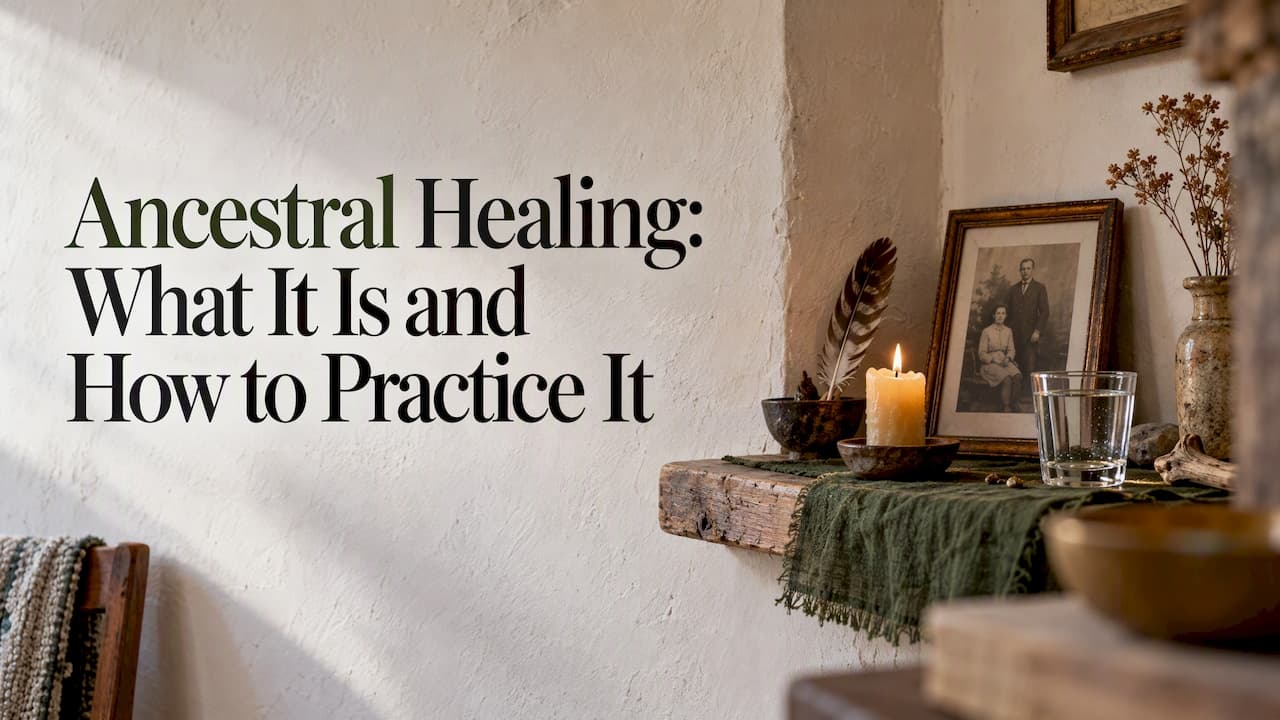
NPR's cross-cultural guide describes personal remembrance such as greeting ancestors, displaying meaningful objects or photos, praying or meditating, lighting a candle and, in many African religious traditions, leaving food offerings. A shelf, a photo, a candle and a glass of water is enough. Start with the ancestors you knew and loved. If your family line is complicated, begin with those you can honor with a clear heart and leave the rest for later.
Speak their names
Once a week, say aloud the names of those you know, going back as far as you can. If you do not know names, say the places or the work they did. Naming is the oldest form of remembrance.
Tell the stories
Interview an elder, record it, and write down the stories that were always repeated. In many Indigenous cultures, ancestors are kept in relationship through rituals, storytelling and ceremonial practices that promote community wellness, belonging and connection to land. Storytelling is available to everyone, and it is often the most healing step.
Ritualize a release
Write down a burden you recognize as inherited: a belief, a fear, a rule. Say what you are grateful for in it, say what you are returning, and burn or bury the paper safely outdoors. Keep this simple and honest. Grief rituals work through meaning rather than repetition, which we explore in why meaning matters more than frequency.

Walk with intention
Take a slow walk on land you feel connected to, carrying a question for your lineage. A medicine walk is a structured way to do this. Notice what you see, what you feel, what you are given. Healing in many traditions is relational, including restoration of relationships with people, the natural world and ancestors, and time on the land is how many people feel that relationship most directly.
How to honor ancestors respectfully
The popularity of ancestral healing raises a fair question: whose practices are you using? Practices vary from one Indigenous nation to the next. The American Psychological Association's grief toolkit notes that storytelling, ceremony and traditional dance may support healing, and that practices vary from tribe to tribe. There is no single "Indigenous way."
Some cultural authorities go further. Australian health guidance stresses that protocols about Country are specific to land and traditional ownership, and warns against adapting them for general ancestral healing, since that can minimize Indigenous sovereignty. Cultural protocols are customs, lores and codes of behavior of particular groups, and Traditional Custodians hold continuing connections with particular land.
A respectful practice follows a few principles:
- Start with your own roots. The strongest, safest ancestral work is with your own lineage and its own traditions, however faded. Look into the folk customs, songs, foods and seasonal observances of your family's region.
- Learn from teachers who are accountable. Seek teachers who name their sources, their training and the lineage a practice comes from.
- Do not claim ceremonies you were not given. If a practice belongs to a specific people, ask whether it is open to outsiders at all.
- Give back. Support the communities and the land you learn from.
We discuss this more in our piece on respecting Indigenous traditions when working with animal symbolism.
Our perspective: why ancestral work belongs in the body and the land
At Sacred Paths we come at ancestral healing as a shamanic practice, and our experience is that information alone rarely shifts anything. People can read every article on generational patterns and still feel stuck, because the pattern lives in the body, in the nervous system, in the way a family table feels. That is why we teach through experience: breath, ceremony, time in nature, and working in a circle of people who witness each other.
Our school sits on La Ferme du Cerf Bleu, a rewilded 18th-century farm in Burgundy, France. The land matters to us. Ancestors are not abstract on a farm that has held people for centuries. You sit with the stones, the trees and the seasons, and the question of who came before you becomes a living one.
We also hold that the ancestral line is not only a place of wounds. Our path draws on Andean and Norse traditions, among other cosmologies, and in both, the dead are a source of guidance, strength and belonging as much as of burden. Healing means reclaiming that strength: becoming, as we say, the medicine your line has been waiting for.
And we say this plainly: we support ancestral work alongside therapy, never instead of it. If you carry trauma, a good clinician and a good ceremonial container can do different and complementary work. Our approach is designed to help you reconnect with your inner essence and your purpose, with a community around you.
— Angell
Working with a guide
Some people want company on this road. If you do, we offer several ways in, depending on how deep you want to go.
- A Shamanic Healing Session is $245 one-off, in person or remote, and suits a single question or a threshold moment.
- Becoming the Medicine: 21-Day Practice is $67 one-off, a short daily practice to build a rhythm of reflection and ritual.
- Becoming the Mystic is $197 one-off, for those who want a more developed path of study.
- Shamanic and spiritual coaching is $395 one-off, or $345 per month for the one-year option, for sustained one-to-one mentoring.
- The two-year initiatory path at Sacred Paths Shamanic School, with its EarthWalker and FireKeeper programs, is for those ready for long-term immersion.

You can see everything we offer, including retreats at La Ferme du Cerf Bleu, on the Sacred Paths home page.
When to bring in professional support
The literature on intergenerational trauma is a reminder that real symptoms deserve real care. If you have flashbacks, panic, persistent low mood, nightmares, self-harm thoughts or difficulty functioning, see a licensed therapist or your physician. Clinically, therapists may use approaches such as Trauma-Focused Cognitive Behavioral Therapy or Narrative Therapy to help people process and break cycles of intergenerational trauma. In the US, if you are in crisis, you can call or text 988 to reach the Suicide & Crisis Lifeline.
A useful rule: let ancestral practice give you meaning, belonging and ritual, and let clinical care address symptoms. Many people find the two reinforce each other.
FAQ
How do you heal ancestral trauma?
Start by noticing patterns without blaming anyone, then map your family story, journal, talk with someone safe and practice grounding when old feelings arise. Add remembrance rituals if they resonate with you. If symptoms are heavy, work with a trauma-informed therapist as well.
Is ancestral healing scientifically proven?
No controlled studies of ancestral healing as a practice have been found. The underlying idea that trauma affects later generations has real research behind it, though the biological pathways are still debated. Treat ancestral healing as a spiritual and reflective practice, not a medical treatment.
What is the difference between ancestral healing and ancestral lineage healing?
The terms are used almost interchangeably. Ancestral lineage healing usually stresses the specific family line and the patterns, gifts and wounds that run through it, while ancestral healing is the broader umbrella, which can include cultural, collective and land-based work.
How do I honor my ancestors without appropriating another culture?
Begin with your own lineage and its customs. A photo, a candle, spoken names and family stories are enough. If you are drawn to a specific Indigenous tradition, learn from accountable teachers and respect that some protocols belong to particular peoples and places.
Sources
- Intergenerational Transmission of Ethnoracial Historical Trauma, Annual Review of Clinical Psychology
- Perspective to Practice: Theoretical Frameworks Explaining Intergenerational Trauma, PMC
- Biological Embedding of Early-Life Adversity and a Scoping Review, PMC
- What is Ancestral Lineage Healing?
- A Review of Family Constellations, Columbia Academic Commons
- Let go of past pain: A mind-body approach to healing ancestral trauma, CNN
- How to Break Generational Trauma, Madison Square Therapy
- Mapping Intergenerational Trauma with Genograms
- What Does It Mean to Heal From Historical Trauma? AMA Journal of Ethics
- How to make an ancestral altar: A cross-cultural guide, NPR
- Indigenous Community Healing and Resilience, American Psychological Association
- Welcome to Country policy, Western Australia Department of Health
- Aboriginal and Torres Strait Islander Protocols, City of Sydney