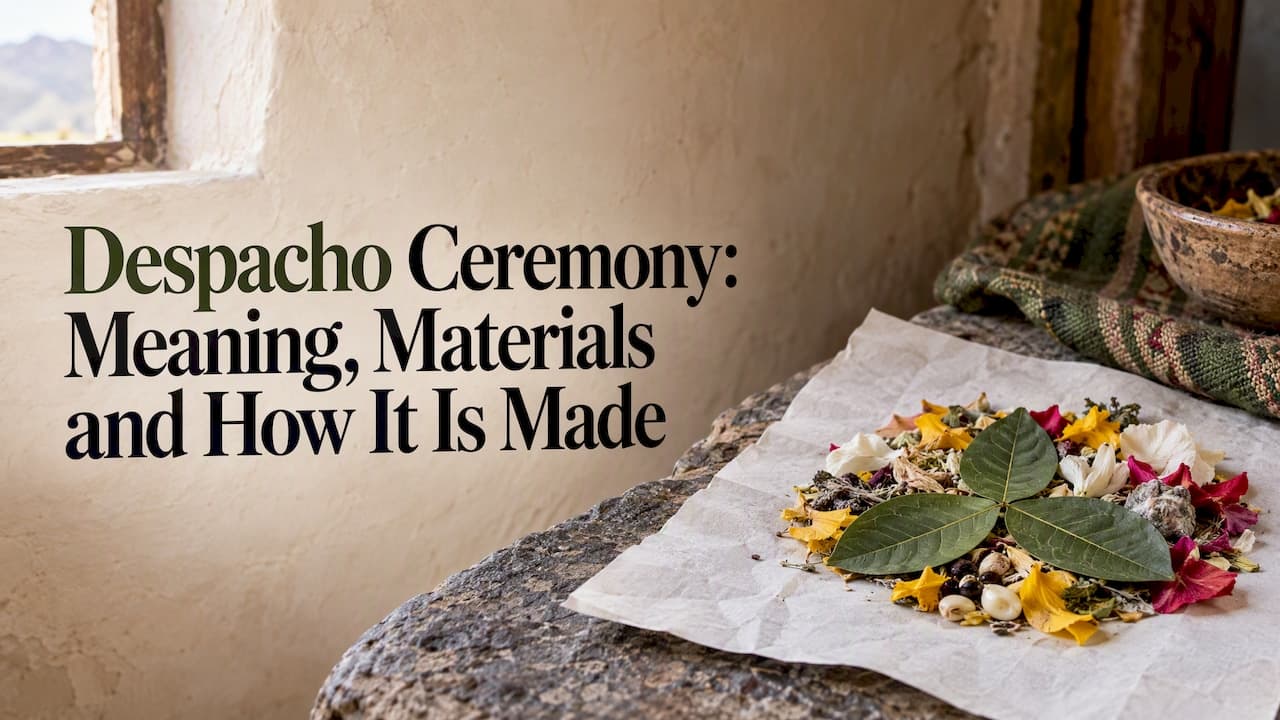
A despacho ceremony is an Andean offering ritual: a prayer bundle built layer by layer from leaves, flowers, grains, sweets and other gifts, then given back to the earth, usually through fire. In Peru, the dictionary of Latin American Spanish defines it as a ceremony of offering to the earth in the religious practice of Andean peoples. It is about reciprocity: you thank, you ask, you give something back. Below you will find where it comes from, what goes in a bundle, how a simple one is assembled and closed, and how to approach it without treating one living tradition as a generic exercise.
TL;DR
- A despacho is a prayer bundle offered to Pachamama (Mother Earth) and the mountain spirits, the Apus, as thanks, a request or a payment of balance.
- The heart of it is the kintu: three coca leaves that carry your intention. Everything else is layered around it.
- A simple version needs a base paper, a few leaves or flowers, grains or sweets, a clear intention and a way to close it, usually fire, or water in adapted forms.
- The word "despacho" means other things outside the Andes. In Mexico, for example, it usually means an office.
- It is a lineage-based practice. Learn from people who received it, and let your version stay humble and honest.
Table of Contents
- What a despacho is and where it comes from
- What a despacho is for
- What goes into a despacho
- How to make a despacho, step by step
- How a despacho is closed and given back
- Is a despacho the same everywhere? Peru, Mexico and elsewhere
- Doing this without taking what is not yours
- Perspective: how we work with offering
- Where to go from here
- FAQ
- Sources
What a despacho is and where it comes from
The word is Spanish, but the practice is far older than the word. Across the southern Andes of Peru, Bolivia and northern Argentina, communities have long fed the earth in return for what it gives. A 1976 study in the journal Allpanchis documents an Aymara ritual called despacho and notes that the same offering goes by other names: mesa, pago, ofrenda, alcansu and pagapu. An earlier Allpanchis paper describes it in rural Peru as a service or payment to the earth, a tribute to Mother Earth for the fruits she provides.
That is the first thing to understand. A despacho is not decoration or a wellness gesture. It sits inside a worldview of ayni, sacred reciprocity: the earth nourishes you, so you nourish the earth.
In the Q'ero communities of the Cusco highlands, the despacho became widely known to outsiders as the center of their practice. In the Quechua-speaking region of Cusco, anthropologists have recorded it as a ritual performed by men in their fields and by women within the household, to bless the family and feed Pachamama.
A grounded example from Choquecancha
In the community of Choquecancha, Peru, researchers describe families going to sacred stones in their fields during the first week of August to burn a family offering to Pachamama. In return she accepts the potato seeds and nurtures them. August is the season when the earth is considered open and hungry, and the offering is tied to planting, household life and the work each person does. It is a practical relationship, not an abstract one.
What a despacho is for
The people who write about the ritual list many occasions: births, deaths, new beginnings, illness, travel, harvests, the turning of seasons. A Quest magazine article on the Q'ero despacho says it honors life milestones such as births, marriages, solstices, equinoxes and new moons. In practice, most people today make one for one of four reasons:
- Gratitude. Thanking the earth, a place, a teacher or a season for what you received.
- Request. Asking for health, clarity, protection or a good path through a transition.
- Repair. Restoring balance after loss, conflict or illness, for yourself or someone else.
- Marking a threshold. A move, a birth, a new job, the end of a relationship, the start of a year.
The medical anthropologist Christine Greenway, writing in Medical Anthropology Quarterly, observes that in healing contexts the items in a despacho bundle embody the identity of the patient, so that symbolic healing can change the patient's lived world. That is an interpretation from fieldwork, not a medical claim. A despacho is a ritual and a prayer. It does not replace care from a doctor or therapist when you are ill or in crisis.
What goes into a despacho
No two despachos are identical. The maker, the purpose and the region shape the bundle. But the architecture is consistent enough to describe.
The base and the kintu
The bundle starts on a sheet of paper, laid down as the foundation, much like wrapping a present. The same source explains that three coca leaves form a triad called the kintu, the central ingredient. Leaves are believed to accept prayers without conditions, so kintus are messengers for gratitude, intentions and prayers. In the simplest form, you blow your gratitude, with heart-centered breath, into a kintu and carry it with you.
Three is not arbitrary. It echoes the three worlds of Andean cosmology: the lower world (Ukhu Pacha), the middle world where we live (Kay Pacha) and the upper world (Hanaq Pacha).

Common ingredients
The following are widely used. Treat the list as a vocabulary, not a recipe you must complete.
| Ingredient | What it usually stands for |
|---|---|
| Coca leaves (kintus) | The prayer itself, carried by breath |
| Flower petals, often red and white | Beauty, offering, the living world |
| Grains, corn, seeds | Abundance, food, the cycle of planting |
| Sweets, candies, sugar | Sweetness offered to the spirits, and a good road |
| Wine, chicha or other drink | Sharing a drink with the earth |
| Shells, small figures or symbols | The sea, specific wishes or relationships |
| Incense or herbs | Cleansing, a sweet smell for the Apus |
Coca leaf is the sticking point for many readers outside the Andes. Coca leaves are a controlled substance in some places, including the United States, where they are tightly regulated, so check your local rules before importing any. Many practitioners who work abroad use other leaves, such as bay, sage or any leaf from a tree or plant that is sacred to them. The first Google result for this keyword describes participants choosing three leaves and holding them like a fan, which is the kintu idea in an adapted form. Be honest with yourself that it is an adaptation.
How to make a despacho, step by step
This is a simple, home-scale sequence that follows the general shape of the ritual. It is not the only way, and it is not a substitute for being taught by someone from a lineage.
- Prepare the space and yourself. Choose a quiet place, ideally outdoors or near a window, with a table or a cloth on the ground. Turn off your phone. Gather everything before you begin so you do not break the flow.
- Gather materials. Collect a sheet of paper for the base, three leaves for your kintu, a handful of petals, some grains or seeds, a few sweets, and a small amount of something to drink. Choose things you can feel good about giving.
- Open the space. Practitioners often begin by calling in the directions (south, west, north, east, above, below and center) and invoking the Apus and Pachamama. If you want a way to do this in plain words, our guide to the four directions prayer shows how people pray it.
- Set your intention. Decide what this despacho is for: one purpose, stated simply. Gratitude is always a good place to begin.
- Make the kintu. Hold three leaves together. Breathe your intention into them, silently or aloud, and lay them at the center of the paper.
- Build in layers. Add petals, grains, sweets and other items around and over the kintu, naming what each one carries. Go slowly. The building is the prayer, not a step before the prayer.
- Wrap. Fold the paper into a tidy parcel, as you would a gift, and tie it with string or wool.
- Offer it. Give the bundle back to the earth (see below).
Realistically, the whole thing takes between 30 and 90 minutes. Beginners often rush the building. Slowing down is the single most useful adjustment.
How a despacho is closed and given back
Fire is the classic route. The Quest article notes the bundle is most typically offered to fire to release the prayers inside. Where a fire is unsafe or not allowed, the same article describes an adapted version offered to water, with a base of cloth or a dissolvable material such as seaweed paper or tortilla, food for the waters and their creatures. Burying a bundle of fully natural materials in the ground is another common choice, but only do it where you have permission and only with biodegradable items, no plastic wrappers, no foil, no synthetic string.
A respectful closing has a few parts:
- Stay with it. Do not walk away while the bundle burns. Watch, and let the silence do some work.
- Say thank you. A short phrase of gratitude to the earth, the directions and the place is enough.
- Close the space. Thank the directions in reverse order, or simply say the ceremony is complete.
- Leave no trace. Take away anything that did not burn, and put out the fire fully.
- Give it time. Many people notice the effects over days or weeks, in a shift of attention or a changed relationship to the issue, rather than on the spot.
Is a despacho the same everywhere? Peru, Mexico and elsewhere
No. Even within the Andes, the practice varies by community, by the person making it and by the purpose. Outside the Andes, the word may point somewhere else entirely. The Diccionario del español de México lists despacho as an office or a place where professionals work, or the act of dispatching goods, or an official communication. So if you searched "what is a despacho in Mexico," the ordinary answer is a law office or accountant's office, not a ceremony. The ASALE dictionary likewise records separate meanings in the Dominican Republic, Nicaragua and northwestern Argentina, so the word is not universally a reference to the Andean rite.
Other Latin American traditions have offering rituals of their own, with their own names, materials and rules. They deserve to be learned on their own terms and not folded into "despacho."
Doing this without taking what is not yours
The despacho is not a neutral technique. It belongs to living Andean communities, and many of them have watched their ceremonies become a product for visitors. A few principles help you stay on the right side of that line.
- Call it what it is. If you adapt it, say so. "A prayer bundle inspired by the Andean despacho" is more honest than "the despacho."
- Learn from people who carry it. Practitioners advise seeking direct, authentic transmission from trained lineage holders rather than treating it as a generic, prescriptive exercise. It is a living practice, not a fixed script.
- Remember the context. The Choquecancha research shows offerings tied to agricultural work, household life, gendered responsibilities and reciprocal nourishment. Take that as a reminder that the ritual has a life that does not depend on your retreat weekend.
- Pay fairly. If you travel to learn, work with community-run or locally owned programs and pay what the work is worth.
- Give back. Reciprocity is the whole idea. A despacho made with taking in mind has missed its point.
The same care applies to other practices. If you are curious, our pieces on meeting your spirit animal while respecting Indigenous traditions and the medicine walk take the same approach.
Perspective: how we work with offering
We teach at La Ferme du Cerf Bleu, a rewilded 18th-century farm in Burgundy, and Angell Deer, our founder, is a trained veterinarian and medicine man who draws on Andean and Norse traditions. What we have learned is that people rarely need a more elaborate bundle. They need a clearer relationship with the thing they are giving to.

When someone comes to us wanting a despacho, we ask what they are grateful for, what they are afraid to ask, and what they are willing to give in return. The answers are often more important than the materials. We keep the ceremony simple, we name the lineage it comes from, and we do not claim it as ours. We also do not use it to promise outcomes. A despacho is a way of showing up in relationship, and the work after the fire, the phone call you make, the habit you change, is part of the offering.
For grief, endings or losses, we find that a ritual works best when its meaning is clear, which we explore in our article on grief rituals. And if you are considering the practice as part of a longer path, come with questions. A good teacher welcomes them.
— Angell
Where to go from here
If you want to experience offering practice with guidance rather than alone, we run work that carries this spirit. A one-on-one shamanic healing session is $245 and a good place to talk through what you want to offer or release. For those who feel called to the Andes themselves, our Great Initiation plant medicine retreat in Peru is $4295 USD per person. And if you want a longer apprenticeship in Andean and Norse shamanism, see the Sacred Paths Shamanic School, which includes the EarthWalker and FireKeeper paths.
FAQ
What is a despacho ceremony?
It is an Andean offering ritual in which a bundle of leaves, flowers, grains and sweets is assembled with prayers and then given back to the earth, often by fire. The Peruvian dictionary definition is a ceremony of offering to the earth. It is used for gratitude, requests, healing and marking life transitions.
What is a despacho offering made of?
The central element is the kintu, a set of three coca leaves. Around it go petals, grains, seeds, sweets, a drink and other symbolic items on a paper base. Outside the Andes, many people substitute other leaves for coca, which is legally restricted in some countries.
How long does a despacho ceremony take?
A simple one made at home usually takes 30 to 90 minutes, including opening the space, building the bundle and offering it. Traditional ceremonies led by a practitioner can run longer. The pace matters more than the clock.
Can I make a despacho on my own?
Yes, a small one for gratitude is a reasonable first step, as long as you call it an adaptation and respect its origins. For healing work, bigger life questions or a fuller understanding of the symbolism, learn from someone who received the practice through a lineage.
What does despacho mean in Mexico?
In Mexican Spanish it usually means an office, such as a law or accounting firm, or the act of dispatching goods, according to the Diccionario del español de México. The ceremonial meaning belongs to the Andes.
Sources
- despacho | Diccionario de americanismos, ASALE
- El rito aymara del "despacho", Allpanchis, 1976
- El Despacho, Allpanchis, 1969
- Oraciones tejidas: misaq'epi y el despacho a la pachamama, 2001
- Objectified Selves: An Analysis of Medicines in Andean Healing, Medical Anthropology Quarterly, 1998
- Despacho: A Q'ero Gift to the Earth, Quest magazine
- despacho, Diccionario del español de México
- Despacho Ceremony Explained: Complete Guide & Practices
- How To Perform a Despacho Ceremony