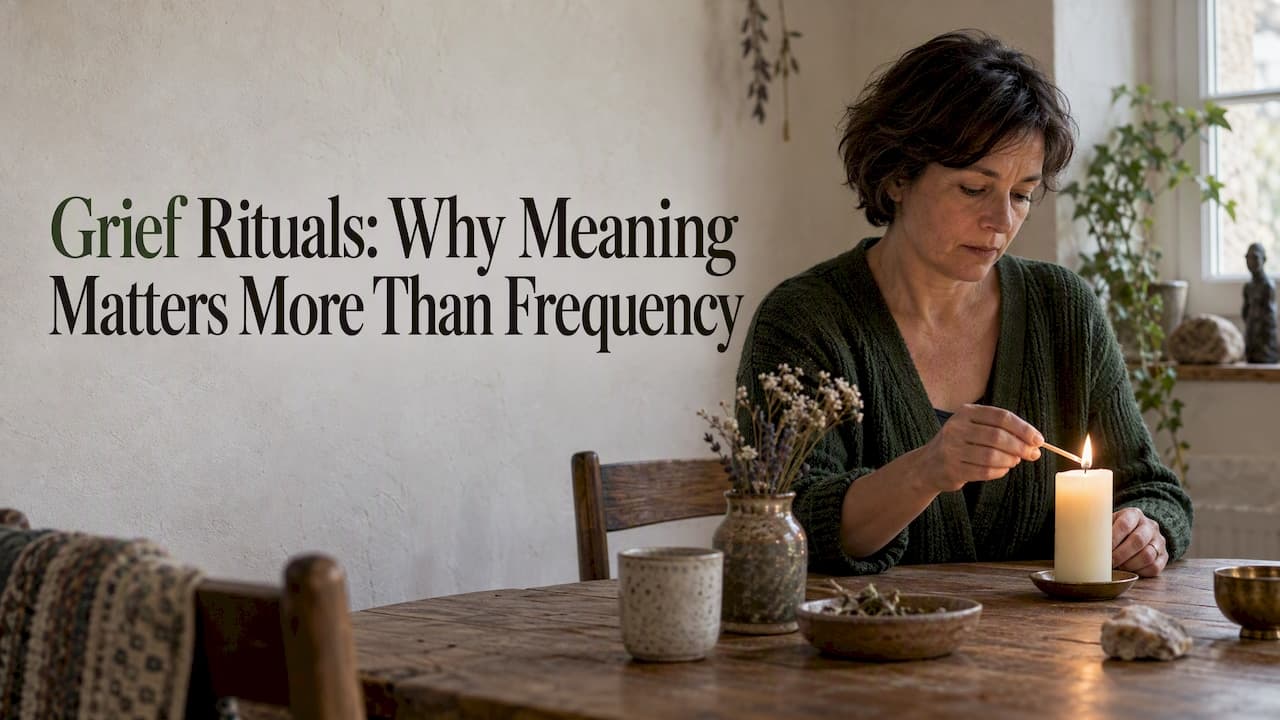
A grief ritual is a symbolic action that gives shape to loss and helps you stay connected to someone who died, and research suggests how meaningful the ritual feels matters more than how often you do it. You can start with something as small as lighting a candle and saying their name out loud. That single act counts.
TL;DR:
- A Quebec study linked ritual satisfaction, not missed rituals, to lower grief reactions; probable prolonged grief symptoms fell from 32% to 13.9% over two years.
- Choose one brief ritual with a clear purpose, symbol, and ending; repeat it consistently, but change or pause it if it begins to feel obligatory.
- For a group gathering, make attendance optional, explain the activity beforehand, leave room for silence, and set a clear time limit, such as an hour.
- For children, use concrete activities such as a shared memory book or bedtime story, let them lead, and keep daily routines steady.
- Seek professional support if grief disrupts daily life, thoughts of harming yourself persist, or intense symptoms continue months later; rituals can complement care.
Table of Contents
- Why rituals help: what research shows about grief and ceremony
- Practical personal grief rituals to try at home
- Communal and family rituals that rebuild connection
- How to design a ritual that fits you: a short framework
- Rituals for children and family-friendly practices
- When rituals help and when to get more support
- Incorporating spiritual coaching elements into personal grief rituals
- The role of storytelling and ancestral connection within grief rituals
- How to create transformative grief rituals that foster personal growth and healing
- Methods for developing group grief rituals that build community and shared healing
- Integration of shamanic grief rituals specific to various cultures or traditions
- Guidance on using nature and natural elements in grief rituals
- What ritual teaches us about staying in relationship with loss
- Finding guided support for your ritual practice
- FAQ
- Sources
Why rituals help: what research shows about grief and ceremony
Rituals work because they turn an internal, formless ache into something you can see, hold, or repeat. Writing a name, lighting a flame, or setting a plate at the table converts raw feeling into symbolic action, which gives the brain something concrete to process and regulate.
A Quebec longitudinal study found that satisfaction with the rituals people actually performed predicted lower grief reactions over time, while the number of rituals they weren't able to carry out did not predict outcomes. In that same sample, probable Prolonged Grief Disorder symptoms dropped from 32% at the start of the study to 13.9% after two years, with ritual satisfaction acting as a mediating factor. The lesson is practical: a ritual done with intention may feel more meaningful than one done out of obligation.
Communal versions carry a social payoff too. Research among the Luhya community in Kenya found that participation in mourning rituals strongly increased prosocial behavior, largely because the shared emotional experience strengthened subjective well-being and community cohesion. A scoping review of grief therapies also found that structured ritual elements, such as writing assignments and farewell ceremonies, show up often in evidence-informed treatment because repetition and specificity make them feel effective.
Practical personal grief rituals to try at home
You don't need special training or a lot of time. The rituals below can be brief and repeated daily, weekly, or on anniversaries.
- Light a candle and say their name: a short, repeatable anchor that works well first thing in the morning or before bed.
- Write a letter you'll never send: say what went unsaid, then keep it in a drawer or burn it safely in a fireproof bowl outdoors.
- Build a memory box: collect small objects, ticket stubs, or handwritten notes tied to specific memories, and add to it over time.
- Cook their favorite dish: taste and smell are strong memory triggers, and sharing the meal with others doubles as connection.
- Plant something living: a tree, a bulb, or a windowsill herb that grows alongside your grief rather than marking an endpoint.
- Make or wear something physical: stitch a piece of their clothing into fabric, frame a photo, or carry a small stone from a place you shared.
Burning or burying a written note works for many people, but if you choose fire, do it outdoors in a safe container, away from anything flammable, and never leave it unattended.
Pro Tip: Pick one ritual and repeat it before adding another. Consistency teaches your nervous system that grief has a place to go.
Communal and family rituals that rebuild connection
Grief isolates, but shared ritual pulls people back together. A memory-sharing circle, where each person tells one story about the deceased, costs nothing and needs no script. A potluck memorial lets everyone contribute something, which spreads the emotional weight across a group instead of leaving it on one host.
Other accessible formats include a short service built around a few readings or songs, a group planting day, or a volunteer shift done in the person's name. The research among the Luhya community found that these kinds of shared mourning practices restore social bonds and sustain prosocial behavior well beyond the event itself, partly because the ritual gives people a structured way to express emotion together rather than alone.
A few practical notes if you're organizing one:
- Make attendance optional: grief timelines differ, and pressure to attend can backfire.
- Set a time limit: an hour with a clear beginning and end feels safer than an open-ended gathering.
- Name the activity in advance: telling people it's a memory circle, not a party, lets them prepare emotionally.
- Leave room for silence: not everyone will want to speak, and that's fine.
How to design a ritual that fits you: a short framework
A ritual doesn't need a tradition behind it to work. It needs a clear purpose and a shape you can repeat.
- Name the purpose: are you remembering, releasing, or simply staying connected today?
- Pick one symbol: a candle, an object, a photo, something that represents the person without needing explanation.
- Set a time and frequency: daily for two minutes, weekly for ten, or once a year on their birthday.
- Add one or two sensory anchors: a scent, a song, a taste, something that pulls the body into the moment along with the mind.
- Keep it brief and bounded: a clear start and end protects you from a ritual that turns into rumination.
A daily example: light a candle each evening, say the person's name, and sit quietly before blowing it out. An annual example: cook their favorite meal every year on the anniversary of their death, light a candle at the table, and tell one story before eating.
Pro Tip: If a ritual starts to feel heavy or obligatory, change it or pause it. The goal is connection, not another task on your list.
Rituals for children and family-friendly practices
Children grieve differently than adults, and they benefit from simple, concrete activities rather than abstract conversation. Guidance on supporting grieving children recommends honest, age-appropriate language, maintained routines, and creative outlets like drawing or memory books.
- Make a memory book together: let the child choose photos, drawings, or stickers for each page.
- Create a bedtime naming ritual: say the person's name and one happy memory before lights out.
- Let the child lead: some want to talk often, others need quiet, and both are normal responses.
- Keep daily routines steady: familiar schedules give children a sense of safety while everything else feels uncertain.
A simple caregiver script works well: "It's okay to feel sad and happy on the same day. Want to tell me one thing you remember about them tonight?"
When rituals help and when to get more support
Rituals offer comfort and structure, but they aren't a substitute for professional care when grief becomes disabling. Watch for warning signs: an inability to function in daily life, persistent thoughts of self-harm, or intense symptoms that don't ease many months after the loss.
Therapists sometimes build ritual elements directly into treatment. The scoping review of grief interventions found that symbolic expression, imagined dialogue with the deceased, and farewell ceremonies appear often in evidence-informed therapy, suggesting rituals can work alongside clinical support rather than replacing it. If a personal ritual leaves you feeling worse rather than steadier, that's a signal to talk to a grief counselor.
Incorporating spiritual coaching elements into personal grief rituals
A spiritual coaching lens adds a layer of intention to ritual that goes beyond the mechanics of what you do. Instead of just lighting a candle, a coaching approach asks what you want your relationship with the deceased to become, and builds the ritual around that question. This shifts the practice from a task to a conversation with yourself.
Spiritual coaching often introduces reflective prompts before or after a ritual: What did this person teach me that I still carry? What am I ready to release, and what am I not ready to release yet? These questions turn a simple act, like writing a letter, into a structured moment of self-inquiry rather than a one-time outlet.
Coaching also tends to frame grief as an ongoing relationship rather than a problem to solve. That reframing matters because it removes the pressure to "finish" grieving on any timeline, and instead treats each ritual as a check-in with where you are now. Pairing a ritual with a short journaling prompt, a breath practice, or a guided reflection session can deepen what the act itself provides, especially when the ritual starts to feel repetitive rather than meaningful.
The role of storytelling and ancestral connection within grief rituals
Telling stories about someone who died keeps them present in a way that silence cannot. Saying their name, repeating a joke they loved, or describing how they handled a hard day are small acts of narrative that research on supportive behaviors specifically encourages rather than discourages. Guidance from the American Psychological Association notes that speaking the deceased's name and continuing to reference shared memories supports healthy connection, rather than suggesting someone needs to "move on."
Many cultural traditions extend this storytelling into a sense of ancestral connection, where the deceased becomes part of a longer family or community lineage rather than a closed chapter. This can look like retelling a grandparent's story to a new generation, keeping a family recipe alive, or naming a child after someone who died. The ritual isn't about resolving the loss. It's about weaving the person into an ongoing story that keeps growing.
Storytelling rituals work especially well in groups, where each person's memory adds a different angle on who the deceased was. A memory circle built entirely around stories, rather than silence or formal readings, often produces the most vivid sense of the person's continued presence.
How to create transformative grief rituals that foster personal growth and healing
A ritual becomes transformative when it asks something of you beyond repetition, a moment of reflection, release, or recommitment to how you want to live. The difference between a routine ritual and a transformative one is usually intention: you're not just marking time, you're using the act to notice how you've changed since the loss.
One way to build this is to pair a physical act with a question. Planting a tree can be paired with the question: what do I want to grow in my own life this year? Writing a letter can be paired with: what would this person want me to know about my future? The physical act grounds the moment, and the question gives it direction.
Transformative rituals also tend to mark a before and after, even in a small way. Burying a written note, releasing stones into a river, or changing a long-held habit "in their honor" can create a felt sense of movement rather than just repetition. These acts don't erase grief. They let you carry it differently.
Growth-oriented rituals work best when revisited periodically rather than performed once and forgotten. Returning to the same symbolic act a year later, and noticing what's different, often reveals more about your healing than any single ceremony could.

Methods for developing group grief rituals that build community and shared healing
Group rituals work best when they balance structure with openness. Too rigid, and people feel like they're performing; too loose, and the gathering drifts without purpose. A workable format usually has three parts: an opening that names why everyone is there, a middle built around shared action or storytelling, and a closing that gives people a way to leave gently.
Simple structures that groups return to:
- A shared object or symbol: each person adds a stone, flower, or written note to a central space.
- A rotating storytelling round: everyone gets a turn to share one memory, with no obligation to speak.
- A collective action: planting a garden, assembling a memory wall, or cooking a meal together in the person's name.
Groups that mourn together tend to build stronger bonds afterward. The study of mourning practices among the Luhya community found that shared ritual participation strengthens prosocial behavior well after the event, largely because the ritual gives people a structured outlet for emotion they might otherwise carry alone. Keeping the ritual optional, time bound, and trauma aware helps make sure that strength extends to everyone in the room, not just the most vocal participants.
Integration of shamanic grief rituals specific to various cultures or traditions
Shamanic traditions across the world approach grief as a relationship between the living and the dead that continues rather than ends. Many practices center on helping the spirit of the deceased move on while giving the living a structured way to express loss, often through drumming, chanting, journeying, or symbolic offerings tied to the natural world.
These traditions vary widely by culture and lineage, and no single shamanic ritual applies universally. What they tend to share is a view of death as a transition rather than a termination, and a belief that unresolved grief can be carried, named, and released through deliberate ceremony rather than left to resolve on its own. Elements like calling in the four directions, working with fire or water, or using an object to represent the deceased's spirit show up across many distinct traditions, each shaped by its own cosmology.
Drawing from Andean and Norse shamanic lineages, this kind of work often treats the dead as still reachable, through journeying, dreamwork, or ceremony, rather than as fully separate from the living. The goal isn't closure in the Western therapeutic sense. It's an ongoing, respectful relationship with the person's memory and spirit, held through practice rather than through a single farewell.
Guidance on using nature and natural elements in grief rituals
Nature offers some of the most accessible symbolic material for grief work because its cycles mirror loss and renewal so directly. A tree planted in someone's memory grows alongside your grief instead of marking a fixed endpoint. A river or stream can carry a written note, a flower, or a small stone, letting the water do the symbolic work of release.

Fire and earth carry their own weight. Burning a letter outdoors, safely and in a contained space, turns words into smoke, a visible transformation that many people find more satisfying than simply discarding paper. Burying an object at the base of a plant ties the physical act of letting go to something that will keep growing.
Seasonal timing matters too. Many people find it meaningful to perform a ritual at the change of a season, the first frost, the first bloom, the longest day of summer, because the natural world's own transitions give the ritual a built-in rhythm. Walking in a familiar natural place the person loved, collecting a leaf or stone from it, or simply sitting outside at the same time each week can anchor a ritual in something larger than yourself, without requiring any particular belief system.
What ritual teaches us about staying in relationship with loss
A ritual isn't a task you complete and check off. It's an ongoing relationship with someone who's gone, one that changes shape as you change. The rituals that last aren't the most elaborate ones. They're the ones you return to because they still mean something, even months or years later.
Nature-rooted practice has taught me that grief rituals work best when they're allowed to evolve. What helps this year may feel hollow next year, and that's not failure. It's permission to keep adjusting until the ritual fits the person you're becoming.
— Angell
Finding guided support for your ritual practice
If you'd rather not navigate ritual design alone, we offer a few ways to go deeper with guided support. Our shamanic healing sessions provide one-on-one support, and our Monthly Shamanic Circle offers a group setting.

- Shamanic Healing Session: a guided, one-on-one session.
- Spiritual Coaching: ongoing support for integrating ritual and reflection into daily life.
- Monthly Shamanic Circle: a communal space for connection.
Each format is experiential and rooted in nature, drawing on practices from multiple cosmologies rather than a single script. If you want structured, guided help building a ritual that lasts, you can explore our spiritual coaching options or join an upcoming circle.
This article is general information, not a substitute for advice from a qualified doctor. Consult a qualified healthcare professional about your own circumstances before acting on anything here.
FAQ
Why is grieving important?
Grieving lets you process the loss of a relationship and adjust to a changed reality, rather than suppressing feelings that tend to resurface later. Research on grief and coping notes that most people recover over time with social support and healthy habits, including talking about the deceased and finding ways to commemorate them.
What's your grief website?
We publish guidance on grief rituals and ceremony on our site at Sacredpaths, alongside shamanic healing sessions, coaching, and retreats for people navigating loss and transition.
How can I best support a friend who is grieving?
Offer concrete, specific help rather than open-ended offers, and feel free to speak the deceased's name. Guidance from the American Psychological Association recommends task-oriented support and continued connection, and advises against urging someone to "move on."
How can I cope with grief?
Coping strategies that tend to help include talking openly about the person who died, accepting a wide range of feelings, practicing self-care, and finding small ways to commemorate them. Psychological guidance on grief notes that grief varies widely from person to person and that most people adjust over time with steady support.
Sources
- Research
- Mourning ritual participation, subjective well-being and prosocial behaviour among the Luhya people of Kenya - PMC
- Frontiers | Ritual in Therapy for Prolonged Grief: A Scoping Review of Ritual Elements in Evidence-Informed Grief Interventions
- Nurturing children through grief, with help from Elmo and his cousin, Jesse
Made with BabyLoveGrowth to reach more people through search