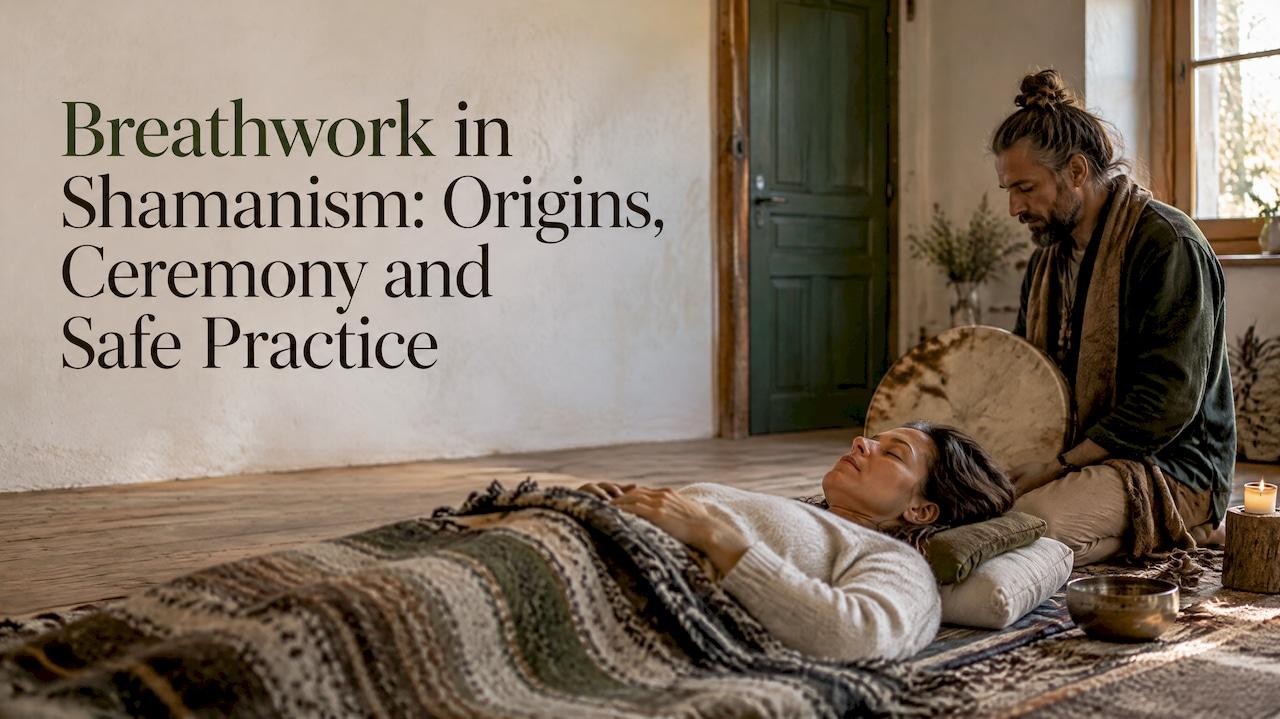
In shamanism, breath is treated as a doorway: a way to move out of the thinking mind, into the body, and from there into the inner world where healing and insight happen. Shamanic breathwork is the modern ceremonial form of that idea. It combines sustained, rhythmic breathing with music, intention and a guide who holds the space. At Sacred Paths, breath is part of how we work with ceremony, and we offer a Breathwork Shamanic Ceremony for people who want to experience it in a held setting rather than alone with a video.
This guide explains where the practice comes from, what happens in a ceremony, what people report, what research does and does not show, and how to approach it safely.
TL;DR
- Many traditions treat breath as life force or spirit. Shamanic breathwork builds on that idea, pairing conscious breathing with music, ritual and intention.
- A ceremony usually means lying down, breathing in a connected rhythm for an extended period, and being guided through what arises, followed by time to integrate.
- People report emotional release, vivid imagery and a sense of reconnection. Research on breathwork is promising but still limited, so treat it as a practice for exploration, not a cure.
- Intense breathing affects your body. Talk with your physician first if you have a heart, blood pressure or other medical condition, and choose a guide who screens participants.
- The container matters as much as the technique: a trained facilitator, a clear structure and time to integrate afterward.
Table of Contents
- Why breath sits at the center of shamanic work
- What shamanic breathwork is today
- What happens in a shamanic breathwork ceremony
- What people report, and what research shows
- Practicing safely
- Our perspective
- Where to begin with us
- FAQ
- Sources
Why breath sits at the center of shamanic work
Across very different cultures, breath has been tied to life, spirit and well-being. A chapter in the book Breathing traces this through concepts such as prana, qi, pneuma, ruach, ka and ik', each a word for breath understood as life force or a divine gift. It also describes breath practices in several shamanic cultures.
The logic is easy to feel. Breath is the one body process that is automatic and voluntary at once. You can ignore it, and it carries on. You can take hold of it, and your heart rate, emotions and attention shift. For a practice that aims to move between ordinary and non-ordinary awareness, that makes breath a natural tool.
One guide on shamanic breathwork notes that in nearly every indigenous ceremony breath is more than an automatic process, and that shamans often use it alongside drumming, singing and ritual to travel into the spirit world or to facilitate healing for others. Breath rarely works alone in these traditions. It is one thread in a ceremony that also holds sound, intention, place and community.
That last point separates shamanic breathwork from a breathing exercise. A technique for calming down before a meeting asks little of you. A ceremony asks you to arrive with an intention, enter an altered state with others present, and then bring what you met back into daily life.
What shamanic breathwork is today
Contemporary shamanic breathwork uses conscious, connected breathing inside a ceremony to support personal insight, healing and reconnection. You breathe in a steady, circular pattern without pausing between inhale and exhale, usually through the mouth, for a sustained period. Music shapes the journey. A facilitator holds the room, and often a helper or partner stays near each participant.
The founder of one well-known modern form has described the music as curated to induce a profound altered state, in which, with eyes closed, people often report vivid insights, visions and a sense of spiritual experience. That description is a useful picture of the intent: the breath opens the door, the sound carries you, and the imagery that appears is treated as meaningful material rather than noise.
It helps to name what it is not. It is not a way to get high, and it is not a performance. People who come expecting fireworks sometimes feel little in a first session and still find the days afterward unexpectedly clear. People who come expecting calm sometimes meet tears or anger. Both are within the range of normal experience for this kind of work.
How it differs from somatic breathwork
You will see "somatic breathwork" used for a family of practices that pay close attention to body sensation, movement, sound and the release of stress held in the body. Many are gentle and paced in small steps. Shamanic breathwork shares the body focus, but frames the experience as a ceremony: there is an opening, an intention, symbolic or visionary content, and a closing. The question you ask changes too. Somatic work often asks, "What is my nervous system doing?" Shamanic work adds, "What is this experience asking of me, and what does it connect me to?"
Both can sit on the same continuum. If you want to understand how other traditions treat breath, this overview of breathwork styles in Qigong shows a very different, slower and more regulating approach to the same human tool.

What happens in a shamanic breathwork ceremony
Formats vary by facilitator, but most ceremonies follow a recognizable arc.
- Opening and intention. The group gathers, the guide explains the process and the safety agreements, and each person sets an intention: a question, a feeling to release, a part of life that needs attention.
- Preparation. You lie down comfortably, often with a blanket and eye covering. A partner or helper may be assigned.
- The breathing. Guided by the facilitator and the music, you breathe in a connected rhythm. The pace and intensity usually rise and fall with the music over the session.
- The deepening. Sensations may include tingling, warmth or cold, tightness in the hands or face, emotion, memories, or imagery. The guide's task is to keep the space steady and to support anyone who needs help.
- Settling. The music softens and the breath returns to normal. This is a time of rest and silence.
- Integration. People often draw, journal or speak in a circle. Making sense of the experience is where much of the value is found.
The circle at the end matters. Sharing with others who have just been through something similar turns a private experience into a communal one, which is how shamanic work has traditionally functioned. Our own article on what happens when people gather to heal explains why the group itself carries part of the healing.
How it relates to journeying and healing
Breath and journeying are close cousins. Journeying usually uses a drum to carry you into an inner landscape; breathwork uses the breath and music for a similar passage. If you are new to inner travel, our beginner's guide to shamanic journeying is a gentler starting point. Breath is also used in healing work such as soul retrieval, where grounding and breathing help a person return to the body and take in what has been recovered.
What people report, and what research shows
People describe a few recurring experiences: a release of emotion they had been carrying, a feeling of lightness, clearer perspective on a decision, a stronger sense of connection to something larger than themselves, and in some cases vivid imagery that stays with them. Our article on what people report from shamanic healing covers the wider picture.
Research on breathwork in general is still developing. A study of 58 Czech-speaking participants, published in the Journal of Psychedelic Studies, found that after a holotropic breathwork session non-judgement rose and stress-related symptoms fell, with satisfaction with life higher at four weeks. Holotropic breathwork is a related form of intense, music-supported breathing, not the same as shamanic breathwork, but it shows what researchers are measuring in this family of practices.
The larger picture is honest about its limits. A 2025 review of breathwork for chronic stress and mental health points to small samples, inconsistent methods and weak control conditions, which makes firm conclusions difficult. A 2023 review of mind-body practices that can occasion non-ordinary states of consciousness likewise calls for more rigorous research. For shamanic practice specifically, a 2025 scoping review found only three studies with prospective or quantitative outcomes and calls for further research.
What does that mean for you? Take shamanic breathwork as an experiential practice. Judge it by how you feel and function over the following weeks, not by a promise. It does not replace medical or psychological care, and it works best alongside it when you have a diagnosed condition. If anxiety is your main concern, a physician's overview such as breathwork techniques for anxiety can help you place ceremonial work next to everyday tools.
Practicing safely
Sustained, connected breathing changes your body's chemistry. People commonly feel tingling, light-headedness or muscle tension, and the emotional content can be strong. That is why this practice is best done in a held container.
Before you book
- If you have a heart condition, high or low blood pressure, a seizure disorder, a history of psychosis or severe mental health crisis, or you are pregnant, talk with your physician first. Tell the facilitator too.
- Do not do intense connected breathing while driving, in water, or alone when you are new to it.
- If you take medication or are in therapy, let your prescriber or therapist know you are planning a session.
What to ask a facilitator
- How are participants screened for health conditions before the ceremony?
- Who is in the room to support people, and what happens if someone becomes distressed?
- What is the structure, from opening to integration, and how long is each part?
- What training and lineage does the guide work from, and how long have they led ceremonies?
- Is there follow-up after the session?
Our guide to choosing a shamanic teacher goes deeper on these questions, including how to tell experience from performance. If you ever need to stop, you can. Slowing your breath back to normal ends the intensity, and a good guide will help you do it without judgment.
After the ceremony
Plan a quiet day. Drink water, eat something simple, and keep a journal nearby. Insights tend to fade quickly, so write them down the same day. If strong feelings linger for more than a few days, or you feel unsafe, contact a licensed mental health professional or your doctor. If you feel you are in crisis, call or text 988 in the US, or your local emergency number elsewhere.

If the experience opens up a bigger shift than you expected, our piece on support during a spiritual awakening may help.
Our perspective
We teach breath as part of a larger path, not as a trick. Breath can open a door in a single evening, but what you do after you walk through it is what changes a life.
In our school we work with Andean and Norse shamanism, in circles and in nature, because we believe experience teaches what information cannot. A breathwork ceremony is one of the clearest examples. You do not learn about your inner world by reading about it. You breathe, you feel, you meet what is there, and you share it with people who are doing the same.
What we ask of every participant is simple: come with an intention, respect the container, and give yourself time to integrate. If you are a seeker in transition, or a healer who wants to deepen your craft, breath is a place where you can start to practice what you already sense: that the body knows more than the mind has been willing to hear.
Angell
Where to begin with us
We offer a Breathwork Shamanic Ceremony, along with monthly circles, retreats at La Ferme du Cerf Bleu, our rewilded 18th-century farm in Burgundy, France, and one-to-one work. If you want to start with a ceremony, or talk through which format fits where you are now, our Sacred Paths home page brings together the current offers. Shamanic coaching sessions are listed at $395 one-off, and a Shamanic Healing Session is $245 one-off, for those who prefer individual guidance before joining a group.

If you would like to go deeper over time, our two-year path, with its EarthWalker and FireKeeper stages, weaves breath, journeying and Norse and Andean practice into a full initiation. Our article on Norse shamanism and seiðr shows one of the traditions it draws on.
FAQ
What is the difference between breathwork and shamanic breathwork?
Breathwork is a broad term for any conscious breathing practice, from calming exercises to intense, extended sessions. Shamanic breathwork places the breathing inside a ceremony with intention, music, symbolic or visionary experience and a closing circle. The aim is not only relaxation but insight and reconnection.
Can breathwork lower blood pressure?
Slow, gentle breathing is often used for relaxation, but evidence is mixed and research is still limited. Intense connected breathing, as used in ceremony, works differently and can change heart rate and sensation. If you have blood pressure concerns, talk with your physician before taking part.
Is a breathwork ceremony safe for beginners?
Many beginners take part, and a ceremony is designed for that. Safety depends on screening, a clear structure and a facilitator who can support you if the experience becomes intense. Share your health history beforehand, and tell the guide if you want to slow down.
How should I prepare for a shamanic breathwork ceremony?
Set a simple intention, eat lightly beforehand, wear comfortable clothes and avoid alcohol and recreational drugs. Plan a quiet evening or day afterward, and bring a journal. Ask the facilitator about any health questions before you arrive.
Sources
- Breathing (Inner Traditions)
- Shamanic Breathwork Explained: Risks & What to Expect (2026)
- Linda Star Wolf on Shamanic Breathwork (Mystic Mag, 2024)
- Holotropic breathwork study, Journal of Psychedelic Studies
- Breathwork for Chronic Stress and Mental Health (PMC, 2025)
- The role of non-ordinary states of consciousness occasioned by mind-body practices (PubMed, 2023)
- Shamanism as a Clinical Intervention: A Scoping Review (PMC, 2025)