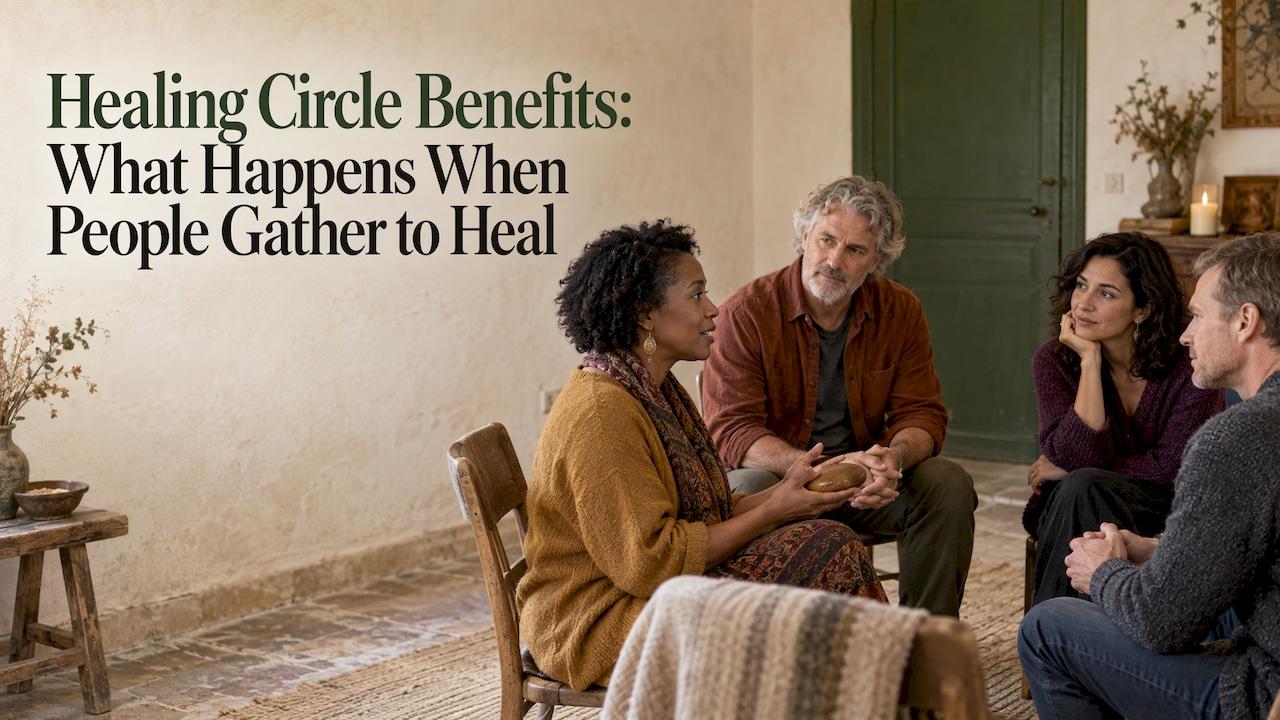
A healing circle is a group of people who sit together, take turns speaking and listening, and support one another without trying to fix anyone. The main benefit is simple and well documented: you are heard, you hear others, and you stop carrying something alone. At Sacred Paths we hold this kind of gathering in our Monthly Shamanic Circle, and this guide explains what a circle gives you and how to enter one well.
TL;DR
- A healing circle is a structured, peer-supported conversation: people sit in a circle, share in turn, and listen deeply. The facilitator's role is not to solve problems for anyone.
- Research on circles in clinics and communities reports gains in connection, validation and, in one primary-care study, symptoms and quality of life. A study in rural Mexico found that gathering and having someone to talk to mattered most.
- Good circles rest on agreements: confidentiality, voluntary sharing, and the freedom to step out and be checked on.
- A circle supports healing but does not replace a doctor or therapist when you are in crisis or need clinical care.
- If you feel disconnected or in transition, a circle with a spiritual and nature-based frame can help you reconnect with your own path.
Table of Contents
- What a healing circle is
- What happens in a session
- The benefits people report and research describes
- Why the circle itself works
- How circles differ by setting
- Safety, confidentiality and limits
- What a good circle looks like from the inside
- Circle work and shamanic practice
- Our perspective
- Join a circle with us
- FAQ
- Sources
What a healing circle is
A healing circle is a community or peer-supported conversation where people gather to share experiences, listen with full attention and support each other. A planning guide from MIT's health and wellness team describes its purpose as creating a safe space where people can be open, and states that the person leading the circle is not there to solve issues for participants.
The circle shape matters. Everyone can see everyone, nobody sits at the head, and no one is a spectator. Many circles also use a talking piece, an object passed around the group. The San Francisco State University participant guide explains that the person holding it is the only one who may speak, so each participant gets uninterrupted time.
The roots are old. Mental Health America notes that healing circles, talking circles and peacemaking circles come from Indigenous and Native American traditions, and that they bring people together to support one another. Today the same form appears in hospitals, universities, community centers and spiritual communities.
Two terms you will see:
- Group healing circle: any circle held for mutual support, whatever the topic: grief, illness, trauma, life change.
- Community healing circle: a circle open to a neighborhood or shared-identity group, often led by trained community members instead of clinicians.
What happens in a session
Sessions differ, but the skeleton is consistent across sources. The Office for Victims of Crime, a U.S. Department of Justice office, describes a talking circle in three rounds: introductions, discussion of a topic, and a discussion about how to heal. The MIT guide adds practical steps you can expect:
- A warm, inclusive welcome.
- A review of the group agreements.
- An optional grounding exercise or icebreaker.
- Questions or prompts that guide the sharing.
- A closing reflection.
Some circles last one evening. Others run for weeks. A Harvard T.H. Chan School article on Rwanda's community healing circles describes a 15-week format in which participants learn to name emotions, sit with discomfort, map their story with a Tree of Life exercise, sing together, witness each other and share when ready.
The practices inside a circle also vary. Mental Health America lists sharing personal experiences, breathing exercises, chanting and group prayer as common elements. Depending on the culture, the OVC resource mentions prayer or smudging as part of the opening.
A first-timer often fears being put on the spot. That is not how a well-run circle works. The San Francisco State guide states that participation is voluntary and that no one has to share unless they choose. Passing the talking piece along in silence is a full way of taking part.
The benefits people report and research describes
Here is what the evidence supports, kept to what the studies actually say.
You are heard, and you hear others
The most consistent benefit is relational. A 2025 exploratory study of women's mental health circles in rural Chiapas reports that participants' improvements were mainly due to gathering with others and having someone to talk to. The authors note that this challenges the assumption that structured teaching or activities are the main driver of benefit. For a person who feels isolated, that is encouraging: the ingredient is presence, and you do not need to be good at anything.
A safe place to be vulnerable and own your story
A 2023 exploratory study of a web-based healing circle in an undocumented community found that participants perceived the session as validating and informative, and survey results showed improved knowledge and understanding right after it. The authors stress the value of safe spaces where people can be vulnerable while keeping ownership of their own narratives. In a circle, you decide what to tell and how. Nobody interprets your story for you.
Measured gains in a clinical setting
A peer-reviewed study of healing and talking circles in primary care in Canada reported that participants who attended four sessions showed statistically significant improvements in reported symptoms and overall quality of life (p < 0.001, effect sizes from 0.75 to 1.19). This was one study of one program, so treat it as a promising signal about what a regular, structured circle can do, not a guarantee for any individual.
Culture and community deepen the effect
An exploratory implementation project that blended Indigenous healing practices with a Western trauma program used sharing circles twice a week over 13 weeks. The authors concluded that the qualitative evidence suggests the blend could be beneficial, and that the sharing circles and the presence of Elders and Aboriginal helpers increased the benefits. The lesson for a seeker: a circle held with real cultural and spiritual grounding offers something a plain discussion group may not.
Reach and accessibility
The Harvard T.H. Chan article reports that the Rwandan model, which trains ordinary community members as facilitators, has reached over 30,320 people at around $24 per participant. Healing in circles does not require a clinic or a specialist on every corner. People can hold each other.
Reconnecting with others and yourself
Support from a group matters at every stage of life. The same logic that makes community support valuable for new parents applies to anyone in transition: when you are surrounded by people who understand your situation, change feels less like a private ordeal. A University of California restorative justice resource frames healing-centered circles as a practice of restoring and strengthening relationships and addressing the conditions that perpetuate disconnection, which is close to what many seekers describe wanting.
Why the circle itself works
The studies point to a few features worth understanding, because they tell you what to look for.
Equal seating and turn-taking. When one person speaks at a time and nobody ranks above anyone else, quieter voices get room. The talking piece does the work a moderator would otherwise do by interrupting.
Listening without fixing. The MIT guide is explicit that the facilitator does not solve issues for participants. This surprises people who expect advice. Many find that being listened to without correction is what they were missing.
Agreements. At the start, participants usually set safety agreements, including the common promise that what is said in the circle stays in the circle. The OVC resource describes this as central, and notes the setting is designed to help people share openly.

Ritual and rhythm. A welcome, a shared silence, a closing: these markers help people step out of ordinary conversation and into attention. The UCSF material and several guides describe the circle as stepping out of ordinary time, and anyone who has sat in one will recognize it.
How circles differ by setting
| Setting | Typical emphasis | Example from sources |
|---|---|---|
| Healthcare and clinics | Symptom relief, regular sessions | Primary-care talking circles with four-session attendance |
| Community and peer support | Mutual aid, shared experience | Rwanda's 15-week circles led by community facilitators |
| Culturally rooted | Elders, ceremony, tradition | Sharing circles with Elders in an Indigenous healing project |
| Restorative and institutional | Repairing relationships | Healing-centered circles in university restorative justice work |
| Spiritual | Presence, meaning, connection to nature or ancestors | Circles with breathing, chanting or prayer |
If your question is "how do I reconnect with who I am?" rather than "how do I manage a diagnosis?", the spiritual and culturally rooted circles are likely your best fit. If you are dealing with a clinical condition, a clinic-based or therapist-led group may be the right place to start, and a spiritual circle can sit alongside it.
Safety, confidentiality and limits
A circle is a powerful setting, and it deserves care. Before you take part:
- Ask about confidentiality. The OVC resource recommends confidentiality agreements. A reputable circle explains its own, including that confidentiality has limits when someone discloses an intention to harm themselves or others, and that mandated reporters, such as some teachers and clinicians, must follow their legal obligations.
- Know you can step out. The MIT guide says participants can leave the circle to gather themselves, and that someone should check on them. You are never trapped in a hard moment.
- Expect support after. The OVC resource advises giving participants information about advocacy services when stories raise strong emotions. If a circle brings up more than you can hold, speak with a licensed therapist or your doctor, and in an emergency call your local emergency number.
- Share at your own pace. You may pass. You are not required to tell your deepest story to benefit.
If you are living with trauma, severe depression or thoughts of harming yourself, tell your doctor or therapist you plan to attend a circle so your care fits together. A circle is a place of support and does not replace clinical care.
What a good circle looks like from the inside
Whether you attend or eventually lead one, these signs show a circle is well held, drawn from the MIT, OVC and San Francisco State guides:
- The facilitator welcomes everyone, explains what a healing circle is and why they host it.
- Agreements are named and reviewed before anyone shares.
- A grounding moment, such as a few breaths or a short silence, opens the space.
- Prompts are open questions, not interrogations.
- The talking piece is respected, and cross-talk and advice-giving are kept out.
- The close gives time to reflect and return to ordinary life.
If you want to learn to hold circles yourself, the craft is about presence and discipline more than technique. Our guide on how to choose a shamanic teacher covers what to look for in someone who will train you. If you are a healer who has been giving too much, our article on healer burnout recovery is a good companion, since sitting as a participant, not as the holder, can be part of how a healer refills.
Circle work and shamanic practice
The circle is also a shamanic form. Many traditions gather in a circle around a fire, a drum or a shared offering, and the logic is the same one the research describes: people heal in relationship. In Andean traditions, that relationship has a name, ayni, reciprocal exchange, which you can read about in our piece on Ayni reciprocity. Each person gives attention and receives attention.
If you want to understand the wider landscape of what people report from this kind of work, see shamanic healing benefits. For circles that touch loss, grief rituals explains why meaning matters more than frequency. Between gatherings, a journal keeps the thread: our spiritual journal prompts offer ways to write about what surfaced.
Our perspective
We hold circles because we have watched what the research now describes: people do not need to be fixed, they need to be witnessed. A circle gives you that without a hierarchy.
At La Ferme du Cerf Bleu, a rewilded 18th-century farm in Burgundy, we teach through experience instead of information. Reading about a circle tells you little. Sitting in one, with the land around you and a group that is learning to listen, changes how you hold your own story.
Our approach is community-centric. Our school draws on several cosmologies, and the circle is the shared form underneath them. It lets seekers, healers and people in transition meet each other as equals while they work on what is theirs to work on.
If you feel disconnected from your purpose, a circle is one of the gentlest ways back. You can arrive with no answers.
Angell
Join a circle with us
If you want to experience this rather than read about it, our Monthly Shamanic Circle is the place to start. It is a recurring gathering in the school's community, and the schedule is published on our site. For deeper work, we also offer a Breathwork Shamanic Ceremony, retreats at La Ferme du Cerf Bleu, and a two-year initiatory path in Andean and Norse shamanism. You can see everything on the Sacred Paths homepage.

If you prefer to begin one-to-one, a Shamanic Healing Session is $245, and Shamanic & Spiritual Coaching is $395, both listed on our site. Many people start with a session and then join the circle.
FAQ
What is the purpose of a healing circle?
The purpose is to create a safe space where people can be open, share experiences and be heard by peers. According to MIT's planning guide, the facilitator is not there to solve anyone's issues. The healing comes from listening, witnessing and shared presence.
Do I have to speak in a healing circle?
No. Participation is voluntary, and the San Francisco State guide says no participant is required to share unless they choose. You can pass the talking piece, listen, and still take part fully.
How is a group healing circle different from therapy?
A circle is peer-supported and focuses on sharing and listening. Therapy is clinical care delivered by a licensed professional. Many people use both, and if you are managing a mental health condition, tell your therapist or doctor you are attending a circle.
What are community healing circles?
They are circles open to a neighborhood or a group with shared experience, often facilitated by trained community members. In Rwanda, the model described by the Harvard T.H. Chan School uses ordinary community members to lead 15-week circles for trauma survivors.
Sources
- MIT Health and Wellness: Healing Circle Planning Guide
- Office for Victims of Crime: Culture is Healing, Facilitating Talking Circles
- San Francisco State University: Healing Circle Participant Guide
- Mental Health America: Community Care
- Harvard T.H. Chan School: Lessons from Rwanda's Healing Circles
- To gather is to heal: Women's mental health circles in rural Chiapas
- An Exploratory Study of Healing Circles in an Undocumented Community
- Introducing Healing Circles and Talking Circles into Primary Care
- Indigenous Healing and Seeking Safety: A Blended Approach
- New Mom Community Support Benefits