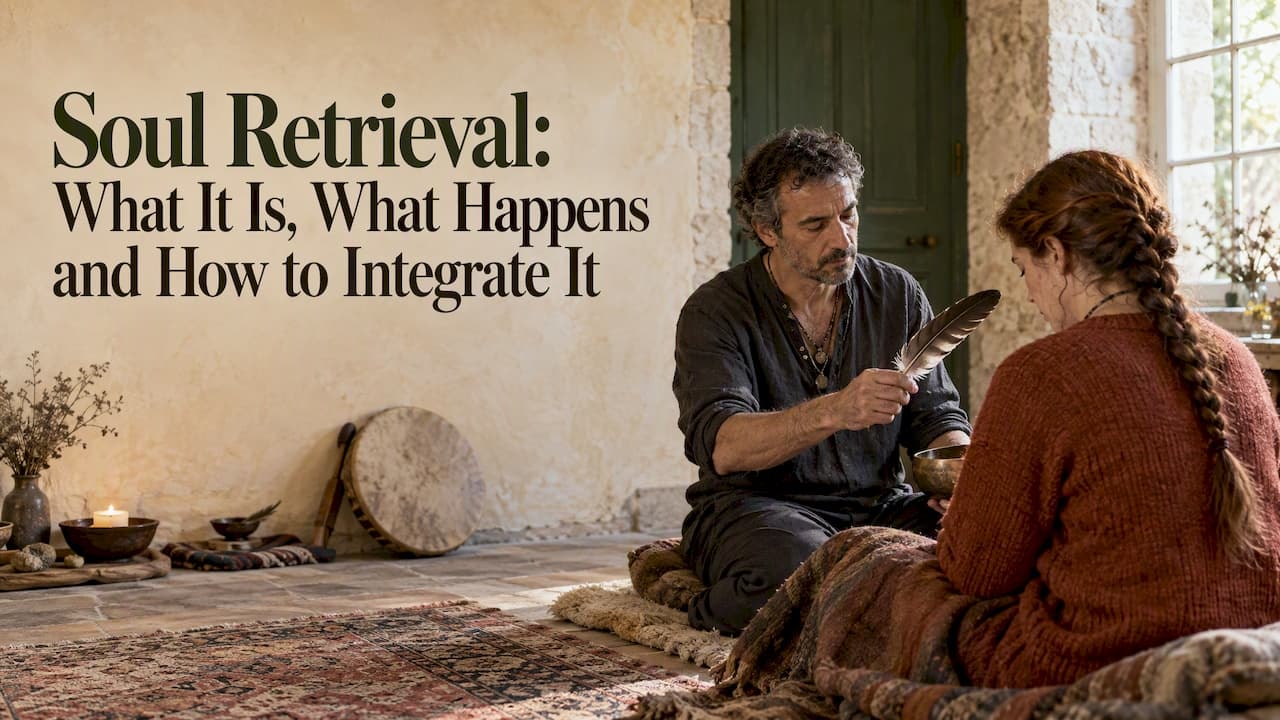
Soul retrieval is a shamanic healing practice in which a practitioner journeys in a altered state, often to drumbeat, to find and bring back a part of a person's vitality or spirit that is believed to have left after a shock, loss or trauma. It is a spiritual and cultural framework, not a medical treatment. Used well, it sits beside good care for the body and mind, never in place of it. Below: what soul loss means, how a session unfolds, what integration looks like, and how to choose a guide.
TL;DR
- Soul retrieval is a shamanic ceremony to call back parts of yourself believed to have departed after a frightening or painful event.
- "Soul loss" is a cultural explanation of distress. Its signs overlap with depression, anxiety and post-traumatic stress, so they are not a diagnosis.
- A session usually has an intention, a journey by the practitioner, a return of what was found, and a conversation about what it means for you.
- Integration, the weeks after, matters as much as the ceremony: rest, grounding, journaling and simple daily acts.
- If you have severe symptoms, persistent dissociation or thoughts of self-harm, see a licensed clinician first or alongside.
Table of Contents
- What soul retrieval means in shamanism
- Soul loss: what it is and what the research says
- Signs people associate with soul loss
- What happens during a soul retrieval
- Can you do soul retrieval on yourself?
- Integration: what to do afterward
- How to choose a practitioner
- Our perspective
- Work with us
- FAQ
- Sources
What soul retrieval means in shamanism
In many traditions the person is more than a body. There is a life force, a spirit, a sense of being fully "here." Shamanic cultures describe how a shock can cause part of that force to withdraw, as a kind of protective retreat. Soul retrieval is the work of finding what withdrew, inviting it back and helping the person welcome it.
The idea is old and widespread, but it is not one single practice. Different cultures describe the cause, the cure and the healer's role in different ways. What you meet today in the United States and Europe is often a modern form shaped by Western teachers of core shamanism, who adapted these ideas for people outside the original cultures. That is worth knowing, and it is why respect for the traditions the ideas came from matters. If you want to go deeper on that point, our guide to respecting Indigenous traditions covers how to approach borrowed practices honestly.
The central intention is easy to state: to put a person back in touch with their own power and presence. People describe the goal in plain words, such as feeling whole again, being able to decide, feeling at home in the body.
Soul loss: what it is and what the research says
The phrase "soul loss" shows up in a well-studied cultural concept called susto. A 2023 peer-reviewed review describes susto as a Latin American explanation in which a frightening event is believed to make the soul leave the body, followed by unhappiness, illness and difficulty carrying out important social roles. The authors treat soul-loss language mainly as a culturally meaningful way of expressing distress, and they stress that the same picture may also reflect a diagnosable mental or physical condition.
Both things can be true at once. For the person living it, the story of a lost part of the self may be the most honest description available. For a clinician, the same person might meet criteria for depression or trauma. A good practitioner holds both views and does not argue the reader out of either.
Research also warns against flattening the idea. A study of fright-related disorders among the Q'eqchi' Maya in Belize found wide variation in signs, diagnosis and treatment and cautioned against treating susto as one uniform disorder. In other words, soul loss is not a single checklist. It is a family of local understandings.

Signs people associate with soul loss
People who describe soul loss commonly mention feeling numb, flat or distant from their own life. Others describe memory gaps, trouble making decisions, or a sense of watching themselves from outside. The 2023 review lists commonly reported signs that include apathy, crying, restlessness, withdrawal, weakness, nightmares, fear and being easily startled, along with physical signs such as palpitations, sweating, nausea and stomach or breathing problems.
The same review is clear that these are not specific to soul loss. They overlap with patterns seen in depression, post-traumatic stress, panic, generalized anxiety, somatic disorders and even infections. So a list of signs cannot tell you whether you have lost part of your soul. It can only tell you something is asking for attention.
The World Health Organization describes how acute stress after trauma can involve detachment, intrusive memories, nightmares, avoidance, concentration problems, irritability and insomnia, and advises seeking professional help if symptoms are upsetting or affect your health or daily functioning.
When to see a clinician first
See a doctor or licensed mental health professional before, or alongside, any ceremony if you notice any of the following:
- Symptoms that are getting worse or have lasted for weeks and affect work, sleep or relationships.
- Frequent or severe dissociation, flashbacks or panic.
- Physical symptoms such as chest pain or breathing problems, which need a medical check on their own terms.
- Thoughts of harming yourself. In the US, you can call or text 988, the Suicide and Crisis Lifeline.
This is not a reason to avoid spiritual work. It is how you make the spiritual work safe. Many people find that talk therapy, such as individual therapy, gives them a steady place to process what comes up, while shamanic practice gives the experience a larger meaning.
What happens during a soul retrieval
Practitioners differ, so treat this as a typical shape, not a rule. A session is often done in person, and many practitioners also work remotely.
- Conversation and intention. You talk about what brought you, what you want to change and any health history. A responsible practitioner asks about medication, mental health care and current stability. You agree on a clear intention.
- Opening the space. The practitioner sets up a quiet room or outdoor place, may call on helping spirits or the land, and explains what to expect. You are usually lying down or resting, with your eyes closed.
- The journey. To the sound of a drum or rattle, the practitioner enters a focused, altered state of awareness and travels in what shamanic traditions call non-ordinary reality. There they look for the part that left and the reason it left. Our beginner's piece on shamanic journeying explains this state in plain terms.
- Return. The practitioner brings back what they found, often by speaking, blowing it into your heart and crown, or placing it with the hands. Some also bring back a message or a condition for the part to stay.
- Sharing. You and the practitioner talk about what they saw. You decide what rings true and what does not. A good practitioner offers images as possibilities, never as verdicts about your life or your family.
- Closing. You ground, drink water, eat something and receive a few simple suggestions for the days ahead.
A session is not a performance, and nobody should pressure you to accept a story that does not fit. You can say no to any part of it at any time.
Does soul retrieval work?
There is no body of clinical trials showing that soul retrieval treats a medical condition, and you should not expect it to. What people report is personal: feeling more present, calmer, more able to grieve or decide. Those experiences are real to the people having them, and they are best understood as meaning-making and ritual, which humans have used around loss and change for a very long time. If you need a medical or psychological outcome, rely on clinical care for it, and let ceremony support your sense of meaning. Our article on why grief rituals work through meaning explores why ritual helps even when it is not a treatment.
Can you do soul retrieval on yourself?
People often ask this. Some practitioners teach self-journeying for gentle, everyday needs, such as asking what you need to feel more grounded. Many others recommend that deeper or older wounds be held by an experienced guide, because the work can stir strong memories.
If you try a simple practice at home, keep it small and safe:
- Choose a quiet time when you are rested and not in crisis.
- Start with grounding: feel your feet, name five things you can see, take slow breaths. Sensory grounding can help orient the nervous system to the present, and one trauma-sensitive mindfulness guide notes that safety has to be felt in the body.
- Keep a short time limit, such as ten minutes, and know how you will end it.
- Write down what you noticed, without forcing meaning onto it.
- Stop if you feel panic, detached or overwhelmed.
The same guide advises that when post-traumatic stress is active and significantly impairing, or dissociation is frequent or severe, this kind of practice is safest in a clinical context. Take that seriously. Going slowly is not weakness.
Integration: what to do afterward
The ceremony is the beginning. Integration is how a returned part of you becomes part of daily life. There is little formal research on this, so what follows is the common practice of experienced guides, offered as suggestions and not as promises.
The first days. People often feel tired, tender, emotional or unusually clear. Plan a quiet day or two. Drink water, eat simply, spend time outdoors and keep a low screen load. Vivid dreams are common to report. Write them down without analyzing them.
The first weeks. Give the returned part something to come back to. That might be a daily walk, a short morning ritual, a creative act or a boundary you have avoided setting. A medicine walk is a simple way to bring attention to your body and the land. If the practitioner suggested a condition or a gesture, honor it.

Be careful with big decisions. Strong feelings can arrive after a ceremony. It is wise to wait before quitting a job or ending a relationship because of what you felt in a session.
Keep your care team informed. If you see a therapist or doctor, tell them what you are doing. Good care teams are more helpful when they know the whole picture.
When integration feels hard. If you feel worse for more than a few days, feel detached, or old memories flood in, contact your clinician and the practitioner who guided you. A good practitioner will welcome that call.
How to choose a practitioner
The field is unregulated, so the choosing is yours. Look for these qualities:
- Clear scope. They say plainly that they do not diagnose or treat medical or psychiatric conditions, and they encourage you to keep your clinicians.
- Lineage and training. They can tell you who taught them and how long they have practiced.
- Informed consent. They explain the process before it starts and let you stop at any point.
- No fear tactics. They do not tell you that you are cursed, doomed or in danger unless you buy more work.
- Clear pricing. Fees are stated up front.
- Respect for sources. They name the traditions they draw from and do not claim ones they do not hold.
We go further in our guide to choosing a shamanic teacher. If your concern is something you feel is lodged in the body or energy field, rather than a lost part, shamanic extraction is the related practice to read about.
Our perspective
We have sat with many people who arrive saying the same thing in different words: I am doing fine on paper and I do not feel like myself. We do not think that needs to be argued into a diagnosis or dismissed as a metaphor. It is a human experience that deserves a human response.
At Sacred Paths, we see soul retrieval as one doorway in a longer path, not a single event that fixes a life. A returned part needs soil: community, daily practice, time in nature and honest mentoring. That is why we teach through experience and circle, not just information, and why our work draws on more than one cosmology, including Andean and Norse traditions.
I came to this work as a veterinarian, trained to look at what is in front of me and to respect what the body knows. That training makes me firm about one thing: ceremony and clinical care are partners. If you are struggling, we want you supported by every good resource available, and we will tell you when something belongs with a doctor or a therapist.
Done with care, with consent and with respect for where the practices come from, this work can help people feel at home in themselves again. That is what we offer, and it is what we would want for a friend.
Angell
Work with us
If you want to explore this with a guide, we offer a one-to-one shamanic healing session, in person or remotely, at 245 $ per session. For a longer path, our school offers the EarthWalker and FireKeeper programs, and we host retreats at La Ferme du Cerf Bleu, a rewilded 18th-century farm in Burgundy, France. You can see everything in one place on the Sacred Paths home page.

Tell us what you are looking for and we will say honestly whether a session, a program or a different kind of support fits you best.
FAQ
What is soul retrieval in simple terms?
It is a shamanic ceremony to call back a part of your vitality or sense of self that is believed to have withdrawn after a shock or loss. A practitioner journeys on your behalf and returns with what they find. It is a spiritual practice, not a medical treatment.
What are the signs of soul loss?
People describe numbness, apathy, memory gaps, indecision and feeling detached from life. Researchers note that these overlap with depression, post-traumatic stress and anxiety, so they are not proof of soul loss. If they affect your daily life, see a clinician.
How long does soul retrieval take, and how long does integration last?
Sessions vary by practitioner, so ask when you book. Integration has no fixed length. Many people give themselves several weeks of quiet routines and reflection, and check in with their guide if things feel unsettled.
Is it safe to do soul retrieval on myself?
Gentle grounding and journaling are low risk for most people. If you live with active trauma symptoms or frequent dissociation, clinical support is the safer setting for deeper work. Stop at any sign of panic or overwhelm.
Sources
- Susto as a cultural conceptualization of distress (2023 review)
- Does "Susto" Really Exist? Indigenous Knowledge and Fright Disorders (PubMed)
- Acute stress disorder (World Health Organization)
- Trauma-Sensitive Mindfulness: Safe Practices for Trauma Survivors