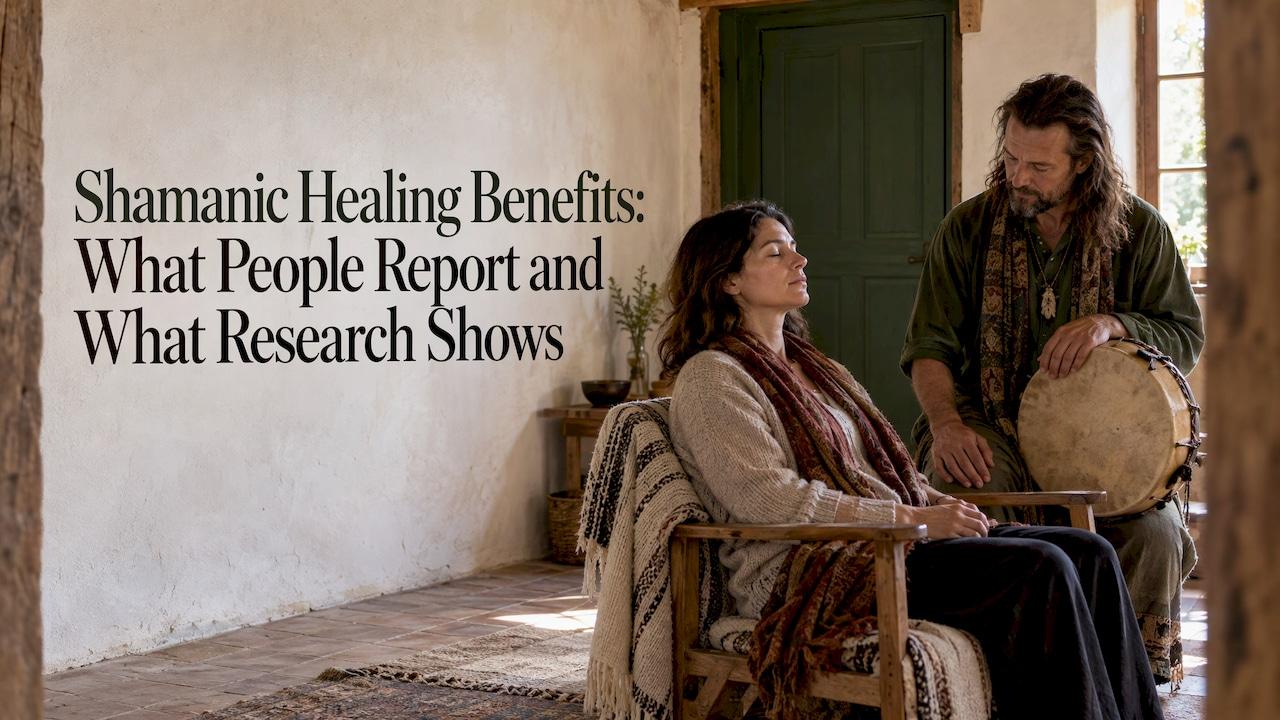
Shamanic healing is a spiritual practice in which a practitioner works with drumming, journeying and helping spirits to address the emotional, physical and spiritual layers of a problem. People come to it for relief from pain, for emotional release and for a renewed sense of direction. Early clinical research points to potential benefits with a relatively low risk of harm, and it is best used alongside, not instead of, medical care. Below you will find what a session involves, the benefits people describe, what the studies say and how to prepare.
TL;DR
- Shamanic healing works with the whole person: body, emotions and spirit. A session starts with an interview, then the practitioner works with tools such as a drum or rattle.
- Reported benefits include emotional release, a stronger sense of agency, less felt pain and a clearer sense of purpose.
- A 2025 scoping review found potential benefits and a relatively low risk of harm, but calls the results preliminary.
- Remote sessions follow the same structure over video. Research on distance healing is mixed, so treat it as a complement.
- Always keep your doctor or therapist in the loop for any medical or mental-health condition.
Table of Contents
- What shamanic healing is
- The benefits people report
- What the research says
- Remote and online shamanic healing
- What to expect from a session
- Our perspective
- Using shamanic healing safely
- Work with us
- FAQ
- Sources
What shamanic healing is
Shamanic healing is one of the oldest healing traditions humans have, found in many cultures under many names. In a typical session, according to the Society for Shamanic Practice, the practitioner begins with an interview about your symptoms, how long you have had them, their severity, the type of pain and any relevant medical information. They then prepare by observing you in a meditative state and asking their allies or helping spirits what is needed.
The tools vary. A drum or rattle is common, and some practitioners also use feathers, tobacco, crystals or other objects. The same source notes that sessions generally last fifteen minutes to half an hour, though they can run up to an hour.
Different lineages emphasize different methods. Some of the best-known are:
- Soul retrieval, which focuses on parts of yourself that feel lost or left behind after hardship. See our guide to soul retrieval and how to integrate it.
- Extraction, which works with energies felt as foreign or stuck. We explain it in shamanic extraction: six steps and evidence.
- Ancestral work, which addresses patterns carried through a family line. Read what ancestral healing is and how to practice it.
- Journeying, a drum-guided inner voyage to meet guides and receive insight. Our beginner's guide to shamanic journeying walks through a first one.
If you want the cultural roots behind the Andean approach, Andean shamanism: paqos, apus and ayni is a good place to start.
The benefits people report
Shamanic healing is not a single technique with a single outcome. The benefits people describe tend to fall into a few groups. Treat these as reported experiences, not guarantees: every person, practitioner and session is different.
Emotional release and balance
Many people arrive carrying grief, old stress or a feeling of being stuck. Because a session gives that material a ritual container, with a witness, a rhythm and a clear beginning and end, people often describe a sense of letting go. Emotional balance and a calmer baseline are among the most common things clients mention.
A stronger sense of agency
The 2024 scoping review on shamanistic trance practices, published in BMC Complementary Medicine and Therapies, reported encouraging outcomes in psychological well-being, including improved quality of life and restoration of agency. Feeling that you are an active participant in your own healing, rather than a bystander to it, is one of the most meaningful shifts people describe.
Relief from physical discomfort
The same review noted encouraging physical outcomes, including reduced functional pain. Practitioners generally present shamanic healing as part of a broader approach. As the Society for Shamanic Practice explains, it is typically used with physical healers and other forms of care, not in isolation.
Clarity, meaning and direction
People in transition, after a job loss, a divorce, a loss in the family or a long season of burnout, often come looking for orientation. Journeying, ceremony and time in nature can help you hear what you already know about the next step. This is where our own work concentrates: reconnecting people with their inner essence and purpose. Our students describe profound personal transformations, and those are their words about their own experiences.
A felt connection to nature and community
Shamanic practice is relational. It places you inside a living world of land, ancestors, animals and community. Simple practices such as a medicine walk can bring this home in an afternoon, and many people find that belonging, not any single technique, is what changes how they feel day to day.

What the research says
The research is early, and it is worth knowing exactly what it does and does not show.
A 2025 scoping review in PMC found that shamanic healing as an intervention has potential benefits and a relatively low risk of harm, and is feasible to deliver. It drew on 16 publications: 1 clinical trial, 2 case series and 10 case reports. Only three studies were prospective or reported quantitative outcomes. The authors consider the results preliminary and recommend that future work collect data on expectancy and belief, and that care be culturally appropriate.
The 2024 review of trance practices points the same way: encouraging outcomes, with research still in its infancy. It calls for rigorous designs, including control groups and placebo conditions.
What this means in practice:
- The signals are positive. Both reviews report potential benefit and low risk of harm.
- The evidence base is young. Small studies and case reports cannot yet tell us how much of an effect comes from the ritual, the relationship, the setting or the expectation.
- The practice is well suited to complementary use. That is how it is traditionally offered, and it is how we recommend you approach it.
It is also worth remembering that ritual, attention, nature and community are things people have valued for far longer than they have been studied. If you are curious about how other expressive and creative practices are studied, this overview of the art therapy research and reported outcomes shows how researchers evaluate non-clinical-seeming approaches to well-being.
Remote and online shamanic healing
Many people ask whether a session over video can work. Logistically it is simple. Healthline describes remote sessions as running much like in-person ones, except over video: you lie down at home, set up a camera on your phone or laptop, and the healer can see and hear you and you them. Practitioners generally hold that energy is not limited by distance.
As for the science of distance healing, it is an open question. A 2015 review of distant healing intention therapies noted that a meta-analysis of 57 human randomized trials found statistically significant effects in active treatment compared with controls (r=0.203), while concluding that the evidence does not yet give confidence in clinical efficacy, partly because many significant studies were of poor methodological quality. One double-blind study of 40 patients with advanced AIDS reported fewer new illnesses, fewer hospitalizations and improved mood in the treated group at six months. A 2012 exploratory study of surgical wound healing found no differences on its main measures, and its authors noted that the variables shaping these effects are not yet well understood.

The honest reading: this is a field with intriguing results and unanswered questions. Many people find that a remote session gives them the same sense of ritual, presence and release as an in-person one, and it makes the work accessible wherever you live. Use it as a complement to your regular care.
Preparing for an online session
- Choose a quiet room where you will not be interrupted, and silence notifications.
- Test your camera, microphone and internet connection beforehand.
- Have water nearby, a blanket and something to lie on.
- Write down your intention or the question you are bringing, plus any symptoms you want to mention.
- Leave time afterward for rest, journaling or a short walk.
What to expect from a session
Whether you meet in person or online, expect this arc:
- The interview. You describe what is going on, including relevant medical information.
- Opening the space. The practitioner centers, calls on their helping spirits and sets the intention.
- The work. Drumming, rattling, breath, song or silence while the practitioner journeys on your behalf or guides you through your own experience.
- The sharing. The practitioner tells you what they perceived and what may be asked of you.
- Integration. You decide how to carry the insights into daily life, often with a simple practice to repeat in the following days.
The integration step is where much of the lasting value is found. A session can open something; what you do in the following weeks helps it take root.
Our perspective
We see shamanic healing as a path back to yourself, not a quick fix. Over the years, what we notice is that people rarely arrive with only one problem. They arrive disconnected: from their body, from their purpose, from the natural world, from a community that holds them.
That is why we teach experientially. Reading about healing is not the same as feeling a drum carry you somewhere new, or sitting in a circle where your story is witnessed. At La Ferme du Cerf Bleu in Burgundy, a rewilded 18th-century farm, we bring together Andean and Norse traditions, along with other cosmologies, and pair them with real-life mentoring.
My own background as a veterinarian shaped how I hold this work. I value careful observation and I value modern medicine. Shamanic practice works best, in my experience, as a companion to medical and psychological care, never a replacement. The two speak to different layers of a person.
If you feel a pull toward this work, listen to it, and begin with a step that fits your life: a single session, a circle or a longer path.
Angell
Using shamanic healing safely
Shamanic healing is traditionally offered as part of a wider approach to health. Keep these points in mind:
- Keep your medical team involved. Healthline states that there is no evidence energy healing can cure specific physical or mental health conditions, and that it can be used as a complementary practice alongside other therapy and medical treatment. If you have a physical or mental health condition, consult a qualified medical professional, and do not stop prescribed treatment.
- Seek urgent care when you need it. For severe mental distress, thoughts of self-harm or a medical emergency, contact a doctor, a licensed therapist or your local emergency number. Research on mental health care in traditional-healing contexts stresses that severe distress calls for genuinely therapeutic interventions, which traditional practices can accompany.
- Integrate with care. If you already work with a clinician, this look at holistic primary care and what the approach means shows how traditional and complementary practices can sit alongside clinical care.
- Choose your practitioner thoughtfully. Look for clear lineage, grounded ethics, respect for the cultures the practices come from and a willingness to work with your doctor. Our practical guide to choosing a shamanic teacher covers what to look for. If you are a healer yourself and feel depleted, our piece on healer burnout recovery may help.
Work with us
If you are ready to experience shamanic healing, we offer a Shamanic Healing Session for $245, in person or remotely. For ongoing guidance through a season of change, Shamanic & Spiritual Coaching is $395 one-off, or $345 per month for the one-year program. If you prefer to begin at home, Becoming the Medicine: 21-Day Practice is $67 and Becoming the Mystic is $197.

For deeper immersion, our school offers the two-year EarthWalker and FireKeeper paths, along with retreats at La Ferme du Cerf Bleu. Visit Sacred Paths to see what fits where you are now.
FAQ
What does shamanic healing do?
It aims to address the emotional, physical and spiritual aspects of a problem together. Practitioners use tools such as drums and rattles and work with helping spirits to find what is needed. People report emotional release, a stronger sense of agency, less felt pain and renewed direction. These are reported experiences, and the research is still preliminary.
Does distance healing work?
The evidence is mixed. A 2015 review found some significant effects across 57 trials but concluded the evidence does not yet support confidence in clinical efficacy. Many people nevertheless value remote sessions as a ritual of presence and release. Use them as a complement to medical care.
Is online shamanic healing the same as an in-person session?
The structure is the same: an interview, the healing work and a closing conversation. The difference is that you are at home and connected by video, so the practitioner can see and hear you. Prepare a quiet space, a comfortable place to lie down and time to rest afterward.
Can shamanic healing replace medical or mental-health care?
No. It is best used as a complementary practice alongside medical treatment and therapy. If you have a physical or mental health condition, keep seeing your doctor or licensed therapist and tell them what you are doing. For a crisis, contact emergency services right away.
Sources
- What is a Shamanic Healing? Society for Shamanic Practice
- Shamanism as a Clinical Intervention: A Scoping Review
- Scoping review on shamanistic trances practices
- Distant Healing Intention Therapies: An Overview
- A randomized double-blind study of the effect of distant healing
- Distant Healing Of Surgical Wounds: An Exploratory Study
- Remote Energy Healing: How It Works and What the Science Says
- Reconciling a Broken Heritage: Developing Mental Health
- Art Therapy Benefits List: What the Research Shows
- Holistic Primary Care: What the Approach Means for You