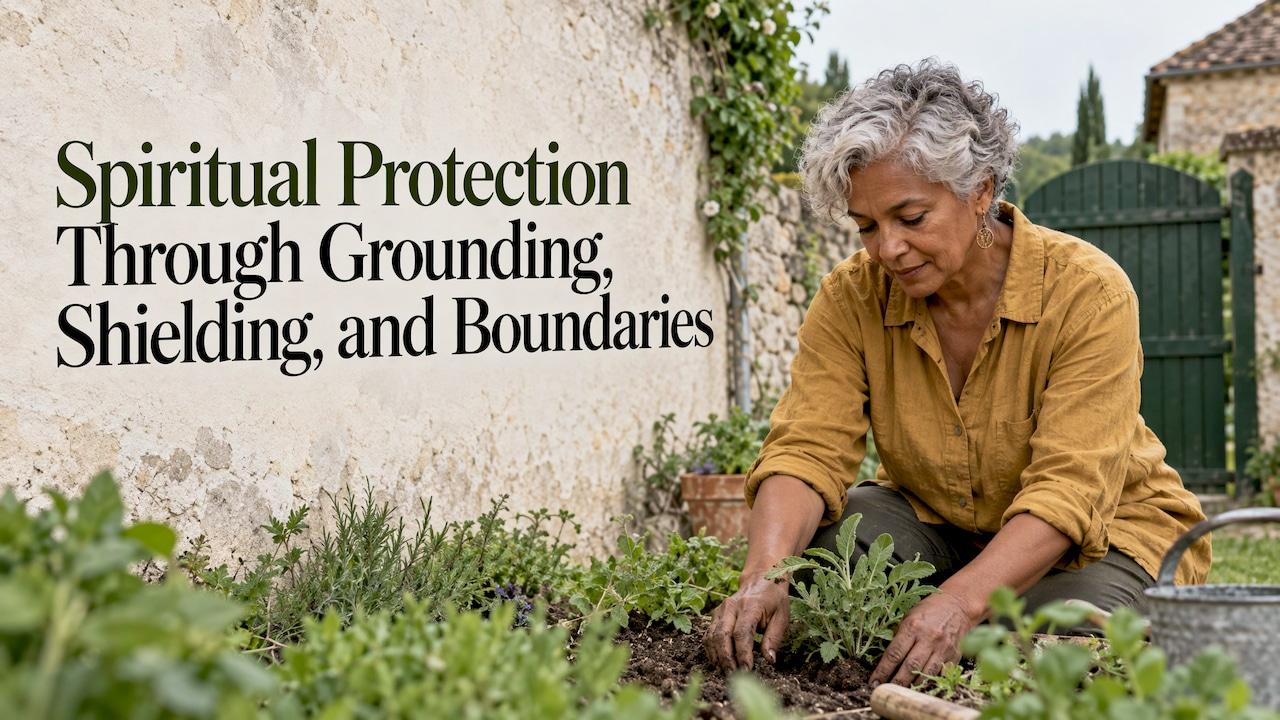
Spiritual protection is the practice of staying steady, clear and yourself when life, people or places leave you drained, anxious or scattered. The techniques that hold up are simple: ground your body first, center your attention, shield with a chosen image, and back it all with ordinary boundaries. In the shamanic traditions we teach, protection is not a wall against the world. It is a relationship with the earth, your breath and your own limits, and it is learned by doing, not by collecting objects.
TL;DR
- Start with grounding. Feet on the floor or the earth, a long exhale, attention on what is physically around you.
- Shielding is a visualization of a boundary around you. It works best when it is selective, letting you notice what is yours and what is someone else's.
- Pair every inner practice with a practical boundary: leaving a room, saying no, shortening a call.
- Smoke, salt, candles and amulets are optional tools. Use them safely and never as a replacement for real-world help.
- If fear of spiritual threats is growing rather than easing, talk to your doctor or a licensed mental health professional.
Table of Contents
- What spiritual protection actually means
- Grounding: the foundation of every other technique
- Centering: gathering yourself before you shield
- Shielding techniques that work in daily life
- A five-minute daily protection routine
- Cleansing and protecting your space
- Safe practice: when protection is not the answer
- Why practice in community and in nature
- Learn protection as a lived practice
- FAQ
- Sources
What spiritual protection actually means
There is no single definition. Across traditions the word covers a group of practices with one aim: to feel safe, centered and in charge of your own energy. Common vocabulary helps here:
- Grounding brings you back into your body and the present moment, and releases excess tension or energy into the earth.
- Centering gathers your attention around your core, usually with breath and a clear intention.
- Cleansing clears a person or place, often with smoke, sound, water or movement.
- Shielding creates an imagined boundary around you.
- Warding extends protection to a space, such as a home.
- Practical boundaries are the real-world choices: ending a conversation, turning off a notification, resting.
You do not need all of them every day. Match the tool to the situation: grounding after a stressful commute, shielding before a draining family dinner, cleansing a room after an argument.
A healthy practice leaves you feeling more capable, not more frightened. If a ritual starts to feel mandatory, or the world begins to feel full of threats, that is a signal to simplify, not to add more rituals.
Grounding: the foundation of every other technique
Grounding comes first because every other technique is easier from a calm, embodied state. It is also the step most people skip.
A two-minute grounding you can do anywhere
- Place both feet flat on the floor and notice the support beneath you.
- Breathe comfortably, then make each exhale a little longer than the inhale.
- Name your date, where you are, and three things you can see.
- Feel the texture of something in your hands, such as a stone, a mug or fabric.
- Notice any sounds without judging them.
These steps echo common grounding exercises used for stress: pressing the feet into the floor, slow exhales, and orienting yourself by naming your date and location. The same source advises stopping if an exercise leaves you more agitated or more detached. Treat that as a rule: grounding should make you feel more here, not less.
Grounding through the earth
In shamanic practice, grounding is literal. You stand, walk or sit on the land and let your body remember that it belongs to it. A UW Medicine article on earthing suggests walking barefoot on grass, sand or soil, gardening with breath paired to movement, slow silent forest bathing, and meditating barefoot at sunrise or sunset. It notes that some studies link direct contact with the earth to better sleep and mood, while research specific to earthing is still limited, and that mindful walking can lower cortisol, a hormone tied to stress.
If you want a deeper version, our guide to forest bathing as a spiritual practice shows how to move slowly through woodland with attention, and our piece on the medicine walk turns a walk into a conversation with the place around you.
Mindfulness is the quiet engine under all of this. If you would like to see how common mindfulness measures work, this overview of a mindfulness assessment explains what such tests actually look at.
Releasing what you are carrying
Traditional grounding has a second half: letting go. In the classic description of grounding and centering, you sit undisturbed, breathe until your breath is even, and gather your energy inward to center. Grounding is the reverse: you send excess energy out through your legs and feet into the earth, or imagine it passing into a tree or a bucket of water. Some people bounce lightly on their feet to shake out the last of it.
A simple version: after a charged day, stand barefoot if you can, picture the tension as heat or weight, and let it drain down through your soles for a few slow breaths. Finish by taking one full breath that belongs only to you.

Centering: gathering yourself before you shield
Center before you build any boundary. Place a hand on your chest, breathe until the breath evens out, and say one sentence of purpose, such as "I stay present and kind, and I stay myself." This takes under a minute and gives the shield something to protect: a clear core rather than a scattered mind.
Shielding techniques that work in daily life
Shielding is a visualization that sets a boundary around you. The best known version is the bubble: focus on your energy core, expand it outward until it surrounds your whole body and extends a little past your skin, and imagine the surface as reflective so that unwanted influence is returned to its source, as described in the same grounding and shielding guide.
Choosing your shield image
The image matters less than your relationship with it. Pick one that feels natural:
| Image | Feels like | Good for |
|---|---|---|
| Bubble of light | Warm, open, gentle | Crowds, public transport, busy offices |
| Mirror | Sharp, reflective | Hostile or critical people |
| Stone wall or boulder | Heavy, stable | Long, tiring meetings |
| Cloak or shell | Close, private | Sensitive moments, hospital visits, grief |
| Tree roots and canopy | Alive, flexible | Nature-minded practice, ongoing stress |
In Andean and Norse shamanic traditions, which we teach, protection often comes from allies rather than armor: the land, the elements, the ancestors. That is why our students practice outdoors, where the shield is not something you build alone but something you stand inside.
Keep the shield selective
A good shield is not total isolation. Its job is to help you notice what belongs to you, what belongs to someone else, and what does not need your engagement. A closed-off person is not protected, only tired. The best test is not a dramatic feeling of energy. It is whether you can stay present in a tense conversation without absorbing the tension.
A visualization also cannot replace permission to act. You are always allowed to leave, say no or end a call early. Do both: imagine the boundary and keep the real one.
A five-minute daily protection routine
This routine combines the steps above into a sequence you can finish before you leave the house or after a hard day.
- Orient. Name the date, time, place and three things you can see.
- Ground. Take ten breaths with longer exhales, feet on the floor or earth.
- Center. Hand on chest, one sentence of purpose.
- Shield. Visualize your chosen boundary for three slow breaths.
- Choose one real boundary. Silence a notification, close a door, wash your hands, or decide in advance when you will leave an event.
Do it for a week and notice what changes. You may find that grounding alone does most of the work, and that is a perfectly good result.
Cleansing and protecting your space
Cleansing clears a person or room after tension. Traditions use smoke, sound, water, salt and light. Sound is the easiest to use safely: clapping in corners, a bell, a drum, music or spoken words and prayer all work as a clearing gesture.
If you use smoke, treat it with care. Smoke is not appropriate for everyone or every building. Keep embers contained in a fireproof dish, protect surfaces, ventilate the room, and avoid smoke around anyone with asthma or other respiratory sensitivity, as well as around pets. "Natural" does not mean harmless. If you have a smoke detector nearby, expect it to go off.
To protect your home as a space of rest, start with order and intention: clear clutter, open windows, set a threshold ritual when you come in, and keep one corner for quiet. Our guide to creating sacred space at home walks through this in practical steps.

Candles, stones, amulets and symbols are meaningful in many traditions. Their power lies in what they remind you to do: pause, breathe, return to your intention. Choose objects that mean something to you and hold them lightly.
Safe practice: when protection is not the answer
Spiritual practice should never delay real-world help. Keep these points in mind:
- If you are in danger, check your physical safety first and contact emergency services or a trusted person.
- Look for ordinary causes. Poor sleep, stress, illness, medication changes, grief and burnout can all produce the feelings people call "energetic attacks".
- Use the lightest fitting response. Often a walk, a meal, sleep or a conversation does more than a ritual.
- Talk to someone calm. A trusted friend, a doctor or a licensed therapist can offer perspective.
- Watch the trend. If fear grows, if you feel watched or targeted, hear voices, cannot sleep, or feel you cannot stop doing rituals, see your doctor or a licensed mental health professional promptly. This is care, not a failure of practice.
Protection should leave you more grounded and more able to live your life. If it does not, change the approach.
Why practice in community and in nature
Protection learned from a screen tends to stay theoretical. It becomes reliable when you practice it with other people, outdoors, over time, and get feedback from someone who has walked the path. A circle gives you witnesses and a place to speak about what you are experiencing without fear. Our overview of what happens when people gather to heal explains why this works, and our introduction to nature-based spirituality is a good place to begin if you are new to the earth-centered way.
Our perspective
People often arrive asking how to shut things out. After years of teaching, our answer is different: protection is the result of belonging, not of defending. When you are rooted in your body, in the land and in a circle of people who know you, much of what felt threatening loses its grip.
At La Ferme du Cerf Bleu, a rewilded 18th-century farm in Burgundy, we teach through experience rather than information. Shamanic practice draws on Andean and Norse cosmologies, and in both the earth is not a backdrop but a teacher and an ally. Grounding is where it starts, and we treat it as a daily craft, like any other skill that deepens with repetition.
My own path bridges two worlds. I trained as a veterinarian and I work as a medicine man, so I hold both respect for the unseen and a firm commitment to practical care. If a person is struggling, the first questions are always about sleep, safety, food, health and support. The spiritual work comes alongside these, never instead of them.
The deepest protection I know is knowing who you are and why you are here. That is what our work is for.
Angell
Learn protection as a lived practice
If you want to move from reading about grounding to practicing it with guidance, we offer several ways in. Becoming the Medicine: 21-Day Practice is $67 one-off, and Becoming the Mystic is $197 one-off. For one-to-one support, a Shamanic Healing Session is $245 one-off, and Shamanic & Spiritual Coaching is $395 one-off. For deeper training, our school offers a two-year initiatory path through the EarthWalker and FireKeeper programs, rooted in Andean and Norse shamanism and in the land at La Ferme du Cerf Bleu.

You can also join our Monthly Shamanic Circle or a Breathwork Shamanic Ceremony. Everything is listed on our main site, where you can choose the entry point that fits where you are right now.
FAQ
What is the difference between grounding and shielding?
Grounding connects you to your body and the earth and releases excess tension downward. Shielding creates an imagined boundary around you. Ground first, then shield, because a shield built on a scattered mind tends to feel flimsy.
How do I protect my energy around draining people?
Ground before you meet them, choose a shield image such as a bubble or stone wall, and keep it selective so you can still listen. Add a real boundary: decide how long you will stay and give yourself permission to leave. The practical choice does as much as the visualization.
How often should I do spiritual protection practices?
A short grounding each day is enough for most people, with shielding or cleansing added when a situation calls for it. You do not need a long ritual every morning. If a practice starts to feel compulsory or anxious, scale it back.
Is it safe to use smoke or incense for cleansing?
Used with care, yes. Keep embers in a fireproof dish, ventilate the room, and avoid smoke around anyone with respiratory sensitivity and around pets. Sound, such as a bell, clapping or drumming, is a smoke-free alternative.
What if I am afraid of spiritual attacks or entities?
Start with grounding, sleep, food and a conversation with someone you trust. If the fear is growing, disturbs your sleep or daily life, or you cannot stop performing protective rituals, see your doctor or a licensed mental health professional. Spiritual practice works best alongside that support.
Sources
- 4 Ways to Ground Yourself by Feeling the Earth, UW Medicine Right as Rain
- Grounding Techniques (12 Exercises), Psychology.com
- Magical Grounding, Centering, and Shielding Techniques, LearnReligions