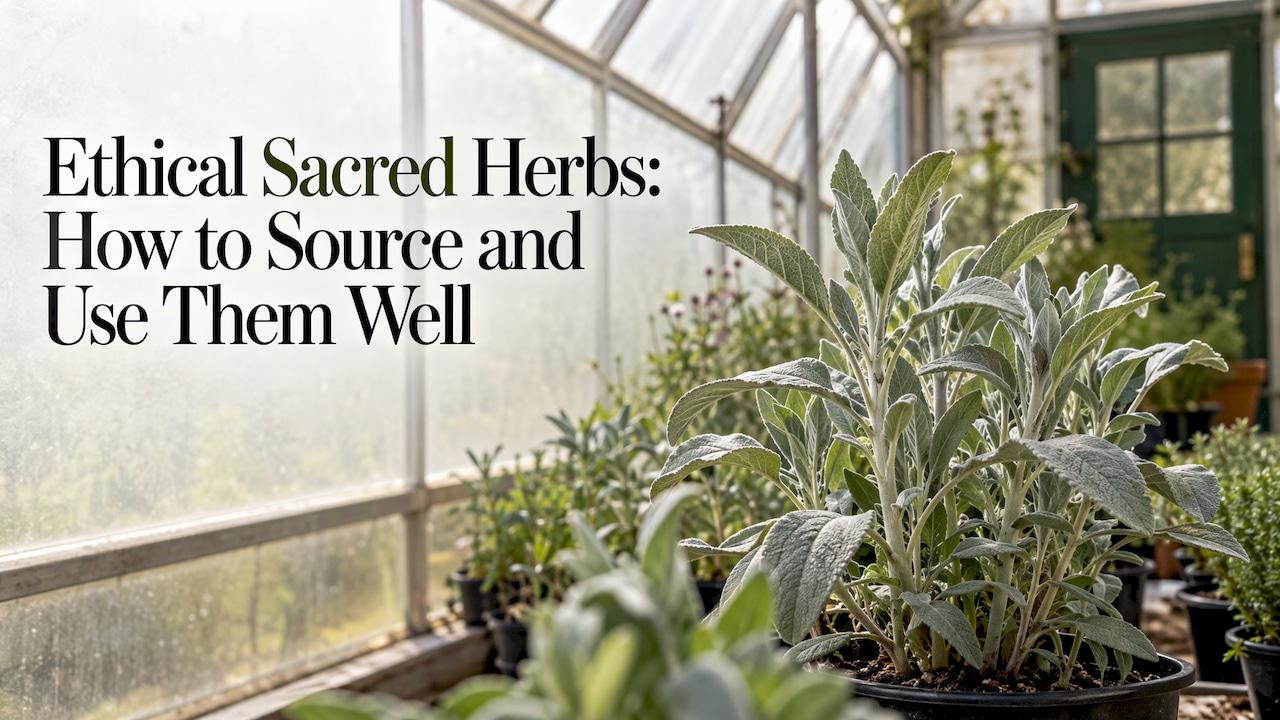
The most ethical sacred herb is usually the one you grew, gathered with permission, or came to know in your own ground. If you buy, the plant's name on the label is not enough. You need to know who harvested it, where, how, and whether that tradition invites you to use it at all. White sage and palo santo need the most care. Both have real supply problems, and both belong to living traditions that are not yours by default.
This guide is for people who want to bring plants into their practice without taking from someone else's. You will get the facts on both plants, a short checklist for buying, plants you can work with instead, and a way of using herbs that keeps the relationship in front of the product.
TL;DR
- White sage is the plant under the most pressure. One 2024 review reports that by some estimates 95% of what reaches the U.S. market is poached. Grow it or leave it.
- Palo santo is not automatically sustainable. Look for wood from trees that died naturally and aged for years, with a named region of origin.
- Words like "responsibly sourced" mean little without a traceable source and a named harvester.
- Plants from your own garden or land, such as rosemary, lavender or local herbs, carry their own history and avoid the supply chain entirely.
- Ethics covers use as well as sourcing. Learn the tradition, give back, and let Indigenous guidance lead where a plant belongs to a people.
Table of Contents
- What counts as a sacred herb
- White sage: why it is the hardest case
- Palo santo: sustainable only when the wood is
- How to read a sourcing claim
- Alternatives to white sage and palo santo
- Using herbs with respect
- Reciprocity as the real test
- Our perspective
- Where to go from here
- FAQ
- Sources
What counts as a sacred herb
People around the world have used plants in ritual for as long as there are records. A 2019 ethnobotanical review of about 180 references documents myrtle, basil, rosemary and three-lobed sage as ritual plants across Judaism, Islam, Christianity and several other traditions, often for warding off the evil eye or bad spirits.
In North America, a university chapter on sacred plants of Native North America describes four plants tied to the medicine wheel: sweet grass for ritual cleansing, tobacco for offering the Pipe to the four directions in ceremonies such as Lakota ceremonies, cedar for purification, and sage. It also notes that each tribe has its own practices and protocols.

That last point shapes everything below. A sacred herb is not a generic wellness item. It sits inside a relationship between a people, a place and a plant. Ethical sourcing starts by respecting that relationship.
White sage: why it is the hardest case
White sage (Salvia apiana) grows in the coastal scrub of southern California and northern Baja. It is central to Kumeyaay knowledge, and a 2026 ethnobotanical study found that land dispossession, commercial overharvesting, urbanization and climate change threaten both the plant and the knowledge system around it.
The legal picture is thin. A 2024 policy review states that no integrated set of policy guidelines or acts of Congress tangibly protects the sacred and ceremonial plants needed for Native American spiritual practice. The same review reports that in June 2018 four people were arrested for harvesting 400 pounds of white sage in a California preserve, worth $12,000 or more on the black market.
Poaching also costs the land. EcoWatch reports that white sage is mycorrhizal, meaning it works with soil fungi, and that its loss opens the way for invasive grasses that raise fire risk. Under California law, harvesting on public land for commercial sale is illegal, and private land requires written permission. High Country News adds that California issues no commercial permits for selling white sage.
White sage is officially neither endangered nor threatened, Gastro Obscura notes, but Indigenous and conservation groups believe heavy commercial harvest is pushing it toward the brink. Many Native Californians have stopped gathering from traditional sites to protect them.
There is a human side too. JSTOR Daily reports that poachers are often undocumented workers who face fines or deportation while middlemen and corporate buyers face no consequences. It also notes that many Indigenous practitioners say white sage should never be bought or sold, because the energy of the person who harvested it comes with it.
What the guidance says to do
The California Natural Resources Agency advises people not to buy wildcrafted or wild-harvested white sage, to grow their own or use sustainable growers, and to support tribes and organizations that cultivate and restore it. The California Native Plant Society urges the same: buy only from reputable growers, regenerative farms and native plant nurseries, boycott wild-gathered products, and grow white sage and local natives in your garden.
If you want it in your life and live in a suitable climate, growing it from nursery stock is the cleanest route. You know its age, its soil and its care, and no one was harmed to get it.
Palo santo: sustainable only when the wood is
Palo santo (Bursera graveolens) is a tree of South America. The IUCN assessed it as Least Concern globally, but The New York Times cautioned that a global rating does not rule out a different national or local status. Good palo santo incense comes from wood collected after the tree dies naturally and then left to age. The ethnobotanist the paper quotes puts quality wood at five to eight years of aging, which lets the heartwood oils mature.

That gives you a clear standard. Wood from a living, cut tree fails it. So does anything that cannot say where it came from.
A buying checklist for palo santo
- Named origin. Look for a country and region, not just "South America".
- Naturally fallen wood. The seller should say the wood came from trees that died on their own, and how long it aged.
- Direct relationships. Mindbodygreen suggests asking whether a supplier works directly with farmers, verifies ethical harvesting and supports their livelihoods, and considering small, Indigenous-owned businesses.
- A real scent. The Times advises checking labels for synthetic palo santo, since some products imitate the scent with chemicals.
- Price and packaging. Unlabeled bulk bags and suspiciously cheap sticks rarely come with a story you can trace.
If a seller answers these questions plainly and specifically, that is a good sign. If the answer is spiritual language with no place or person in it, move on.
How to read a sourcing claim
The same questions work for any herb. Ethnobotanist Deborah Small, quoted by High Country News, says buzzwords such as "responsibly sourced" mean nothing if you do not know the source or their practices. Treat the claim as a prompt to ask, not as an answer. The logic is the same as for any crop: knowing the grower and the method is what makes sourcing ethical, as this step-by-step look at sourcing ethically shows for another plant.
For sage, the 2026 study records what Kumeyaay harvesters look for, and these markers tell you what careful gathering looks like:
- Only mature leaves are taken, in specific seasons, with collection areas rotated.
- Harvesters wait until the flowering stage is visible and avoid cutting the flowering branch, to protect seed dispersal and the plant's reproductive cycle.
- Very thick stems suggest cutting too close to the base.
- Flowering stems in a bundle, or moisture and early mold from poor drying, point to careless handling.
- Bundles tied differently from traditional careful bundles are another warning sign.
If a bundle shows these signs, you are probably holding someone else's loss.
A USDA best-practices guide on foraging Indigenous and wild plants makes the wider point. Traditional foraging methods have been shown to support seed dispersal, germination, soil health and plant productivity, and harvesters should follow local Indigenous protocols and ask elders or knowledge holders for guidance.
Alternatives to white sage and palo santo
The best alternative is a plant with a relationship to you. That might be rosemary from your garden, lavender from a neighbor, or a native herb you learned to identify on your own land. Rosemary and myrtle, for example, have long ritual histories in Mediterranean traditions, according to the 2019 ethnobotanical review above. Using them draws on your own cultural ground and does not borrow someone else's.
A few guidelines help:
- Grow or gather locally and lightly. Take what you can identify with certainty, from land where you have permission, and take little. Leave the plant able to regrow and set seed.
- Do not simply swap one sacred plant for another. Cedar and sweet grass, for instance, are sacred to some Native nations. Switching to them from white sage moves the pressure rather than removing it.
- Skip smoke when you can. Open a window, ring a bell, bring in fresh air, light a candle, or sit with a cup of tea made from a garden herb. Ceremony is attention, and the herb is one way to hold it.
- Choose plants you can name. If you cannot say what it is, where it grew and who tended it, it is not yet a plant ally.
For ideas on setting up a place for this, see our guide to creating sacred space at home.
Using herbs with respect
Sourcing is half the question. The other half is how and why you use a plant.
The California Natural Resources Agency says Tribes know best how to manage the tending and gathering of white sage, as they have done for millennia, and frames commercial smudging as cultural appropriation: taking an element of another culture without acknowledgment. EcoWatch notes that American Indian and Alaska Native people were subject for nearly a century to laws that jailed or killed them for practicing their religions, including burning white sage, and that Native communities have asked non-Native people to stop.
So a respectful path usually looks like this:
- Learn whose plant it is and what that people say about outsiders using it.
- Follow their guidance, including the guidance not to use it.
- Support Native-led cultivation and restoration where it exists.
- Do not sell sacred plants as a product or a trend. A source quoted by High Country News says it is against protocol to sell medicines, whoever the seller is.
This is a high standard, and it is meant to be. A plant held sacred by a people has been protected by their protocols for a long time.
Reciprocity as the real test
In Andean practice, the principle of ayni means sacred reciprocity: you give as you receive. Applied to herbs, it asks what the plant, the place and the people who tend it are getting from you. Our article on ayni and reciprocity in the Andes explains the idea in detail, and how to honor land spirits is a good next read if you want to build a relationship with the ground under your feet.
A practical version of ayni with herbs:
- Ask permission before you gather, and listen for an answer in whatever way is true to you.
- Leave something: water, a song, attention, a promise to protect the patch.
- Take only what you will use.
- Tend what you take from. Plant seeds, remove litter, support local restoration.
- Pass on what you learn, including what you chose not to do.
A medicine walk is a simple way to begin. You go out to learn the plants of your own place before you reach for anyone else's.
Our perspective
At La Ferme du Cerf Bleu, our work rests on experience in nature and not on information alone. That shapes how we think about sacred herbs. A plant is not an accessory for a ritual. It is a teacher with a home, a season and a people who know it.
The most common mistake we see in seekers is the wish to hold something sacred right away. A bundle arrives in the mail and the connection is supposed to follow. In our experience of this path, the connection comes first, through time spent with the land, humility with the traditions, and giving back. The herb follows from that relationship.
That is why we teach reciprocity and ask students to learn the plants and land close to them. Our school brings Andean and Norse teachings together with real-life mentoring, so you can build your practice from sources you can name and honor. If a plant belongs to another people, honoring it can mean stepping back and finding your own.
Angell
Where to go from here
If you want guidance on building a practice that does not depend on borrowed or bought sacred plants, our Becoming the Medicine: 21-Day Practice is a one-off $67 practice you can start now. Our other programs and sessions are on the Sacred Paths site.

If you are weighing a longer commitment, our guide on choosing a shamanic teacher lays out what to look for, and the Andean medicine wheel article shows how the directions and elements organize one tradition's relationship with plants and place.
FAQ
Is it ethical to buy white sage?
The guidance from California's Natural Resources Agency and the California Native Plant Society is not to buy wild-harvested white sage, and to use cultivated plants from growers or your own garden. Some Indigenous practitioners hold that it should never be bought or sold at all. Growing your own, or choosing a different plant from your own place, avoids the question.
Is palo santo sustainable?
It can be. The tree is rated Least Concern globally, and good wood comes from trees that died naturally and were left to age for years. Sustainability depends on the specific supplier, so look for a named region, naturally fallen wood and a direct relationship with harvesters.
What can I use instead of palo santo or white sage?
Use herbs you grow or gather yourself, such as rosemary, lavender or other local plants, and take little. Avoid simply swapping to another plant that is sacred to a Native nation, such as cedar or sweet grass. You can also work without smoke, using sound, light, fresh air or a quiet moment.
How do I know if sage was ethically sourced?
You need to know the grower, the place and the method. Warning signs include very thick stems, flowering stems in the bundle, moldy or damp leaves, and vague marketing with no named source. A claim such as "responsibly sourced" means little without those details.
Sources
- Sacred Plants of Native North America
- Myrtle, Basil, Rosemary, and Three-Lobed Sage as Ritual Plants (Economic Botany, 2019)
- Vanishing Cultural Landscapes: White Sage, Indigenous Knowledge (2026)
- Sacred and Ceremonial Plants on Public Lands (2024)
- EcoWatch: That Sage Smudge Stick Probably Came From Stolen Plants
- JSTOR Daily: Plant of the Month, White Sage
- Gastro Obscura: How the Rage for Sage Threatens Native American Traditions
- High Country News: Sage Advice
- California Native Plant Society: White Sage (Flora, Spring 2022)
- California Natural Resources Agency: Native American Heritage Month
- USDA: Foraging and Harvesting Indigenous and Wild Plants Best Practices
- The New York Times: Is Palo Santo Endangered?
- Mindbodygreen: Palo Santo, How To Buy It Responsibly