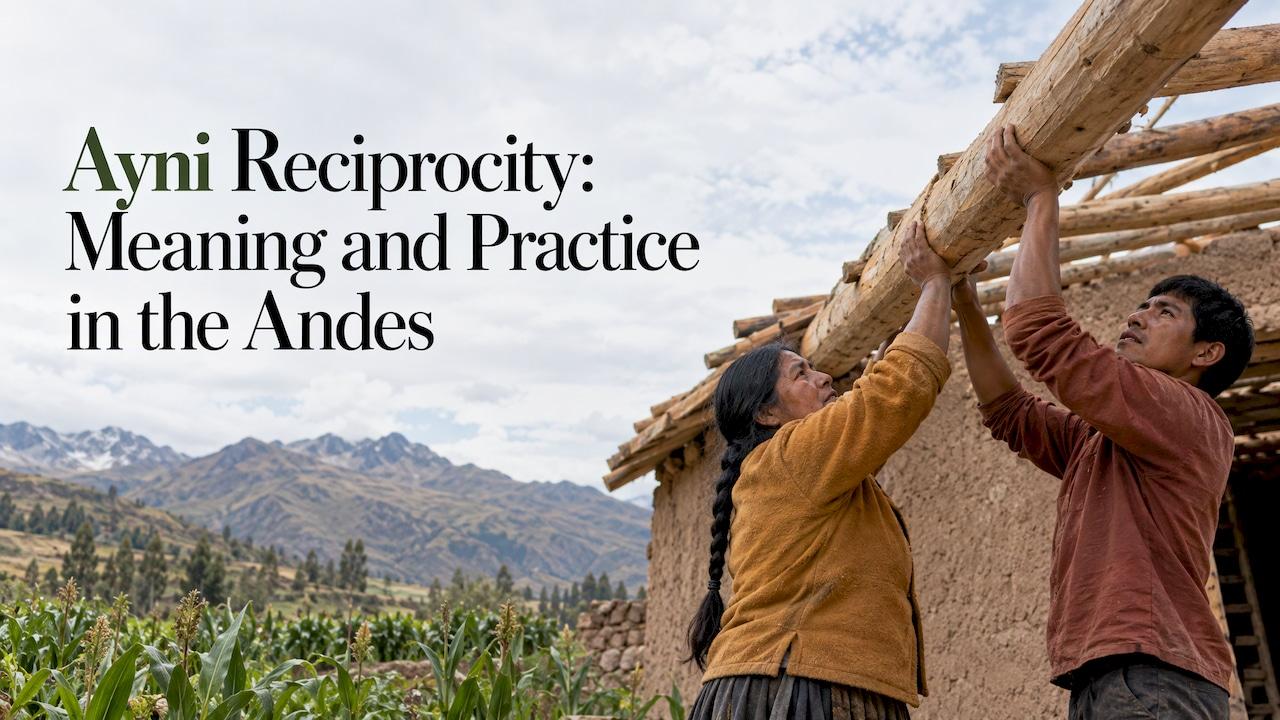
Ayni is a Quechua word for reciprocity. It describes a cycle of help given and help returned, practiced for generations in Andean communities and understood there as a way of keeping people, land and the living world in balance. The short version is "today for you, tomorrow for me." The fuller version is a working practice, rooted in particular mountains, farms and villages, and it asks more of you than good intentions.
This guide covers what ayni means, how it works on the ground, how it connects to the sacred, how its meaning is changing, and how someone outside the Andes can practice it respectfully.
TL;DR
- Ayni is a Quechua (and Aymara) term for reciprocity: balanced, voluntary exchange of help, labor and gifts that is returned over time.
- It is a practice before it is an idea. It happens through planting, building, festivals and offerings, and it requires both giving and receiving.
- In the Andean worldview it extends beyond people to mountains, the earth (Pachamama), ancestors and the natural world.
- It is not a generic word for kindness. It belongs to specific Andean communities, and those communities are changing it.
- Outside the Andes, the respectful move is to practice real mutual aid in your own life and credit where the teaching comes from.
Table of Contents
- What ayni means
- How ayni works in everyday community life
- Why ayni runs so deep in Andean life
- Sacred reciprocity: ayni beyond people
- How ayni is changing
- Practicing ayni respectfully if you live outside the Andes
- Our perspective
- Go deeper with Sacred Paths
- FAQ
- Sources
What ayni means
In Quechua, the noun ayni covers community work, mutual help, voluntary and balanced reciprocal aid, and solidarity. Dictionary entries for the word list those senses side by side. It is also found in Aymara, and the same concept appears with spellings such as ayniy or aini, referring to reciprocity among Andean mountain communities or to the practice itself, according to a general reference entry.
The most quoted gloss is "today for you, tomorrow for me." Threads of Peru gives it that way and says the practice dates to Inca times and remains a part of Andean culture.
A more careful definition comes from a global resilience dictionary entry on ayni: an enduring cycle of help, responsibility and return, associated with Quechua, Aymara and other Andean communities, and not exclusive to Peru.
Two details matter in that definition. First, the word "cycle." Ayni is never a single act of generosity. Second, "responsibility." When you receive, you owe a return, and when you are asked, you show up.
How ayni works in everyday community life
Picture a family that needs to plant a field or raise the roof of a house. Neighbors and relatives come to work. The host feeds them and gives them drink. Later, when those neighbors have their own planting or building to do, the host and family go and work for them. Community members help one another with private activities, receive food and drink from the host, and later return the favor, either to the same people or to others in need.
No contract and no invoice hold this together. What holds it is memory, reputation and the shared understanding that everyone will need help eventually.
Ayni compared with faena and mita
Ayni is private reciprocity between households or individuals. Threads of Peru separates it from two public forms: faena, public work days called by community leaders, and mita, a word meaning "turn," where people take turns serving. Faena and mita are organized by the community as a whole. Ayni is arranged between the people involved.

Equivalent, not identical
Research on Aymara communities in Bolivia draws a useful distinction. In ayni laboral, labor is exchanged and the return need not be identical but must be equivalent. In ayni festivo, identical things are exchanged in principle, gifts are counted individually, and recipients remain debtors until they make the equivalent return.
So a day of hauling stones might be answered with a day of planting. A festival gift of a certain kind is answered in kind. The accounting is real, but it is relational. You are not clearing a debt to leave the relationship. You are keeping the relationship alive.
More than a value
A thesis by Catherine Curran reports that Andean interviewees find ayni so pragmatic that studying it as an abstract concept makes little sense to them. In her reading, ayni is much more than a value: it is a dynamic practice that requires both sides, the action of giving and the action of receiving.
Receiving is half of ayni. Many Westerners are more comfortable giving than receiving, and the practice quietly corrects that.
Why ayni runs so deep in Andean life
A landscape that demands cooperation
One explanation is geographic. An essay from Emory University explains that the Andean region combines a low desert coast, formidable mountains and dense rainforest, which makes it almost impossible to survive in a single ecological niche. With cooperation between people living in different zones, all can prosper. Reciprocity was a survival technology long before it became a spiritual teaching.
Duality as the norm
The same essay describes ayni as representing duality as the basic assumption behind phenomena, from social obligations to gender roles to weaving. It notes that Quechua has no word for a single finger but does have one for the space between two fingers. In that view, a single thing is an aberration while the interrelated pair defines completeness.
A chapter on Aymara spirituality makes a parallel point: the Andean worldview rests on male-female pairing, because reciprocity, duality and complementarity form the defining principle, and personhood belongs to the couple rather than the individual.
An old practice with big results
The Smithsonian's National Museum of the American Indian describes ayni as a core value that has served Andean people since pre-Inka times and helped the Inka accomplish monumental projects, including water management and diversified agriculture to feed millions. It also notes that the Qhapaq Ñan, the Inka road system, is still alive: rural communities maintain portions of it in the spirit of ayni, with a community leader called a qollana organizing the work teams.
Curran's ethnohistorical work adds that ayni may reflect a cosmovision going back to pre-Hispanic times, appears in colonial-era texts and endures today, creating a distinct resilience that supports the vitality of Andean communities.
Sacred reciprocity: ayni beyond people
Searchers often meet the phrase "sacred reciprocity" next to ayni. In Andean life, the exchange does not stop at the human community. Ayni is discussed in relation to divinities such as the apu (mountain spirit) and Pachamama, and it also governs relationships with ancestors, the natural world and between non-humans. The idea is that everything is connected through a vital flow.
An academic paper on Andean animism describes how, in the highlands of Peru and Bolivia, animate presence is most clearly expressed in prominent mountains (apus), agricultural fields (Pachamama), the house, the recently dead and miraculous saints. These entities offer benevolent productivity to those who engage in appropriate reciprocity.
The same paper warns against separating ritual offering from everyday work. Farming, herding, music and dance are also acts of communication and exchange with Pachamama and the apus. The offering is not a transaction judged by a visible result. It is part of the continuity of daily life.

That is the heart of it. You are not paying the mountain for a favor. You are taking part in a relationship you were born into.
The five principles
In communities such as the Q'ero, five principles are described as defining the Andean way of life: munay (to love), yachay (to learn, know and remember), llank'ay (to work), kawsay (life) and ayni. Ayni is regarded as the most important, and it is broadly defined as the exchange of energy between humans, nature and the universe. If you want the wider context of paqos, apus and how these principles fit together, our guide to Andean shamanism, paqos, apus and ayni walks through it.
How ayni is changing
An honest picture of ayni includes its present, not only its ideal.
- It can weaken. A study in the province of Aroma, in La Paz, Bolivia, reported that the original ayni had weakened about 25 years before the article, becoming infrequent and sometimes limited to the family circle. The authors describe a kind of forced indebtedness displacing cooperation and solidarity.
- It is not a utopia. The global resilience dictionary notes that reciprocity can coexist with inequality, social pressure, migration, commercialization and changing ways of life. Communities practicing ayni are not conflict-free.
- It is being reinterpreted. Research by Amber Wutich and colleagues finds that NGO discourse both broadens and weakens the concept, recasting it to fit newer reciprocal practices tied to commercialization and evangelization in Bolivian communities. Matthew Bird's chapter on shifting uses and meanings of ayni takes up the same theme.
- It is still being studied as a living practice. A 2017 anthropology article proposes understanding reciprocity as a moral-symbolic economic practice socially reproduced through everyday material life. It also notes that some uses of ayni in political speech have been criticized as essentializing and antiquated.
None of this makes ayni less real. It makes it a living tradition, which is exactly what you would expect from something practiced for centuries.
Practicing ayni respectfully if you live outside the Andes
The most useful guidance comes from the Andean side. The global resilience dictionary says ayni should not be used as a decorative word for kindness or cooperation in general, and it belongs to specific Andean historical, ecological and community contexts. It adds that the lesson for other societies is not to copy ayni but to support locally trusted forms of shared labor, mutual assistance and resource governance.
Here is how that can look in practice.
- Start with your local web of exchange. Who helped you this year? Who could you help next week? Ayni begins with specific neighbors, friends and colleagues, not with an abstract intention.
- Practice receiving. Accept help without rushing to cancel the debt. A return that comes in time, in a form that fits, keeps the relationship going.
- Return equivalent value. Not identical, equivalent. If someone gave you a weekend of their labor, offer something of comparable weight when they need it.
- Extend it to the land. Give back to the place that feeds you: tend a garden, restore a stretch of creek, pick up what others leave behind. The Andean view treats the natural world as a partner in the exchange.
- Name your source. When you speak about ayni, say it is a Quechua and Aymara teaching from the Andes, and learn from Andean voices.
- Keep it honest. If you notice yourself keeping score to win rather than to keep a relationship in balance, you have drifted from the practice.
A simple weekly ayni check
Once a week, ask three questions. What did I receive? What did I give? Who am I currently in debt to, in a good way, and how will I return it? Writing the answers down for a month tends to show where your life is out of balance.
Our perspective
At Sacred Paths we teach Andean and Norse shamanism, and ayni sits at the base of how we work with students. We do not present it as a slogan. We treat it as a discipline you practice daily, with people, with the land and with the unseen.
At La Ferme du Cerf Bleu, a rewilded 18th-century farm in Burgundy, ayni becomes concrete. Land that is given care gives back. Circles in which each person contributes and receives are stronger than classrooms where one person talks. That is why we favor experiential learning over information, and why our approach is community-centered.
The reading above matters to us: ayni belongs to Andean communities, and we honor that by naming its source and by practicing it in real relationships, not as a borrowed vocabulary. Our work is to help people reconnect with their inner essence and their purpose by learning to give and receive in balance.
If ayni calls to you, begin with practice, not theory. The theory will follow.
Angell
Go deeper with Sacred Paths
If you want guided practice rather than reading alone, we offer paths for different stages. Becoming the Medicine: 21-Day Practice is $67 and Becoming the Mystic is $197. For longer work, our two-year initiatory school (EarthWalker and FireKeeper), shamanic coaching and retreats in Burgundy are all described on our site. Explore Sacred Paths programs to see what fits where you are now.

Whichever you choose, the invitation is the same: show up, give, receive and let the exchange teach you.
FAQ
What does ayni mean?
Ayni is a Quechua word for reciprocity, covering mutual help, balanced exchange and solidarity. It is often summed up as "today for you, tomorrow for me." It is also used in Aymara and refers both to the concept and to the practice of it in Andean mountain communities.
What is the difference between ayni and sacred reciprocity?
Ayni is the Andean practice. "Sacred reciprocity" is a common English phrase for it when the exchange includes mountains, the earth and ancestors as well as people. In the Andean view these relationships are all part of one flow, and offerings and everyday work are both forms of exchange with the animate world.
Is ayni only practiced in Peru?
No. It is associated with Quechua, Aymara and other Andean communities and is not exclusive to Peru. Research on its modern forms includes communities in Bolivia, and the concept appears across Peru, Bolivia and Ecuador.
Can anyone practice ayni?
You can practice reciprocity in your own life, and many people find the Andean teaching a powerful guide. The respectful way is to name its Andean origin, learn from Andean voices and apply it through real mutual aid in your own community instead of treating it as a general synonym for being nice.
Sources
- ayni, Wiktionary
- Ayni, Wikipedia
- Ayni: Andean Reciprocity, Threads of Peru
- Ayni, Global Resilience Dictionary
- Communal Reciprocity in the Andes, Ursinus College
- El cambio recíproco entre los aymaras, SciELO Bolivia
- Dialogues in Thread, Emory University
- Spirituality and the Pachamama in the Andean Aymara Worldview, Springer
- Reciprocity, Andean Style, Smithsonian NMAI
- The Social Agency of Things? Animism and Materiality in the Andes, UCL
- El ayni, Revista de Investigación Scientia
- Ayni Real and Imagined, Arizona State University
- Critique of reciprocity, Universidad del Pacífico
- Theorizing Reciprocity, Journal of Latin American and Caribbean Anthropology