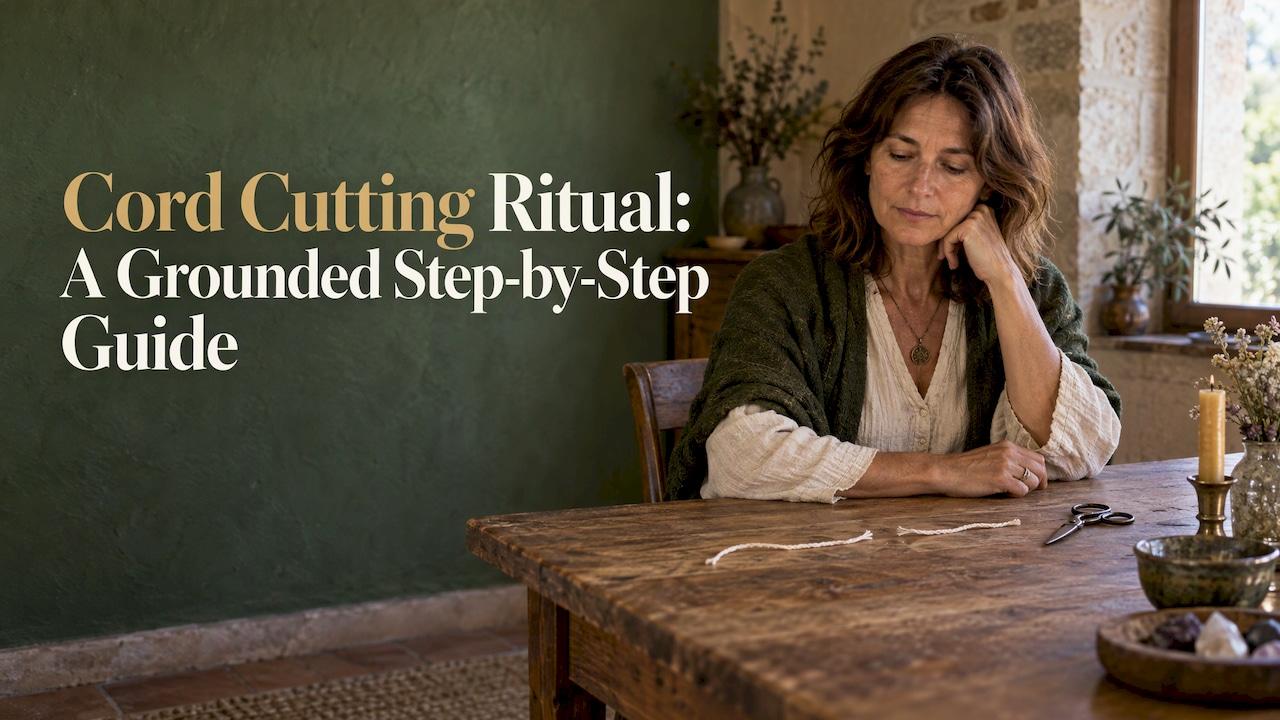
A cord cutting ritual is a symbolic act of releasing an energetic tie to a person, a place or a chapter of your life, so that your attention and vitality stop flowing toward something that has ended. It works best in three parts: ground yourself in your body and the earth first, make the cut with a clear intention and a physical gesture, then change something real in your daily life afterward. At Sacred Paths Shamanic School, at La Ferme du Cerf Bleu in Burgundy, we teach this as one small piece of a larger practice of coming back to yourself, and this guide gives you the whole sequence.
TL;DR
- A cord cutting ritual symbolically releases draining attachments. It does not have to end the relationship, and it is not a medical or psychological treatment.
- Ground first (feet on earth, slow breath), name one specific pattern you are releasing, make the cut, then close with grounding again.
- What you do in the following days decides whether the release holds: fewer checks, clearer boundaries, more of your energy given to sleep, friends and work.
- If distress stays intense for more than a week, or the bond involves abuse or trauma, bring a licensed therapist in alongside the ritual.
- A simple morning grounding practice, barefoot on the earth, keeps you steady between rituals.
Table of Contents
- What a cord cutting ritual is, and what it is for
- Before you begin: ground yourself
- How to do a cord cutting ritual, step by step
- What to expect afterward
- Does it work?
- Grounding with nature, every day
- Common mistakes
- Our perspective
- Where to go deeper
- FAQ
- Sources
What a cord cutting ritual is, and what it is for
Many traditions hold that bonds with other people create invisible energetic cords, across friendships, family ties and romantic relationships. A cord cutting ritual symbolically severs the ties that keep you attached to people and situations no longer serving you. The aim is to call back the energy you gave away and return the energy you took on, so you regain control of your own energy.
That last point matters. Releasing an attachment is not the same as renouncing connection. The same source stresses that we are relational beings, and that a cord is worth cutting when attachment is draining your life force. Done well, it can restore balance without ending the relationship: you stay a parent, a colleague or a friend, but you stop feeding a loop of worry, resentment or longing.
Cord cutting as a named technique is largely a modern energy-work practice, but its ingredients are old: binding and severing gestures, intention spoken aloud, offerings to fire or earth, and a closing that returns the person to ordinary life. In shamanic work these are done in a prepared space, with the earth underfoot.

Signs a cord may be worth cutting
You keep thinking about someone long after the conversation is over. You rehearse arguments in the shower. You feel another person's mood in your body even when they are not in the room. You feel tired after contact with someone, or you feel pulled back toward a job, a house or an old version of yourself. These are the experiences people describe when they speak of a cord. Treat them as an invitation to look closely at the bond, not as a diagnosis.
Before you begin: ground yourself
Most rituals that go wrong go wrong at the start. Cutting a cord while you are flooded with anger or grief tends to produce more agitation, not less. Grounding first gives you a steady body to work from.
A simple version you can do in ten minutes:
- Go outside if you can. Stand barefoot on grass, soil or sand.
- Soften your knees and let your weight drop through the soles of your feet.
- Breathe out for longer than you breathe in, six to eight times.
- Notice what you can hear, smell and feel on your skin.
- Name one thing you are grateful for. Gratitude steadies the nervous system and tells the ritual it is coming from respect, not revenge.
If you cannot get outside, sit on the floor with your back against a wall and feel the weight of your body being held. The point is to arrive in the present moment before you ask anything of the ritual.
How to do a cord cutting ritual, step by step
You need very little: a quiet hour, something that stands for the cord, and something to cut it with. Everything else is optional.
1. Choose one bond and name the pattern
Pick a single person or situation. Then be specific about what you are releasing. "My ex" is vague. "The habit of checking whether they have seen my messages" is workable. Writing a few lines on paper helps. Researchers describing the ritual's value suggest also listing what still feeds the attachment, and naming the feeling that needs room, whether that is sadness, relief or anger.
2. Prepare a simple space
Switch off your phone. Light a candle if you like, and sit where you will not be interrupted. If you want a setting that feels set apart from daily life, our guide to creating sacred space at home shows how to do it with what you already own.
3. Choose how to represent the cord
There are three common ways:
- A physical cord. Tie the two ends of a piece of string, wool or cotton thread to two objects, or to two knots, one for you and one for them or the situation.
- A natural object. Psychiatrist Judith Orloff describes going into nature, finding a large stick, declaring that the relationship is over, and breaking it. It is physical, outdoors and unmistakable.
- Pure visualization. Close your eyes, scan your body for where the attachment sits (chest, belly, throat), and picture the cord running from that spot to the other person.
If you want to use fire, read our fire ceremony guide first for safe practice.
4. Raise your intention, then cut
Speak your intention aloud, in your own words. Then cut the string with scissors, break the stick, or see the cord dissolve in light, fire or water. Do it slowly and in one decisive motion. Many people feel a physical release, a long exhale or a wave of emotion. Let it come.
5. Say what is true
You do not need a script, but words help the mind register a threshold. Some examples in plain language:
- "I thank you for what this bond taught me, and I release it now."
- "I take back the energy I gave. I return what I carried that is yours."
- "My energy is my own. I am free, and so are you."
Avoid curses or wishes of harm. A cord cut with contempt tends to keep you looking at the person. Cutting "with love and finality" is a phrase many practitioners use for a reason: it closes the connection without feeding it.
6. Return the cut pieces and close
Bury the string, give the pieces to a tree's roots, or put them in running water. Then ground again: feet on the earth, three slow breaths, a hand on your chest. Say thank you and say the ritual is complete. Drink water, eat something, and take a slow walk.
What to expect afterward
Expect a mixed picture. Many people report feeling lighter, with a sense of release. Others feel sadness, relief or an urge to reach out as the mind adjusts. Guidance on aftercare suggests avoiding social media, rereading messages or replaying the relationship for at least a few days, and filling the space with movement, restorative people or a new focus.
The ritual is the threshold. What follows is the work. A cord tends to reform if the daily behavior that fed it stays the same, so pair the ritual with one concrete boundary:
- Mute or unfollow the person, or silence the thread.
- Decide when, and whether, you will reply, and write it down.
- Move an object, a photo or a routine that keeps pulling you back.
- Tell one trusted friend what you have done.
Signs the release is holding
Over the following weeks, look for less urgency to check or contact the person, the ability to remember them without losing your day, clearer boundaries, faster recovery after reminders, and energy flowing back toward sleep, friendships, work and plans. Progress is rarely a straight line. A bad week does not mean the ritual failed. It means you are a person, and you can repeat the practice or deepen it.
Does it work?
There is no clinical trial of energy cords, and a cord cutting ritual is a symbolic practice, not a treatment. What research does show is that ritual itself can help people through loss. In experiments on bereavement and breakups, psychologists Michael Norton and Francesca Gino found that performing a ritual increased participants' sense of control and eased grief. Their rituals were not about energy cords, but the finding fits what many people report: a deliberate act marks a change, and the mind follows.
If you are also working through a loss, our article on why meaning matters more than frequency in grief rituals will help you shape a practice that stays personal. For a research-informed look at how symbolic rituals can support coping while remaining distinct from clinical care, see this private plan on grief and ritual.
When to bring in a therapist
If intense distress lasts beyond about a week, or the bond involves trauma, abuse or coercion, work with a licensed therapist alongside any ritual. They address different layers of the same experience. If you ever feel unsafe or have thoughts of harming yourself, contact a doctor or, in the US, call or text 988, the Suicide & Crisis Lifeline.
Grounding with nature, every day
Grounding is not only a preparation for cord cutting. It is what keeps your energy yours between rituals. The practice is plain: put your body in direct contact with the living earth and pay attention.

A morning grounding ritual
Within the first hour of waking, stand barefoot in grass in a quiet, sunlit spot. Soften your knees, close your eyes and feel your feet center your body. Attend to sounds, scents and sunlight, think of something you are grateful for, then wiggle your toes and open your eyes. The same source notes that morning light helps regulate circadian rhythm, which can support restful sleep.
Other ways to ground spiritually
- Walk barefoot on soil or sand for a few minutes. A review of grounding research reports early findings on stress and sleep, though the field is still developing.
- Lean against a tree and breathe with your spine supported.
- Touch water. Rinse your hands and face in a stream, or at the sink, with attention.
- Offer something back. Leave a pinch of tobacco, a flower or a spoken thanks at the base of a tree.
- Sit with the seasons. Notice the moon, the weather and the light. Our new moon ritual guide is a gentle way to build a monthly rhythm.
If these practices appeal to you, our article on nature-based spirituality shows how to begin.
Common mistakes
- Cutting in the heat of the moment. Ground first, and wait until the sharpest wave has passed.
- Cutting everything at once. One bond per ritual.
- Expecting an emotional delete button. The ritual marks the change. Daily choices make it real.
- Skipping the closing. Ground again and thank the space, so you return fully to ordinary life.
- Cutting cords with someone who needs your care. A child, a dependent parent or a partner you are committed to: the goal is a healthier connection, not a severed one.
Our perspective
We have never taught cord cutting as a trick. In the shamanic path we walk, an energetic tie is information: it shows where your attention, love or fear is still invested. The ritual is a way of answering that information honestly.
What we see as essential is the ground beneath it. People who feel disconnected from their purpose often try to cut away the pain without first returning to the body and the earth. We start the other way around: feet on soil, breath slowed, community around you, and only then the cut. Experiencing a practice in a circle, under open sky, is different from reading about it, and that is why our teaching favors experience over information.
We also believe in follow-through. A ritual is a doorway. Mentoring, a regular practice and companions who know your path help you stay on the other side of it.
Angell
Where to go deeper
If you would like a guide for a bond that feels too tangled to cut alone, Sacred Paths offers a Shamanic Healing Session at 245 $, remote or in person, and shamanic and spiritual coaching at 395 $ one-off. For a daily practice that builds the grounding this guide describes, Becoming the Medicine: 21-Day Practice is 67 $. Both are designed for people in transition who want to reconnect with their own path.

You can also explore the school and retreats at La Ferme du Cerf Bleu, a rewilded 18th-century farm in Burgundy, on our main site. If your ritual work is part of a wider shift, our guide to spiritual awakening support is a good next read.
FAQ
Do cord cutting rituals actually work?
They are symbolic practices, and experiences vary. Many people report feeling lighter afterward, and research on rituals more broadly shows they can increase a sense of control and ease grief. The release lasts when you pair it with real boundaries and changed habits.
What should I say during a cord cutting ritual?
Use your own plain words: thank the bond for what it taught you, state that you release it, and say that you take back your energy and return what is not yours. Keep the tone respectful, without curses. Close by saying the ritual is complete.
Is cord cutting dangerous?
The practice itself is gentle, but strong emotions can surface. Ground first, cut one bond at a time, and avoid doing it in a state of rage. If distress lasts beyond a week, or the bond involves abuse or trauma, see a licensed therapist alongside the ritual.
How often can I do a cord cutting ritual?
There is no fixed number. Some people do it once for a specific bond, others return after a few weeks if old patterns resurface. If you feel the urge to repeat it daily, focus on boundaries and grounding instead.
What is a simple way to ground myself each morning?
Stand barefoot on grass within the first hour of waking, soften your knees, breathe slowly and notice sounds, scents and light. Add one thing you are grateful for, then open your eyes. Five minutes is enough.
Sources
- What Is a Cord-Cutting Ritual, and How Can It Help?
- How to Cut an Unhealthy Bond with Someone, Judith Orloff MD
- Cord Cutting Ritual: What It Is and How to Do It
- Still Attached After Cord Cutting? What to Do Next
- The Power of Rituals in Life, Death and Business
- Sunlight Meditation, Blackberry Magazine
- Grounding (earthing): An integrative review
- Grief in sobriety: a private plan