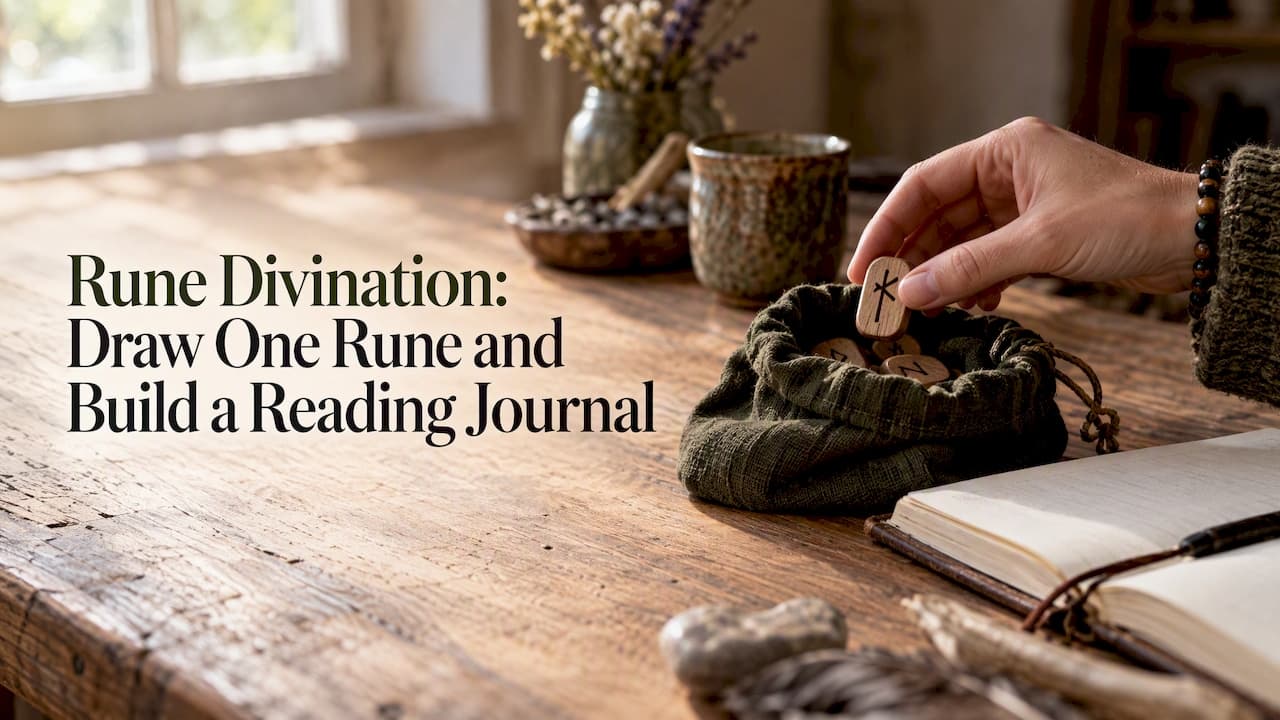
Divination with runes is a guidance practice that uses symbols from the runic alphabet as prompts for reflection. The easiest way to begin is to draw a single rune and sit with it for a few minutes. Below, we cover where runes come from, how to prepare a set, core casting methods, how to interpret what you see, and a quick reference for all 24 Elder Futhark symbols.
TL;DR:
- Tacitus described lot casting around 98 AD but never identified the marked lots as runic letters; modern rune divination is a reconstruction from fragmentary evidence.
- Ask a specific question that invites reflection, record your first impression before checking a keyword, and revisit your notes after a few weeks for patterns.
- For a three rune spread, assign the first draw to the situation, the second to its obstacle, and the third to advice or likely direction.
- Reversals are optional, and several Elder Futhark symbols look identical upside down; if you use them, interpret nuance rather than good or bad.
Table of Contents
- What runes are and where rune divination comes from
- Preparing your rune set: buying, making, and caring for it
- Preparing to cast: mindset, questions, and setup
- Core rune casting methods and spreads
- Interpreting a reading: reversals, combinations, and narrative
- Elder Futhark quick reference: the 24 runes
- Practitioner perspective: blending history with lived experience
- Editorial take: start small, keep records, stay skeptical
- A guided path if you want company on the way
- FAQ
- Sources
What runes are and where rune divination comes from
Most modern readers work with the Elder Futhark, the oldest runic alphabet, which has 24 runes arranged in three groups of eight called ætts. The names and meanings people use today are reconstructed from later sources, so treat them as a living vocabulary rather than a fixed code.
The best-known ancient description of lot-casting comes from Tacitus. In his Germania, written around 98 AD, he describes cutting strips from a nut-bearing tree, marking them with signs, scattering them on a white cloth, and drawing three. Scholars caution that he does not say those signs were runic letters.
Runes themselves were a real writing system. Viking Age people carved them on stone, wood, and metal, and the later Younger Futhark shrank the alphabet to 16 letters. Many modern divinatory systems are reconstructed syntheses built on fragmentary evidence. That is fine, as long as you know what you are practicing: a modern craft informed by history.
Preparing your rune set: buying, making, and caring for it
You can buy a set or make your own. Both work. What matters is that the symbols are clear and the set feels right in your hand.
Store-bought sets come in stone, ceramic, glass, and manufactured wood. They are consistent, durable, and ready the day they arrive. Handmade sets take more effort but carry the maker's attention into every symbol. Traditional wood choices include oak, hazel, pine, and cedar, though any wood you can cut and mark safely will do.
A simple way to make a wooden set:
- Gather 24 flat pieces of equal size, such as sliced branch disks or small wood tiles, plus one blank piece if you like.
- Sand each piece smooth, front and back.
- Draw each rune lightly in pencil, then carve, wood-burn, or paint over the lines.
- Seal with natural oil or clear varnish so the symbols do not wear away.
- Let everything dry fully before handling.
For painted stones, choose smooth river stones of similar size, paint the runes in a single color, and seal them. Carving tools and wood-burners are sharp or hot, so work slowly and keep them away from children.
Pro Tip: Make your first set simple. A plain, slightly imperfect set you actually use will teach you more than a flawless one that sits in a drawer.
For storage, keep your runes in a cloth bag or small wooden box so they stay together and stay protected. Some practitioners cleanse a new set by passing it through incense smoke, leaving it under moonlight overnight, or placing it beside a bowl of salt. Others skip this entirely. If you do use a routine, keep it brief and consistent, and repeat it whenever you feel the set needs a fresh start, such as after a long break from reading.
Preparing to cast: mindset, questions, and setup
A reading is only as clear as the question behind it. Vague questions ("What will happen this year?") return vague symbols. Specific, open-ended questions work better: "What should I understand about my current project?" or "What helps me move forward with this decision?" Questions that start with "what" or "how" invite reflection, while yes-or-no questions tend to leave you staring at a rune with nothing to say.
Set up a space where you will not be interrupted:
- Lay a cloth or clear a flat surface. A white cloth echoes the Tacitus account, but any natural, plain surface works.
- Keep your runes in a bag so you can draw without seeing the symbols.
- Mix the runes thoroughly with your hand before every draw.
- Have a notebook nearby to write down the question and result.
Before you begin, ground yourself. Take three slow breaths, feel your feet on the floor, and spend a moment in silence or say a short phrase of intention. This shifts your attention from the day's noise to the question in front of you.
Core rune casting methods and spreads
Here are several methods, from simplest to most involved. Start with the first one and add the others as you gain confidence.
Single-draw or daily rune
This is the best starting point. In the morning, state a simple question such as "What should I be aware of today?" Mix the runes, draw one without looking, and place it in front of you. Notice your first reaction before you consult any meaning. Then write down the rune, your impression, and one sentence about how it might apply. At the end of the day, add a note about what actually happened. Within a few weeks, you will have a personal record of how each symbol shows up in your life.

Three-rune spread
The three-rune draw is the closest modern echo of the Tacitus account, where lots were drawn three at a time. Here is a reproducible method:
- State your question aloud or write it down.
- Mix the runes in the bag and breathe for a moment.
- Draw the first rune and place it on the left. This is the overview, the heart of the situation.
- Draw the second and place it in the middle. This is the challenge or the thing in the way.
- Draw the third and place it on the right. This is the advice or likely direction if you act on what you see.
- Read all three together as a short story before you look up any individual meaning.
Say your question is about whether to change jobs, and you draw Raidho, Isa, then Kenaz. Raidho (journey) suggests movement is already underway. Isa (stillness) points to a freeze or a delay as the obstacle. Kenaz (torch) advises bringing light to the situation: gather information before you move. The story reads naturally: you are ready to go, something is holding you in place, and clarity will free you.
Nine-rune scatter
This method gives you more detail and a visual layout. Draw nine runes from the bag, hold them in your cupped hands, and let them fall onto the cloth. Then read them like this:
- Runes that land closest to the center speak to the heart of the question.
- Runes near the edge describe background influences or things at a distance.
- Runes that land face down are usually left unread, or read as hidden factors, depending on your approach.
- Runes that land touching or overlapping can be read as a pair influencing each other.
Look first at the overall pattern: is the scatter tight or wide, crowded or sparse? A cluster near the middle with a few outliers suggests a focused situation with a couple of outside pressures. Then read the central runes, then the neighbors, and finally the stragglers. Resist the urge to read all nine in order. The scatter is a map, not a list.
Cast on cloth with position mapping
For deeper work, mark a cloth with a few zones before you cast. A simple version divides it into past (left), present (center), and future (right). A more advanced version, which some practitioners use, maps the cloth to the layers of Norse cosmology, with regions for the world above, the human world, and the world below. This is optional, and the Norse mapping is a modern interpretive layer rather than an ancient requirement. Cast a handful of runes, read each by where it lands, and note which zone is crowded or empty.
If you are curious how structured layouts work in other traditions, this guide to the ten-card Celtic Cross shows how position meanings and micro-readings combine in tarot. The same logic of assigning a role to each position carries over well to rune layouts.
Pick one method and use it consistently. Switching constantly makes it hard to tell what is working.
Interpreting a reading: reversals, combinations, and narrative
A single rune is a prompt. A reading is the story you build from several of them. Here is a framework that keeps interpretation grounded.
Reversed or upside-down runes. Some practitioners read them as blocked energy, a hidden side of the symbol, or something that needs inner work before it can flow. Others ignore reversals entirely, and several runes look identical upside down, so they cannot be reversed at all. If you use reversals, favor nuance over a binary "good" or "bad" verdict. A reversed Fehu does not mean you will lose money. It may mean you are holding resources too tightly, or that something you value is not circulating.
Combinations. When two runes appear together, ask what role each plays:
- Modifier: one rune colors or reshapes the other.
- Clarifier: one rune explains why the other appears.
- Obstacle: one rune names what stands in the way of the other.
For example, Ansuz (messages) beside Laguz (flow, intuition) might point to a conversation guided by feeling rather than logic. Ansuz beside Isa (stillness) might suggest a message that is stuck or unsaid. Same first rune, different story.
Building a narrative. Try this sequence:
- Restate your question in one line.
- Note each rune's position and its keyword.
- Link every rune to the question, asking how it speaks to the situation.
- Write a two- or three-sentence summary in plain language.
- Add the personal context only you know: what has been happening in your life, what you already suspected.
Then test it. A good reading usually produces a small click of recognition, or a useful new question. If it produces only anxiety, step back; the symbols are prompts for reflection, not verdicts.
Pro Tip: Write your interpretation before you open any reference book. Your first association is data about your own mind, and you can compare it against traditional meanings afterward.
Journaling is what turns a hobby into a practice. Record the date, the question, the runes, your first impression, and later, what happened. Revisit entries after a few weeks. You will notice that some runes keep appearing around the same themes, and those patterns become your personal meanings.
Elder Futhark quick reference: the 24 runes
Use these keywords as prompts, not as fixed definitions. Sources vary, and your own associations matter as much as any list. Each line gives the rune's name, a keyword, and a short hint.
First ætt (Freyr's group)
- Fehu: wealth and resources (what you have and how it moves)
- Uruz: strength and new energy (raw vitality, endurance)
- Þurisaz: challenge and force (a threshold, a necessary conflict)
- Ansuz: messages and speaking (communication, insight, inspiration)
- Raidho: journey and movement (travel, rhythm, right action)
- Kenaz: torch and clarity (knowledge, creativity, illumination)
- Gebo: gift and exchange (generosity, partnership, balance)
- Wunjo: joy and belonging (harmony, comfort, shared well-being)
Second ætt (Heimdall's group)
- Hagalaz: disruption (sudden change that clears the ground)
- Nauthiz: need and constraint (a lesson in limits or patience)
- Isa: stillness (a pause, a freeze, a call to wait)
- Jera: harvest and cycles (reward that follows steady effort)
- Eihwaz: endurance and axis (resilience, connection between worlds)
- Perthro: mystery and chance (hidden things, fate, the unknown)
- Algiz: protection (boundaries, guarding, reaching upward)
- Sowilo: sun and success (vitality, direction, confidence)
Third ætt (Tyr's group)
- Tiwaz: justice and courage (honor, sacrifice, a clear stand)
- Berkano: growth and renewal (birth, nurturing, new beginnings)
- Ehwaz: partnership and trust (cooperation, steady progress)
- Mannaz: self and community (the human, awareness of others)
- Laguz: flow and intuition (water, emotion, the unconscious)
- Ingwaz: seed and potential (gestation, completion before release)
- Dagaz: dawn and breakthrough (transformation, a turning point)
- Othala: heritage and home (inheritance, roots, what you belong to)
The 24 groupings above follow the three ætts of the Elder Futhark, though the divinatory keywords come from modern practice rather than ancient testimony.
Avoid reading these literally. Þurisaz does not predict a fight; it may simply say that a necessary pressure is present. Treat each keyword as the first word in a conversation, then let your journal show you what the rune means for you. Over time, you will replace borrowed meanings with ones you have earned.
Practitioner perspective: blending history with lived experience
Here is what we can say honestly. Tacitus documents a Germanic practice of casting lots, but he does not tell us those marks were runic letters, and no surviving ancient text lays out a rune-reading method. What we practice today is reconstructed, and it works because people bring study, attention, and repetition to it.
That is good news for beginners. You do not need a lineage or an expensive set. You need a question, a few minutes, and a notebook. The meaning grows from combining reading with repeated journaling and honest reflection. If you eventually want guided, immersive learning, such as courses, mentorship, or retreats, those paths exist, and the core practice stays fully available to anyone who prefers to learn on their own.
Editorial take: start small, keep records, stay skeptical
The most overrated part of rune work is memorizing meanings. A reader who knows all 24 keywords but never journals learns less than someone with six runes and a year of notes. The conventional advice to "trust your intuition" also falls short without a record to check it against. Intuition improves when it meets feedback.
Our advice is to draw one rune a day before trying a spread. Write before you look anything up. Hold the history loosely: the Tacitus passage is a fascinating clue, not proof of an unbroken tradition, and you are allowed to enjoy the practice without pretending otherwise. Treat readings as prompts for decisions you remain responsible for, never as predictions to hide behind.
Finally, practice respectfully. These symbols belong to a living cultural inheritance, so learn the context, credit your sources, and avoid claiming ancient authority for modern methods.
— Angell
A guided path if you want company on the way
If you prefer to learn with a teacher and a community instead of working alone, we offer another path. At Sacred Paths Shamanic School, we teach experiential, nature-rooted practice, including Norse and Andean traditions, through longer programs, retreats at La Ferme du Cerf Bleu in Burgundy, and one-on-one mentoring. You can read about our shamanic and spiritual coaching to see whether guided work suits you. Self-study works well for many people; if you want a hand to hold along the way, we would be glad to meet you.

FAQ
What is divination with runes?
Divination with runes is a reflective practice in which you draw or cast symbols from a runic alphabet and interpret them as prompts for a question. Most people use the 24 symbols of the Elder Futhark. It works best as a tool for reflection rather than a prediction of fixed outcomes.
How do I read runes as a beginner?
Start with a single daily rune. Ask a specific, open-ended question, draw one rune, write your first impression, and only then check its keyword. After a few weeks of journaling, move on to the three-rune spread described above.
Do I need to make my own runes?
No. Store-bought sets work well, and a handmade set is a personal choice rather than a requirement. Pick whichever feels comfortable and clear in your hand, then care for it with simple storage and an optional cleansing routine.
Is rune divination an ancient tradition?
Not in the form we practice today. Tacitus describes lot-casting among Germanic peoples, but scholars caution that he does not show the marks were runic letters. Modern rune divination is a reconstructed practice built on that fragmentary history.
Should I use reversed runes?
It is optional. Some readers treat a reversed rune as blocked or hidden energy, while others ignore reversals. If you use them, read for nuance rather than "good" or "bad," and note that several runes look the same upside down.