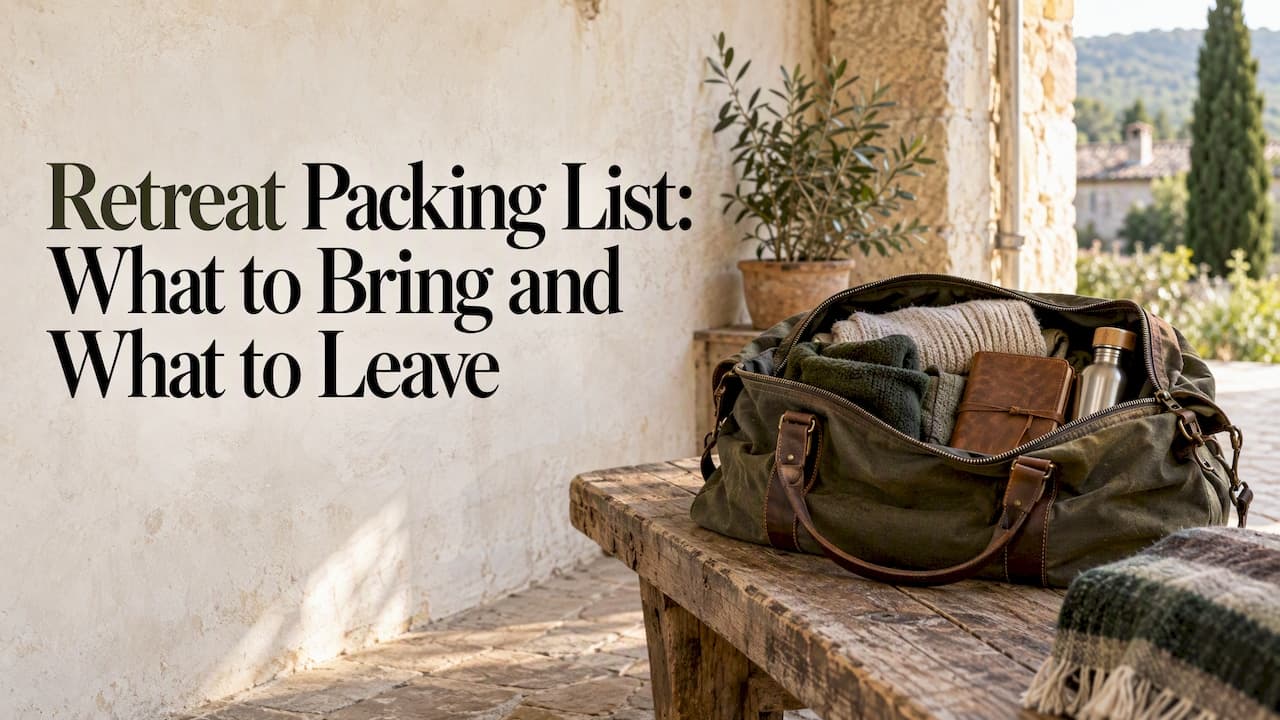
Pack soft, comfortable layers you can sit and move in, shoes that slip on and off, a refillable water bottle, your medications, a journal with two pens, and earplugs with an eye mask. Then pack less than you think you need. A retreat is not a vacation, and the lighter your bag, the more attention you have left for the reason you came.
This list is written for shamanic, spiritual and wellness retreats, including ones held on rural land with shared rooms, outdoor ceremony and unpredictable weather. It also covers the part most lists skip: preparing yourself, not just your suitcase.
TL;DR
- Bring layers, not outfits. Fit and comfort matter far more than looks.
- Earplugs, an eye mask, a journal and two pens are the items first-timers most often wish they had.
- Carry medications in your carry-on, in original packaging, with a doctor's letter if you are flying abroad.
- Read your organizer's own guidelines before you pack. They override any generic list, this one included.
- Leave work, screens, valuables and "just in case" items at home.
Table of Contents
- Start with the retreat's own instructions
- Clothing: comfort over style
- Sleep and comfort
- Journal, tools and practice items
- Toiletries and health basics
- Documents, money and insurance
- Food, drink and snacks
- What to leave at home
- How to prepare yourself
- Our perspective: bring the openness, not the baggage
- If you are preparing for a retreat with us
- Final check before you zip the bag
- FAQ
- Sources
Start with the retreat's own instructions
Before you touch a suitcase, find the welcome email or information packet your organizer sent. Many centers have specific requests, such as no synthetic fragrance or no outside alcohol. Some supply mats, bedding or towels. Others expect you to bring your own.
If something is unclear, ask. Questions worth sending a week ahead:
- Is bedding provided, or do I bring a sleeping bag or sheets?
- Will we spend time outdoors in the evening or overnight?
- Are there dietary, scent, or substance restrictions?
- Is there phone signal and Wi-Fi, and are devices collected?
- Is there laundry on site?
Clothing: comfort over style
Experts agree a retreat is not a performance or a fashion occasion. Choose clothes that fit well and let you sit cross-legged for long stretches. Do not break in a new outfit on the retreat.
What to bring
- Two or three loose tops in breathable fabric, plus one long-sleeved layer.
- Two or three comfortable bottoms: soft trousers, leggings or joggers. Skip anything with a tight waistband.
- A warm layer such as a fleece or wool sweater. Evenings outside get cold even after warm days.
- A rain shell or poncho. Ceremony and walking on the land rarely stop for weather.
- Socks and underwear for the whole stay, plus a couple of extra pairs. For a week, extra socks and underwear are about all you need on top of the basics.
- A shawl or blanket-scarf for meditation, ceremony or sitting on cool ground.
- Sleepwear you would be comfortable wearing to walk to a shared bathroom.
- A hat and sunglasses for outdoor days.
- A swimsuit, if the venue has a pool, river or sauna. Check first.
Shoes
Bring slip-ons for moving between rooms and a closed pair you can really walk in. If your retreat is on a farm or in the countryside, add a pair you do not mind getting muddy.

A simple capsule formula
If you like a rule, the popular 5-4-3-2-1 method means five tops, four bottoms, three pairs of shoes, two layers and one accessory set, in a coordinated color palette. The 3-3-3 version (three tops, three bottoms, three pairs of shoes) suits shorter stays. On a retreat, where nobody is looking at your outfits, lean toward the smaller one.
Sleep and comfort
Many first-timers regret leaving behind earplugs and a good eye mask. In shared accommodation, sleep schedules differ, and country nights come with animals, wind and early risers.
- Earplugs and a sleep mask
- A small pillow or travel pillow if you are particular about sleep
- A sleeping bag liner or sheets, if bedding is not supplied
- A headlamp or small flashlight, so you do not wake your roommates at night
- Slippers or warm socks for cold floors
One cozy blanket is a luxury worth considering if you are driving. If you are flying, skip it unless the organizer recommends it.
Journal, tools and practice items
Bring a notebook and two pens. Even people who never journal at home find they want to capture insights, and spare pens tend to wander. Choose a notebook small enough to carry to every session.
If you already have a personal practice, bring only the items you actually use: a rattle, a drum, a stone, a small cloth, a candle that is allowed on site. Do not buy a bag of new tools for the occasion. If a ceremony needs particular items, your facilitator will say so in advance.
Toiletries and health basics
Keep it simple and unscented where you can.
- Toothbrush, toothpaste, hairbrush, any contact lens supplies
- Unscented or lightly scented soap, shampoo and deodorant
- Sunscreen and bug repellent
- Lip balm, tissues and tweezers (useful for splinters outdoors)
- A small first-aid kit: bandages, blister plasters, pain relief you already know you tolerate
- Your usual vitamins, if you take them
- Reading glasses and a spare pair of glasses
- A refillable water bottle
- Towels, if not provided
Medications and medical documents
Pack all prescriptions in your carry-on, never in checked luggage. Keep them in original packaging, with a copy of the prescription and, for international travel, a doctor's letter. Some countries have strict laws on specific psychotropics and other medications that are sold over the counter at home.
The World Health Organization advises that travelers visit a travel clinic, ideally 4 to 8 weeks before departure, which also gives time to deal with vaccinations. Before you go, check that each of your medications is legal in your destination country. If you take medication for a mental health condition, talk to your prescriber before the trip. Do not stop or change a dose to "go in clean."
If your retreat involves breathwork, fasting or plant medicine, ask your own doctor whether it is safe for you given your heart, blood pressure, pregnancy, psychiatric history or any medication you take. Some medications can interact dangerously with plant medicines, and a facilitator is not a substitute for a physician's answer.
Documents, money and insurance
For international retreats, check this list two weeks before you leave:
- Passport valid for the length required by your destination
- Any visa or electronic travel authorization your nationality needs. Rules change, so check the official government page for your destination rather than a third-party summary
- Printed copy of your booking confirmation and the venue's address and phone number
- Emergency contacts, written on paper as well as on your phone
- A bank card and a small amount of local cash
- Travel insurance
On insurance, WHO's traveler checklist says cover should include medical emergencies and medical repatriation, and you should check that your pre-existing conditions and planned activities are covered. Read the policy wording on activities. Some policies exclude things that sound ordinary to you.
Keep valuables small. As official British guidance puts it, leave jewelry and valuables at home if you can, and carry only the money you need for the day.
Food, drink and snacks
Most retreats provide meals. Bring a few snacks only if the organizer allows outside food, and only ones that suit your own dietary needs. If you have allergies, tell the organizer weeks ahead, not on arrival. Some retreats ask you to avoid caffeine, sugar, alcohol or meat in the days before. Follow those instructions, since they are part of the preparation.
What to leave at home
Experienced retreat guides point out that guests often over-pack "just in case" items, and that a simpler environment reduces decision fatigue and leaves more room for reflection. Leave these behind:
| Leave at home | Why |
|---|---|
| Laptop and work files | They pull your attention back to your inbox |
| Several "nice" outfits | Nobody needs them, and they take up space |
| Jewelry and valuables | Risk of loss, and a distraction |
| Strong perfume or scented products | Many centers ask guests to avoid them |
| Outside alcohol or recreational drugs | Most centers prohibit them |
| A stack of books | One book is plenty, and a journal matters more |
| Full-size toiletries | Travel sizes do the job |
If you must bring your phone, plan for it. Tell the people who depend on you where you will be and when they will hear from you. Set an away message. Put your phone on airplane mode on arrival.
How to prepare yourself
Packing is the easy part. Preparing for a spiritual retreat is mostly about arriving with a settled body and a clear intention.
- Simplify the week before. Finish urgent work, handle bills and family logistics, and avoid scheduling anything stressful the day you return.
- Rest. Many people arrive exhausted from last-minute preparation. Go to bed early for several nights before you leave.
- Follow any dietary guidance from your organizer.
- Write down your intention. One or two sentences about what you want to open, release or understand. Hold it lightly, since retreats often surprise you.
- Arrange integration. Plan a quiet day or two after you return. Tell one trusted person you will want to talk, and keep your journal handy.
- Look after your mental health. If you have a history of anxiety, trauma or depression, tell the facilitator in advance and speak to your therapist or doctor. The UK government's guidance on mental health while traveling points to preparing ahead and to national travel health resources.
Our perspective: bring the openness, not the baggage
We have watched people arrive with enormous suitcases and an equally heavy list of expectations. The two usually go together. At Sacred Paths, our work is experiential: we learn by doing, in circle, in nature, with practice rather than lectures. That kind of learning needs a person who is present, and presence is easier when you are not managing stuff.
So our advice is simple. Pack what keeps your body warm, dry and rested. Bring one notebook and your honest questions. Leave your performance at home, along with the idea that you must arrive "ready." You are allowed to arrive tired, doubtful or in the middle of a life transition. That is often precisely why people come.
The most useful preparation we know is not on any list. Spend a few quiet mornings outside before you travel, without a phone, and notice what you feel. If you can sit with that for twenty minutes, you already know how to begin.
— Angell
If you are preparing for a retreat with us
If you are considering a longer immersion, we run retreats and ceremonies, and offer The Great Initiation Plant Medicine Retreat in Peru at $4,295 per person (one-off). Each retreat has its own preparation guidance, which we send to participants. Follow that guidance over any general list.
If you would rather start closer to home, our Monthly Shamanic Circle and Breathwork Shamanic Ceremony are a lower-commitment way to feel how we work. You can also talk through your intentions in a Shamanic Healing Session, priced at $245 (one-off), or look at our shamanic school if you want a long-term path.
Final check before you zip the bag
- Organizer's guidelines read and questions answered
- Layers, rain shell, slip-ons and walking shoes
- Earplugs, eye mask, headlamp
- Journal and two pens
- Medications in the carry-on, with letter and copies
- Passport, insurance, any required travel authorization
- Phone plan and away message set
- Intention written down
FAQ
What should I pack for a first retreat?
Start with soft layers, slip-on shoes plus one walking pair, a water bottle, medications, a journal and two pens, earplugs and an eye mask. Add toiletries and a rain layer. Your organizer's information packet decides everything else.
What is the 5-4-3-2-1 rule for packing?
It is a capsule wardrobe method: five tops, four bottoms, three pairs of shoes, two layers and one accessory set in one color palette so everything mixes. For a retreat you can usually go lighter, since comfort matters more than outfit variety.
What is the most forgotten item when packing for a trip?
There is no single answer, but health items and documents cause the most trouble. WHO guidance advises checking that your medications are legal at your destination and seeing a travel clinic early. Carry prescriptions in original packaging in your hand luggage.
How do I prepare for a spiritual retreat beyond packing?
Rest, simplify your week, follow any dietary guidance, and write a short intention. Ask your doctor about any medical concerns, especially if the retreat involves breathwork, fasting or plant medicine. Plan a quiet day or two afterward to integrate what came up.
Sources
- The Complete Retreat Packing List, Retreat Ledger
- What to pack for a wellness retreat, Tendground
- What to Pack for Your First Retreat, RetreatsOS
- Travel and health, World Health Organization
- International travel and health checklist for travelers, WHO
- Support for British Nationals Abroad: a guide, GOV.UK
- Mental health and wellbeing abroad, GOV.UK
- How to Pack Light in a Carry-On, Peek at This