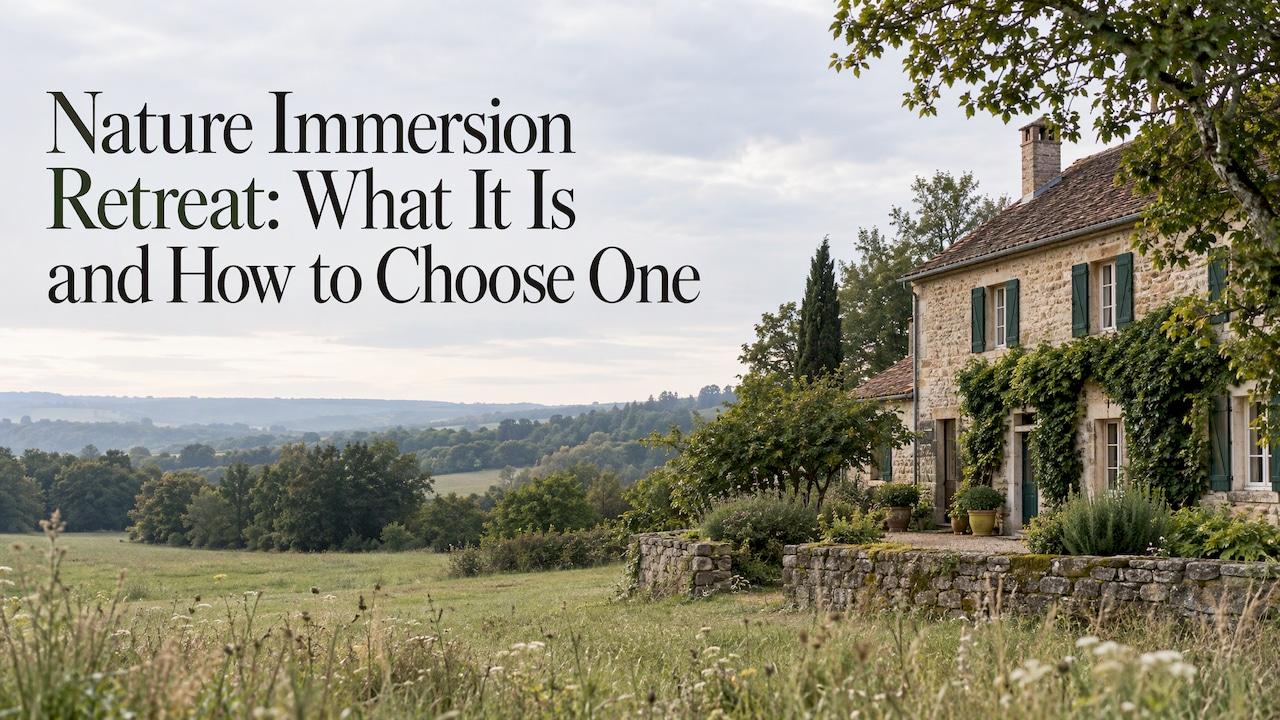
A nature immersion retreat is a stay of several days in a wild or rewilded place, with a guide and a structure, where the landscape is the teacher rather than the backdrop. What separates it from a hike or a cabin weekend is intention: you arrive with a question, you are held by a group and a facilitator, and you leave with a way to carry the experience home. If you feel disconnected from your purpose, stand at a life threshold, or want to deepen a healing practice, the setting and the guidance matter equally. At La Ferme du Cerf Bleu, a rewilded 18th-century farm in Burgundy, France, Sacred Paths Shamanic School holds retreats built on exactly that idea.
TL;DR
- A nature immersion retreat combines time in a natural setting with guided practice, a small community and time to integrate, which is what sets it apart from simply being outdoors.
- A large 2019 review found positive effects on well-being, stress response and social skills in many studies, though the evidence quality is low to moderate and physical-health results are less consistent.
- In a Danish pilot trial, the outdoor setting added the most value for connection to nature, which is often the doorway to reflection and purpose.
- Choose by facilitator, format, group size, your health and what happens after you go home.
- Sacred Paths offers retreats in Burgundy and a plant medicine retreat in Peru, plus coaching and healing sessions for the weeks after.
Table of Contents
- What a nature immersion retreat actually is
- What happens on one: common activities
- What research says about nature immersion
- Who a retreat in nature is for
- How to choose a retreat: seven questions
- Perspective: why land and lineage belong together
- Sacred Paths retreats and what comes after
- Preparing and integrating: a simple routine
- FAQ
- Sources
What a nature immersion retreat actually is
Spending an afternoon in a park is time in nature. An immersion retreat is different in three ways.
Duration. You stay long enough for the first days of restlessness to pass. Phones go quiet, sleep follows daylight, and attention settles on what is in front of you. The research below covers programs from a few days to four weeks.
Structure. Someone designs the days. There are sessions, silences, shared meals, and time alone. The guide's task is to help you notice and make sense of what comes up, not to entertain you.
Community. Most retreats gather a small group. Shared experience in a wild place tends to build trust quickly, and many people say the group is what made the experience real.
A retreat in nature can be a silent meditation week, a forest therapy workshop, a wilderness camp or a spiritual immersion. They share the setting but differ in purpose, so the first question is what you want from it.
What happens on one: common activities
Formats vary, but most programs draw from the same toolbox:
- Slow walking and sensory practice, such as forest bathing, where you move without a destination and attend to sound, smell and light. Our guide to forest bathing as a spiritual practice explains how to begin.
- Mindfulness and meditation outdoors, often sitting or lying on the ground.
- Solo time, sometimes a few hours alone on the land with a question.
- Fire circles, ceremony and sharing, where the group speaks and listens.
- Movement and breathwork, to move stored tension.
- Land-based skills such as foraging, tending animals or working with plants.
- Journaling and integration sessions, so insights become decisions.
In shamanic retreats, you can add drumming journeys and work with cosmology and guide animals. Anthropologist Denise Lombardi's study of French neo-shamanism, reviewed by Nonfiction.fr, describes intensive stays of around 15 people in rural lodgings, yurts or campsites, built as sequenced sessions where participants learn a cosmology and take part in drum journeys. It also notes that these seminars often form part of a longer training path, which is worth remembering when you weigh a single retreat against a longer commitment.
What research says about nature immersion
You should know what is solid and what is still being learned.
The broadest evidence comes from a 2019 systematic review by Mygind and colleagues, covering 461 publications from 2004 to 2017, of which 133 were controlled studies. Roughly 55% of 97 psychological well-being outcomes were positive, about 58% of the stress-response outcomes, about 58% of the cognitive-performance outcomes and about 70% of the social-skills outcomes. Physical-health outcomes were less consistent, at around 37% positive. The authors rated the quality of the evidence as low to occasionally moderate, so read these as encouraging signals, not guarantees.
Two smaller studies show what a retreat can change:
- In a 2015 pilot study of 46 young adults at a four-week wilderness camp in the United States, perceived stress, relaxation, positive affect, wholeness and transcendence all improved, and so did nature connection. Resilience, self-esteem and physical activity did not change significantly. The authors suggest that high starting scores may explain part of that, and they had no control group.
- In a 2021 Danish pilot trial of a five-day mindfulness retreat with 60 stressed students, connectedness to nature was the outcome where the outdoor group did better than the control group, with a medium-sized effect at the three-month follow-up. The authors recommend larger trials with programs designed to use the natural setting more fully.
The second finding is the one that matters most for people on a search for meaning. Connection to nature is not a side effect. It is the shift that lets many people feel part of something larger, and it stayed measurable three months later.
The immediate body response is also documented. A 2017 NPR report describes a 2011 study in which adults aged 36 to 77 who took a four-hour forest walk saw systolic blood pressure fall from 141 to 134 mmHg, with larger drops in blood pressure and stress hormones than city walkers.

Who a retreat in nature is for
People come to immersion retreats from several places in life.
Seekers of personal transformation. You feel that the life you built no longer fits, and you want room to hear what comes next. Long, unscheduled days outdoors give that room.
People in transition. After a divorce, a loss, a career ending or a move, a retreat marks the threshold. The ritual of leaving, staying and returning helps the change feel real. Our article on nature-based spirituality is a gentle place to start if you are new to this way of seeing.
Healers deepening their craft. If you already work with others, time on the land where you are the one receiving, in a lineage-based setting, refreshes your practice and shows you your own edges.
Those who feel disconnected from purpose. You may not have words for what is missing. Land, silence and a circle of people often provide them.
How to choose a retreat: seven questions
1. Who is guiding, and what is their background?
Ask how long the facilitator has practiced, what tradition they work in, and how they came to it. A guide who has trained in both a modern profession and a traditional path can speak to both your body and your spirit. At Sacred Paths, Angell Deer is a trained veterinarian and medicine man who draws on several cosmologies.
2. What is the cultural context?
Shamanic practices come from living cultures. Look for retreats that name their lineages, such as Andean or Norse traditions, and treat them with respect, rather than blending symbols with no explanation.
3. What is the format?
Ask about group size, daily rhythm, how much is guided and how much is free, whether there is ceremony, and whether you sleep indoors. A circle of a dozen or so people feels very different from a crowd.

4. Where is the land?
A rewilded farm, a mountain valley and a tropical rainforest each teach differently. A place with a long, quiet stretch of land and few visitors allows deeper rest.
5. What about your health?
Be honest about physical limits, medications and mental health history. If you are in treatment for a mental health condition, are pregnant, or live with a chronic illness, talk to your doctor or therapist before you go, especially for retreats that involve fasting, breathwork, long ceremonies or plant medicines. Research on nature exposure for people with cancer is growing, a 2023 scoping review gathered twelve studies, but a retreat is not a treatment, and your care team should know your plans.
6. How emotionally safe is the space?
Strong feelings often surface in silence. A good retreat tells you in advance what to expect, offers a way to step out of a session, and has a guide who stays present when you are shaken.
7. What happens after?
Integration decides whether the retreat changes your life or stays a lovely memory. Look for follow-up: a circle, a call, mentoring, a practice to keep. Preparing well also helps, and our retreat packing list covers what to bring and what to leave behind.
Perspective: why land and lineage belong together
We have watched the same pattern again and again in our work: people do not need more information. They need an experience that they can feel in the body, in a place that holds them, with others who are on a path of their own.
That is why our school is built on experiential learning rather than passive coursework. The land at La Ferme du Cerf Bleu is a rewilded 18th-century farm, and we treat it as a teacher. Participants take part in personal and collective journeys, and the circle is the heart of how we learn, not an extra.
We draw on more than one cosmology, including Andean and Norse shamanism, because the questions people bring are not confined to one culture. Training as a veterinarian taught me to observe living beings closely. Walking the medicine path taught me to listen to them. Both belong in the work.
The studies suggest that the setting adds most through connection to nature. For us, that connection is where the reclaiming of a sacred path begins. A retreat opens the door. What you do in the weeks afterward, with mentoring, practice and community, is how you walk through it.
Angell
Sacred Paths retreats and what comes after
Sacred Paths holds retreats at La Ferme du Cerf Bleu in Burgundy, where you can immerse yourself in nature and in ancient practices alongside a community. If you want to go deeper into a plant-medicine tradition, we also guide The Great Initiation Plant Medicine Retreat in Peru, listed at 4295 USD per person.

The work does not need to end when the retreat does. You can continue with a Shamanic Healing Session at $245, remotely or in person, or with Shamanic & Spiritual Coaching at $395, or a year of coaching at $345 per month. For a longer commitment, the two-year path in Andean and Norse shamanism runs through Sacred Paths Shamanic School in the EarthWalker and FireKeeper programs. To begin at home, the 21-day practice Becoming the Medicine is $67 and Becoming the Mystic is $197, both on the Sacred Paths site.
If you want a first taste of the circle, the Monthly Shamanic Circle and the Breathwork Shamanic Ceremony are listed on our site as well.
Preparing and integrating: a simple routine
Before you go. Write one question you are carrying, in a sentence. Reduce screen time for a week. Sleep well in the days before. Read about the place and the practices so nothing surprises you.
While there. Keep a small notebook. Let the first two days be uncomfortable without judging them. Share in the circle only what feels true, and rest when you need to.
In the first week back. Protect your calendar. Write down what you noticed, and choose one small change you can keep, such as a morning walk outdoors or a weekly time in a green place. Tell one trusted person what happened.
In the first three months. The Danish trial found its clearest effect at the three-month mark, so build a practice that lasts that long: regular time outside, a circle or mentor, and a review of your question. Guidance helps here, as our piece on spiritual mentoring and outdoor practice shows.
FAQ
How long should a nature immersion retreat be?
The studies above cover stays from five days to four weeks, and many people report that the real settling begins around the third day. A long weekend can open a door, while a week or more gives time for deeper reflection and integration. Choose the length that your life and your health allow.
Is a retreat in nature the same as a wellness holiday?
Not quite. A holiday aims at rest and pleasure. A retreat adds guidance, a purpose and a community, and it asks something of you. Many people find both rest and clarity, but the structure is what makes the difference.
Do I need experience with shamanism or meditation?
No. People arrive from many backgrounds, including seekers new to this path and healers with years of practice. What helps most is openness and willingness to take part honestly. Tell your guide about any health condition beforehand.
What should I do after a retreat?
Keep one practice going, write down what you learned, and stay connected to a community or mentor. Follow-up sessions, such as coaching or a healing session, help you turn insight into action.
Sources
- Immersive Nature-Experiences as Health Promotion: systematic review (Mygind et al., 2019)
- A Short Mindfulness Retreat for Students to Reduce Stress (Djernis et al., 2021)
- Addressing Nature-Deficit Disorder: A Mixed Methods Pilot (Warber et al., 2015)
- Forest bathing melds nature with mindfulness (NPR, 2017)
- Sur les terres françaises du néo-chamanisme (Nonfiction.fr, 2024)
- Nature-Based Interventions and Exposure among Cancer Survivors (scoping review, 2023)