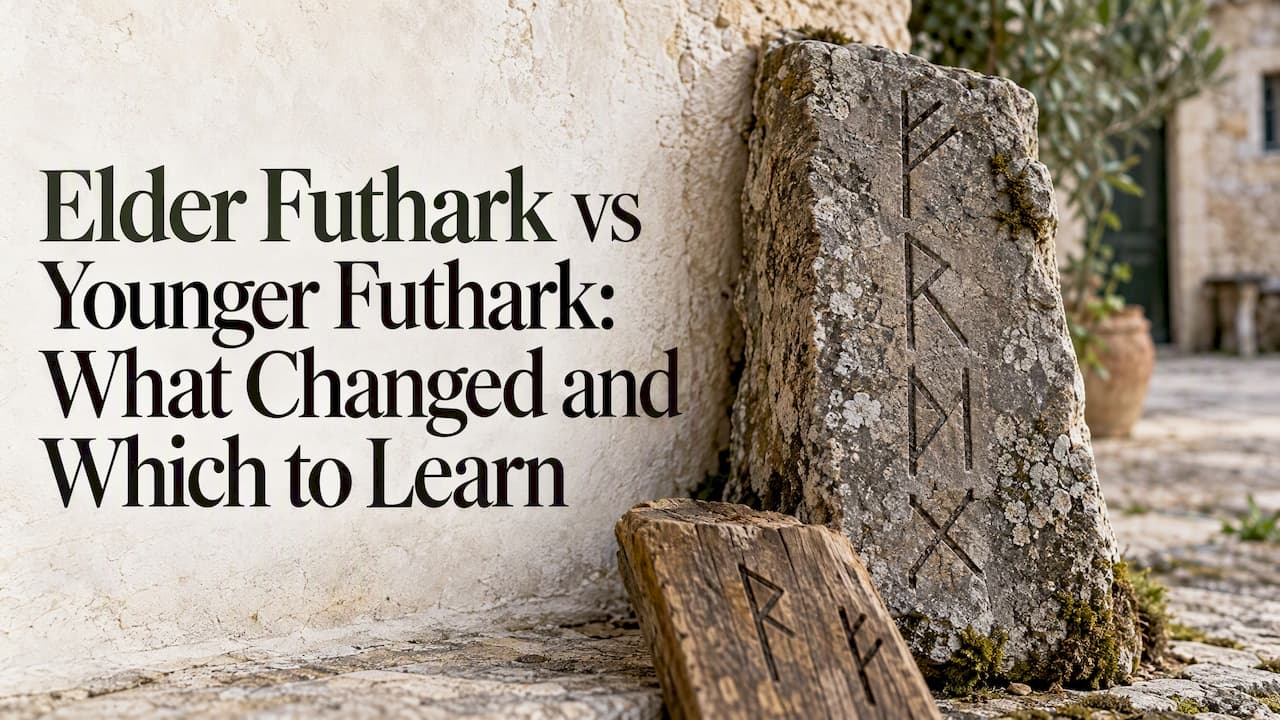
The Elder Futhark is the older runic alphabet, with 24 runes, used roughly from 150 to 650 CE. The Younger Futhark is the later Scandinavian alphabet, cut down to 16 runes, used in the Viking Age from about 725 to 1075 CE, according to the University of Copenhagen's runology department. The younger row grew out of the elder one. It is not a rival system, and that fact answers most of the confusion beginners run into.
Below you will find the differences side by side, the reasons the alphabet shrank, what the surviving inscriptions tell us, and a practical answer to the question most readers really have: which one should I learn?
TL;DR
- Elder Futhark: 24 runes, ca. 150 to 650 CE, the oldest Germanic writing system, found on objects and stones across early Germanic lands.
- Younger Futhark: 16 runes, ca. 725 to 1075 CE, the script of Viking Age Scandinavia, with over 3,000 surviving runestones.
- Why it shrank: the spoken language changed, and fewer signs had to cover more sounds, so one rune often stood for several.
- Which to learn first: start with the Elder Futhark, since the Younger one is derived from it. For Viking Age texts, learn the Younger one as well.
- Not the same as Anglo-Saxon runes: Britain and Frisia developed their own expanded row.
Table of Contents
- The short version: two stages of one alphabet
- Elder Futhark vs Younger Futhark at a glance
- The two rows, rune by rune
- Why 24 became 16
- How the runes were cut: wood, stone and two Younger styles
- Who used them, and for what
- What about Anglo-Saxon runes?
- Order, ciphers and a small trap
- Runes as sound and as meaning
- Which one should you learn first?
- Perspective: why we start with the older row
- Where to go from here
- A simple study plan
- FAQ
- Sources
The short version: two stages of one alphabet
The word futhark is simply the first six sounds of the row, the way "alphabet" comes from alpha and beta. The Viking Age runes overview from vikingage.se notes that the younger row begins f, u, þ, o, r, k, where the older one has an a-rune in the fourth place. That one swap tells you a great deal about what happened: the language moved, and the letters followed.
The period labels you will see are not tidy. The Copenhagen runology page splits runic writing into three periods: older runes in the elder futhark, Viking Age runes in the younger futhark, and a medieval phase afterward. The medieval language resource at Charles University dates the Elder Futhark to the years 200 to 700. Sources round the edges differently because inscriptions are rare at the start and the end, and scholars date them by object, language form and style. Treat any set of dates as a range, not a switch that flipped on a given year.
Elder Futhark vs Younger Futhark at a glance
| Feature | Elder Futhark | Younger Futhark |
|---|---|---|
| Number of runes | 24 | 16 |
| Approximate dates | ca. 150 to 650 CE | ca. 725 to 1075 CE |
| Language written | Proto-Norse and early Germanic | Old Norse |
| Surviving inscriptions | About 350 | Over 3,000 runestones |
| Typical look | Straight, angular strokes | Two main styles, one more detailed |
| Sound precision | Closer to one sign per sound | One sign covers several sounds |
| Typical places | Objects, early stones | Monumental stones, everyday inscriptions |
The inscription counts come from the Younger Futhark article on Wikipedia, which summarizes historians' view that the older script was probably known to a small literate group, while the younger one reached everyday use.
The two rows, rune by rune
The Elder Futhark runs in three groups of eight, traditionally called aettir:
- ᚠ ᚢ ᚦ ᚨ ᚱ ᚲ ᚷ ᚹ
- ᚺ ᚾ ᛁ ᛃ ᛇ ᛈ ᛉ ᛊ
- ᛏ ᛒ ᛖ ᛗ ᛚ ᛜ ᛞ ᛟ
The Younger Futhark, as listed by vikingage.se, has sixteen:
- ᚠ ᚢ ᚦ ᚬ ᚱ ᚴ ᚼ ᚾ ᛁ ᛅ ᛋ ᛏ ᛒ ᛘ ᛚ ᛦ
Several older runes are simply gone: the ones for g, w, j, p, the "ng" sound, the "d" sound, the e-rune and the o-rune in its old form. Some survive in altered shapes. The a-rune of the older row became the o-rune, because the sound it had stood for changed. A new a-rune took its place, taken from a different older sign.
You can see how this works with sound. The younger alphabet had to spell with fewer signs, so the same rune might write k and g, or t and d, or u, o and w, depending on context. A reader who knew the language could tell. A modern reader sees a letter that looks ambiguous. That is not carelessness. It is a system tuned to a language its readers spoke natively.
Why 24 became 16
The shrinking is the most debated part of the story. The mainstream explanation is linguistic. As Proto-Norse developed into Old Norse, sounds merged and changed, and the reduction occurred alongside those phonetic shifts. The younger alphabet had to fold several sound values into single signs.
A linguistic paper by John Robertson in Futhark 2 frames the move from older to younger as a series of graphemic shifts, not a sudden redesign. That fits what the surviving objects show: a gradual change over generations, not one decree.
The odd thing, and the reason the question is still alive, is that the new alphabet was less precise for writing. Yet it spread widely. Part of the answer seems to be social. A smaller, simpler set is easier to teach, easier to carve, and easier to use without a specialist. This is a reasonable inference from the contrast in inscription numbers, not a proven motive.
How the runes were cut: wood, stone and two Younger styles
The Elder Futhark's straight, angular strokes are tied to wood. The Milwaukee Public Museum's page on rune stones explains that grain dictates form when you carve in wood, which is why curves are rare. The Younger Futhark saw wider use on stone, where more detail and curved elements became possible.

Within the younger row there are two stylistic variants, described on the Lexilogos runic keyboard page. Long-branch runes were used for monumental inscriptions on stone. Short-twig runes were the more compact, everyday form. Nine runes differ between them. If you meet a Viking Age rune that looks like a stripped-down version of the one you learned, that is probably why.
For a student, this has a practical effect. If you learn one chart and then open a museum photo, you may not recognize half the signs. Learn the variants early, and keep a chart that shows both.
Who used them, and for what
The elder script is thought to have been restricted. The Wikipedia summary cited above describes it as likely a script known to a limited literate elite, with about 350 inscriptions surviving. The younger script reached many more people and survives on over 3,000 runestones. That is a big claim about a society, so hold it loosely: survival depends on what was carved in stone rather than written on wood that rotted.
For the purposes of a modern reader the point is simple. The Elder Futhark belongs to the earliest phase of Germanic writing. The Younger Futhark is the alphabet most people picture when they think of Vikings. If you see a runestone in Denmark, Sweden or Norway from the Viking Age, it is almost certainly Younger Futhark.
What about Anglo-Saxon runes?
Readers often ask whether Viking and Anglo-Saxon runes are the same. They are not. The Anglo-Saxon futhorc, used in Britain and Frisia from the fifth century, was a separate development from the 24-character Elder Futhark. According to the Anglo-Saxon runes article, it expanded to 28 characters and later to 33, while Scandinavia went the opposite way and condensed to 16.

So there are three things worth keeping apart: the Elder Futhark as the common ancestor, the Younger Futhark as the Scandinavian reduction, and the futhorc as the English and Frisian expansion.
Order, ciphers and a small trap
If you go deeper into the Younger Futhark, you will meet cipher runes, a system that encodes runes by position in the row. Order matters there. According to the article on cipher runes, in the Viking Age order the m-rune comes before the l-rune. That order was reversed in the 13th century under Latin influence, which led early modern scholars to misread some ciphers. Check which order a source is using before you decode anything.
Runes as sound and as meaning
Runes are not only letters. Each sign has a name, and the name carries a concept. The Old Norse overview from Charles University explains the acrophonic principle: the rune for s is called sól, meaning sun. So each character stands for a sound and for the idea in its name.
This is the bridge between runes as writing and runes as something richer. Norse sources describe runes as gifts from Odin, and popular accounts such as this overview of rune magic describe them as tools to communicate and to shape reality. That is how Norse culture is described in the sources; whether you work with runes that way is a personal choice.
A caution belongs here. Much of what circulates online about the meaning of each rune, especially fixed "divinatory" meanings, is modern. The historical record gives us names and sounds. Divinatory systems were built on top by later writers. That does not make them worthless to a practitioner. It means you should know which layer you are working in.
Which one should you learn first?
It depends on what you want.
- You want to read Viking Age inscriptions or visit runestones. Learn the Younger Futhark, including both long-branch and short-twig forms. Expect to read context as much as letters.
- You are curious about the earliest runes, or you want to understand the whole system. Start with the Elder Futhark. A beginner on a runology forum put it simply: the younger row is based on the elder one, so learning the elder first gives you the logic. Students of runology often do it that way.
- You want to use runes in meditation, journaling or divination. Most modern practice uses the 24-rune Elder Futhark because each rune has a distinct name and image. The Younger Futhark has fewer signs, and each one has to carry more.
- You are choosing a tattoo or a pendant. Check the era. A phrase written in Elder Futhark is not Viking Age writing, and a Younger Futhark spelling of a modern English word will look odd to anyone who reads it. Also be careful with historical claims: the academic study on Viking tattooing finds no direct archaeological evidence that Viking Age Scandinavians tattooed, so avoid presenting a rune tattoo as an authentic Viking tradition.
Perspective: why we start with the older row
At Sacred Paths we treat runes as a living language of relationship, not a decoder ring. In our work we begin with the 24 signs of the Elder Futhark because each one has its own name, sound and image, and that gives a person something to sit with. We ask people to learn a rune slowly, by drawing it, carving it, saying its name aloud and noticing what it stirs, before reading about it.
We also keep the history honest. The Younger Futhark is the writing of the people who left us thousands of stones, and it deserves study on its own terms. When we teach Norse material we say plainly what is documented, what is later tradition and what is personal experience. That clarity is not a limit on the practice. It is what keeps the practice grounded.
If you want to take a single rune into daily life, our guide to rune divination with a reading journal walks through drawing one rune and recording what happens. If you are curious about the ritual side of Norse tradition, read our piece on the blót ceremony today.
— Angell
Where to go from here
If the Norse thread is calling you beyond reading, our Sacred Paths Shamanic School offers a two-year initiatory path that includes Andean and Norse shamanism, built around practice and community rather than passive coursework. If you would like a conversation first, you can also explore shamanic and spiritual coaching, priced at $395 one-off, or join the Monthly Shamanic Circle.
A simple study plan
- Week 1: Learn the 24 Elder Futhark names and sounds. Copy each rune by hand, in straight strokes.
- Week 2: Learn which eight runes sit in each aett and write your own name phonetically.
- Week 3: Compare with the Younger Futhark chart. Mark which runes disappeared and which changed value.
- Week 4: Look at photographs of Viking Age runestones and try to pick out the 16 signs. Use a chart with both long-branch and short-twig forms.
- Ongoing: Check every claim about meaning against a named source, and note whether it is historical or modern.
FAQ
Is the Younger Futhark better than the Elder Futhark?
Neither is better; they served different times and languages. The Elder Futhark is more precise for sounds, while the Younger Futhark fit the sound system of Old Norse and was used far more widely, with over 3,000 surviving runestones.
Were both alphabets used at the same time?
The periods are separate in the main, with the Elder Futhark ending around 650 CE and the Younger starting around 725 CE according to the University of Copenhagen. There was a transition in between, so some objects show features of both, and dates are always approximate.
Where is the Elder Futhark from?
It is the first Germanic writing system, which originated on the European continent, as the Charles University overview of Old Norse explains. Inscriptions are found on objects and stones across early Germanic lands, and later Scandinavia carried the tradition forward.
What is the most powerful rune?
There is no historical ranking of runes by power. Norse sources treat runes as sacred and tied to Odin, but the idea of one "most powerful" rune comes from modern practice. Pick one that you can research and work with over time.
Sources
- Runology, University of Copenhagen
- Younger Futhark, Wikipedia
- Runes and the futhark, vikingage.se
- Futhark 2, John S. Robertson (2011)
- Rune Stones, Milwaukee Public Museum
- Younger Futhark keyboard, Lexilogos
- Anglo-Saxon runes, Wikipedia
- Cipher runes, Wikipedia
- Old Norse, Medieval languages and literatures
- Rune magic and galdrastafir, The Collector
- The Tattooed Warrior of the North, Academia